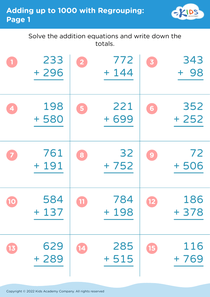
Improving math skills Adding up to 1000 Without Regrouping Worksheets for Ages 5-9
3 filtered results
-
From - To
Boost your child’s math confidence with our "Improving Math Skills: Adding Up to 1000 Without Regrouping" worksheets, tailored for ages 5-9. These engaging activities help young learners practice their addition skills in a fun and effective way, focusing on building a strong math foundation. The worksheets emphasize adding numbers without regrouping, allowing children to focus on mastering this essential skill without the complexity of carrying over. Designed with colorful visuals and kid-friendly exercises, these resources make learning math enjoyable and interactive. Download our worksheets today and watch your child enhance their math abilities while gaining confidence in problem-solving!
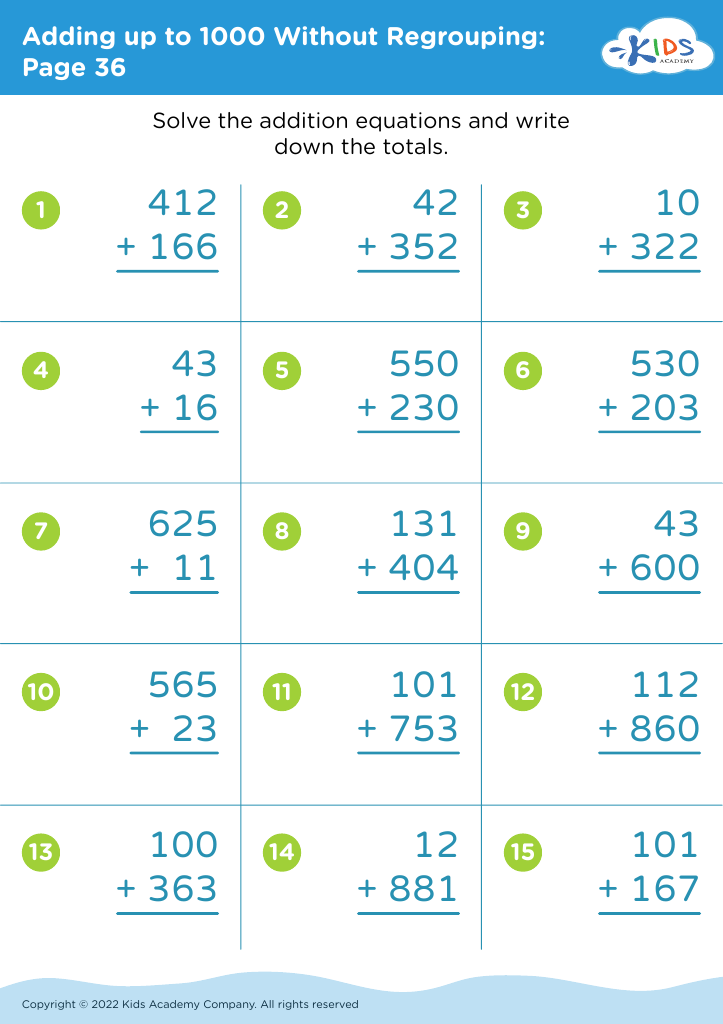
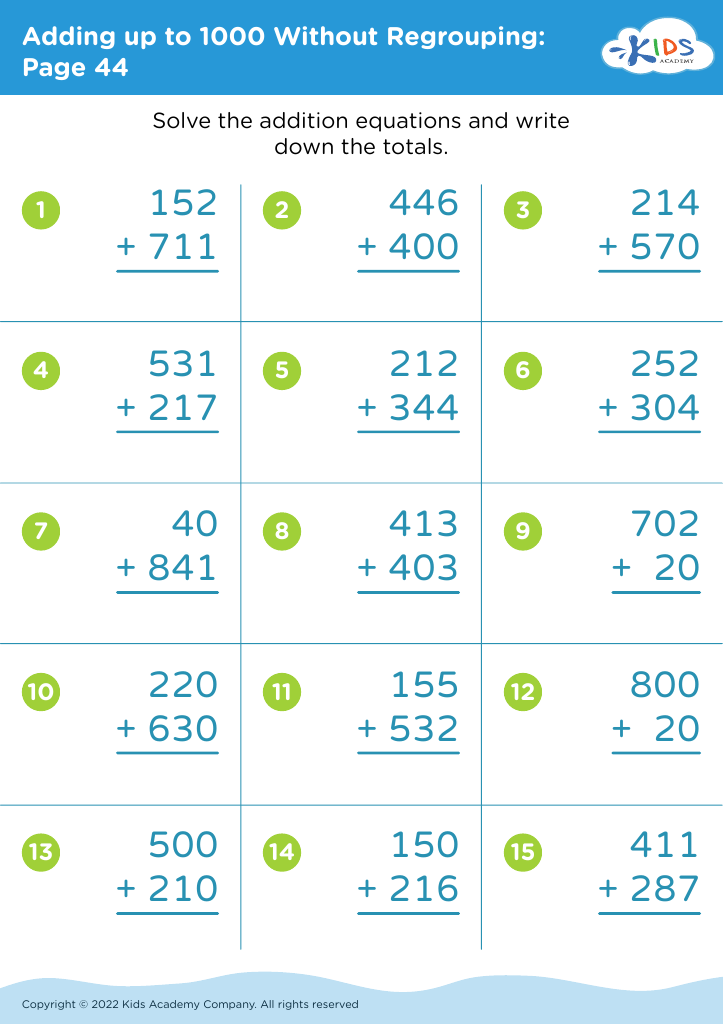
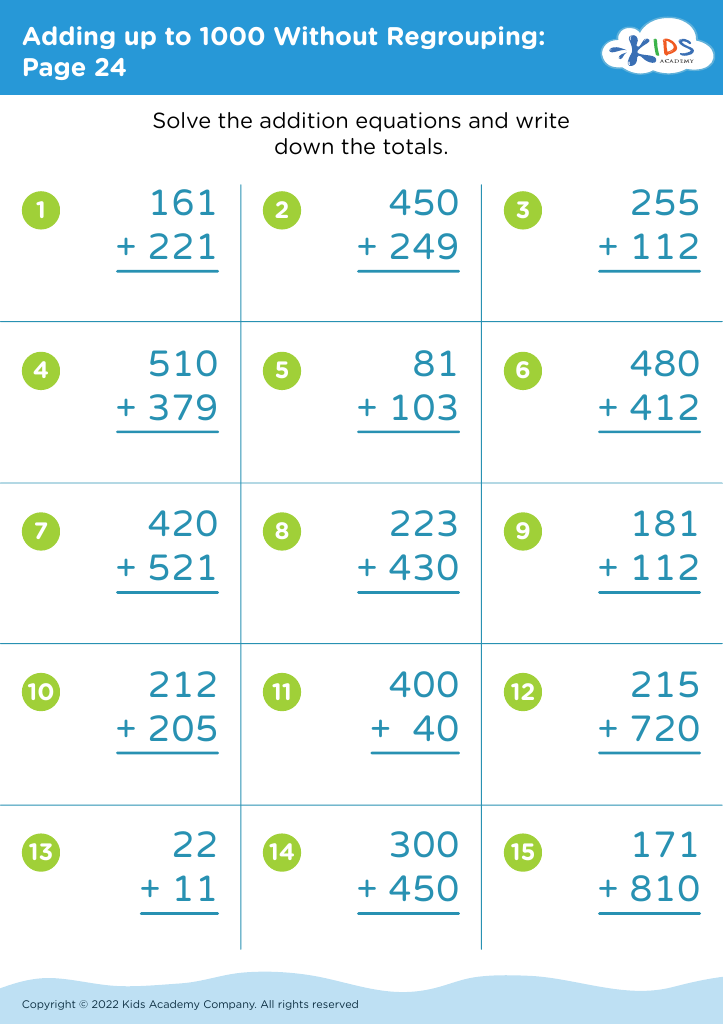


Improving math skills, particularly the ability to add numbers up to 1000 without regrouping, is crucial for children aged 5-9 for several reasons. Firstly, mastering basic addition lays the foundation for more complex mathematical concepts and operations they'll encounter later in their education. When children understand how to add without regrouping, they develop solid number sense, which fosters confidence and a positive attitude towards math.
Furthermore, this skill can prove invaluable in daily life. Being able to quickly and accurately add numbers without regrouping helps children with real-world scenarios like budgeting their allowance or shopping for items. It promotes mental math abilities, encouraging them to calculate quickly in their heads rather than relying solely on calculators.
For parents and teachers, establishing these skills early on can help identify areas where children may need extra support, allowing for targeted intervention. Moreover, promoting strong mathematical skills enhances overall academic performance and critical thinking abilities, which are essential not just in math but across all subjects. Ultimately, caring about children's math skill development contributes to their lifelong learning and prepares them for future academic success.