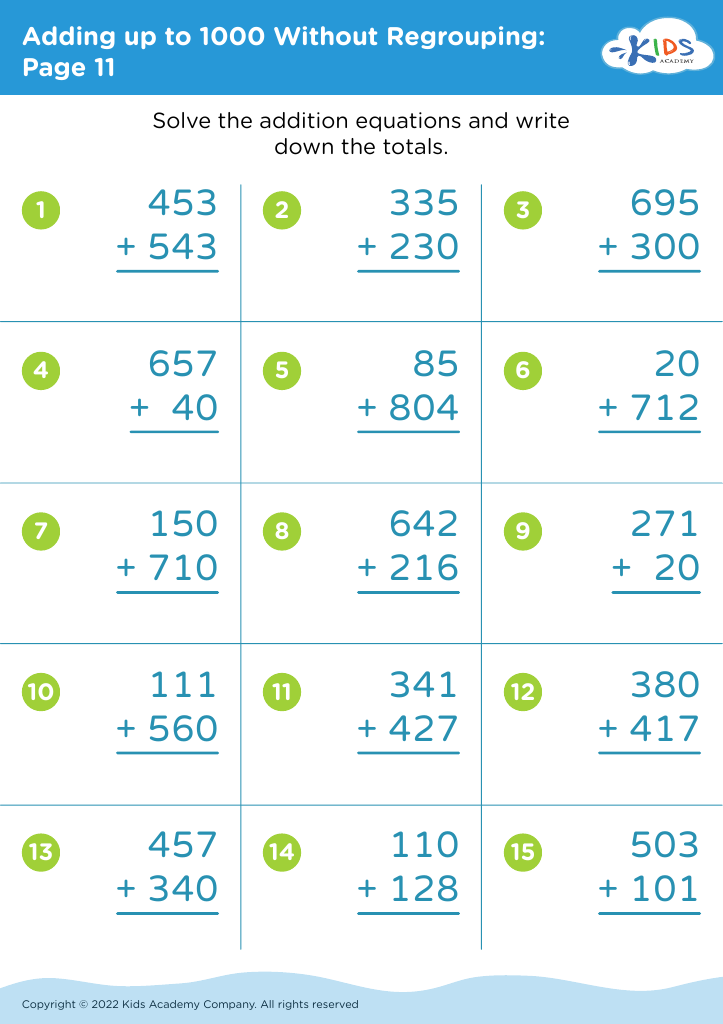
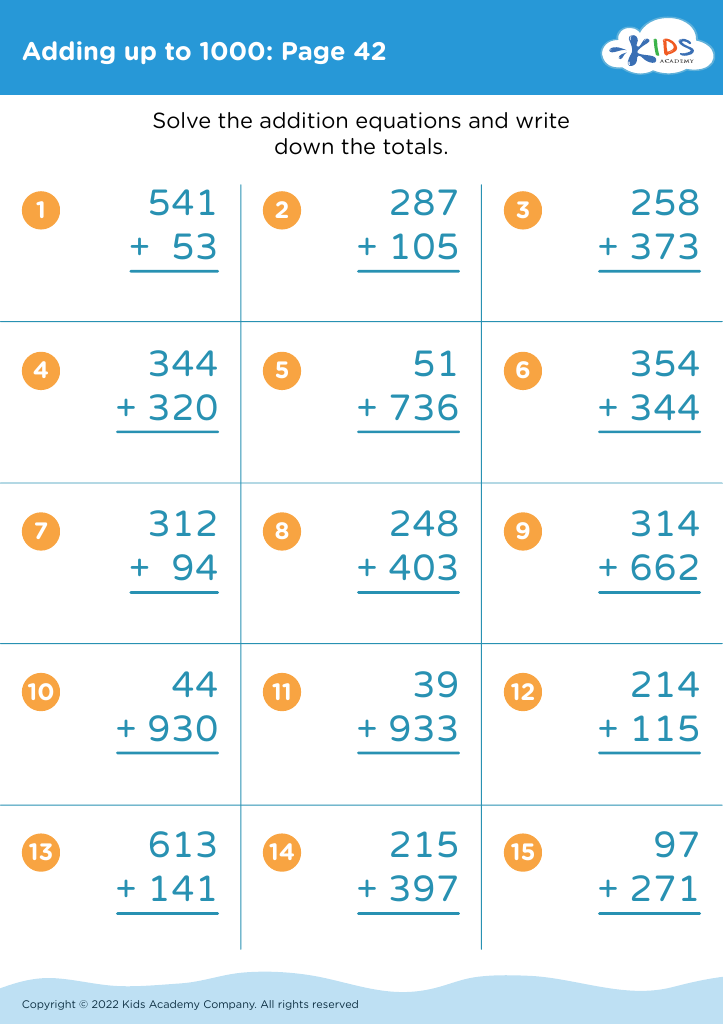




Counting skills, particularly adding up to 1000, play a crucial role in the cognitive development of children aged 5-9. At this stage, children are building foundational math skills that will support their future learning in mathematics and beyond. Developing strong counting abilities enhances children's understanding of numbers, promotes logical thinking, and improves problem-solving skills. Mastery of counting up to 1000 helps children develop classifying and organizing abilities, essential for various academic subjects.
Additionally, counting fosters confidence as children palpably see their progress in mastering quantification, and they begin to understand larger concepts like place value and basic arithmetic operations. With ample opportunities to practice, children can learn to recognize patterns and relationships in numbers, paving the way for a deeper understanding of more complex mathematical concepts as they advance in grade levels.
Moreover, strong counting skills are essential for everyday life—whether it’s understanding money, time, or measurements—which are skills they will employ daily. By prioritizing counting skills from an early age, parents and teachers ensure that children are well-prepared for future academic challenges and life skills, fostering a lifetime love and appreciation of mathematics.








