Improving counting skills Adding up to 1000 Worksheets for Ages 5-9
4 filtered results
-
From - To
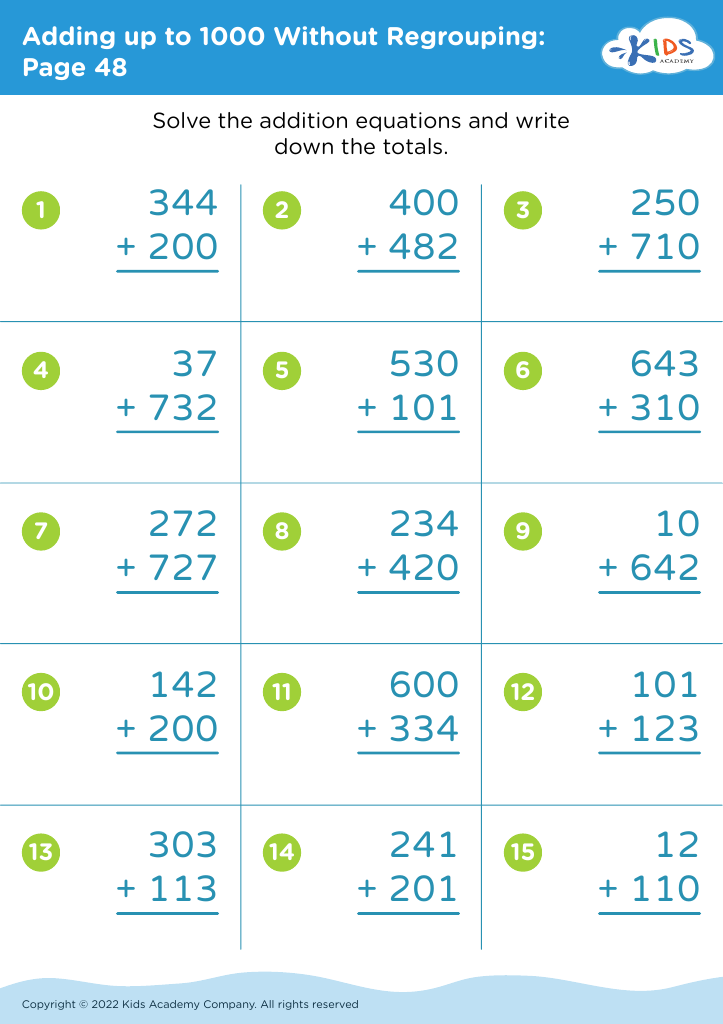
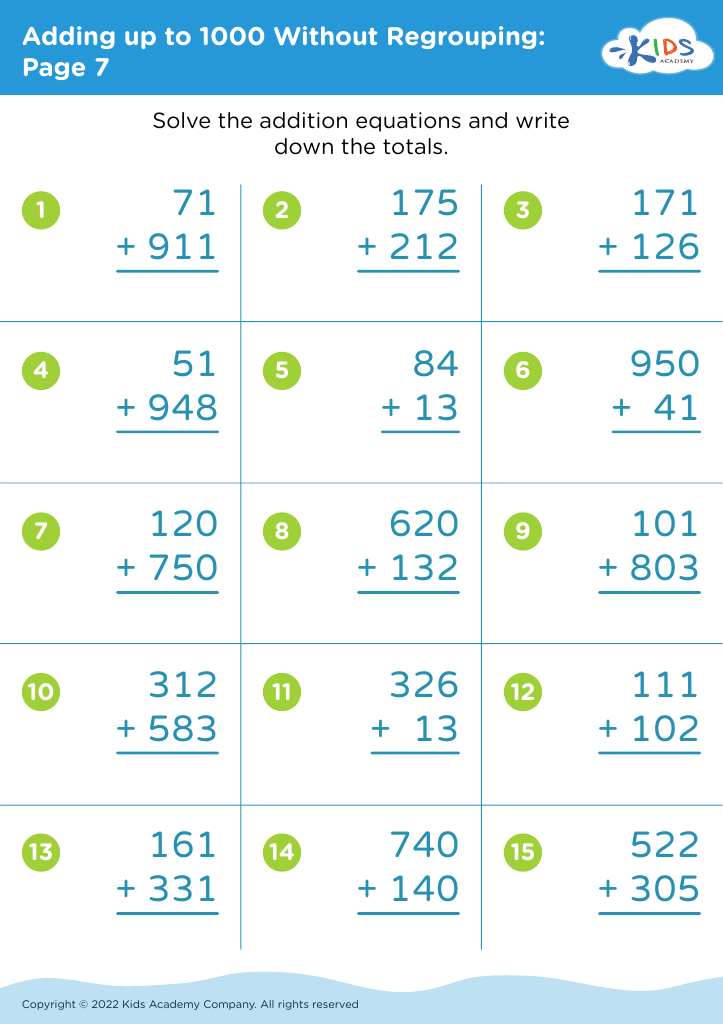
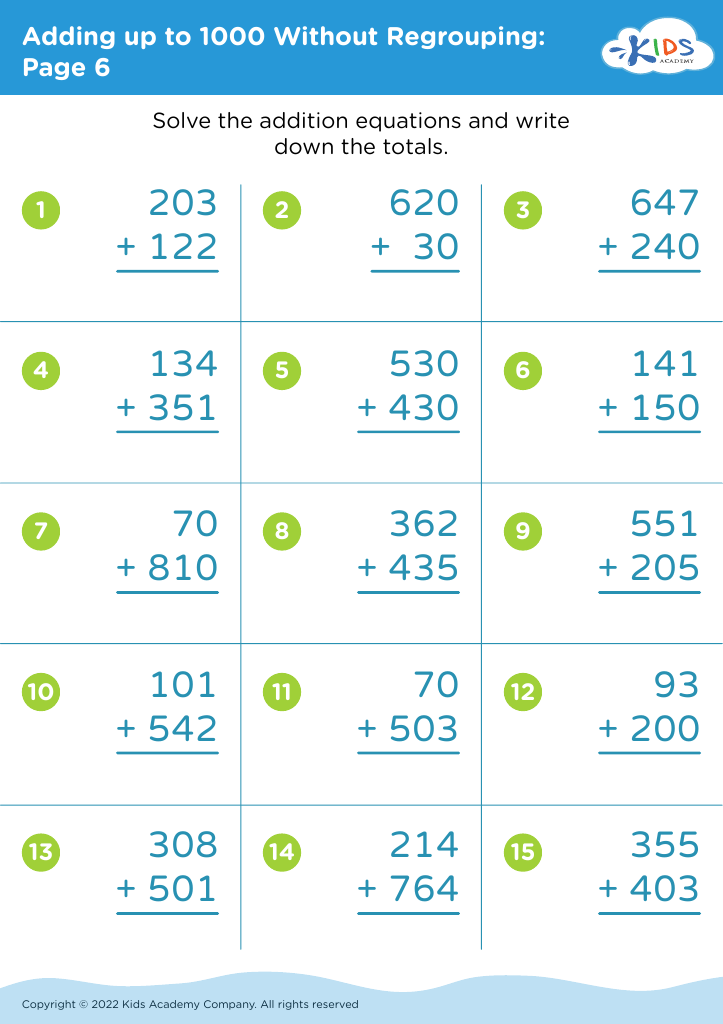
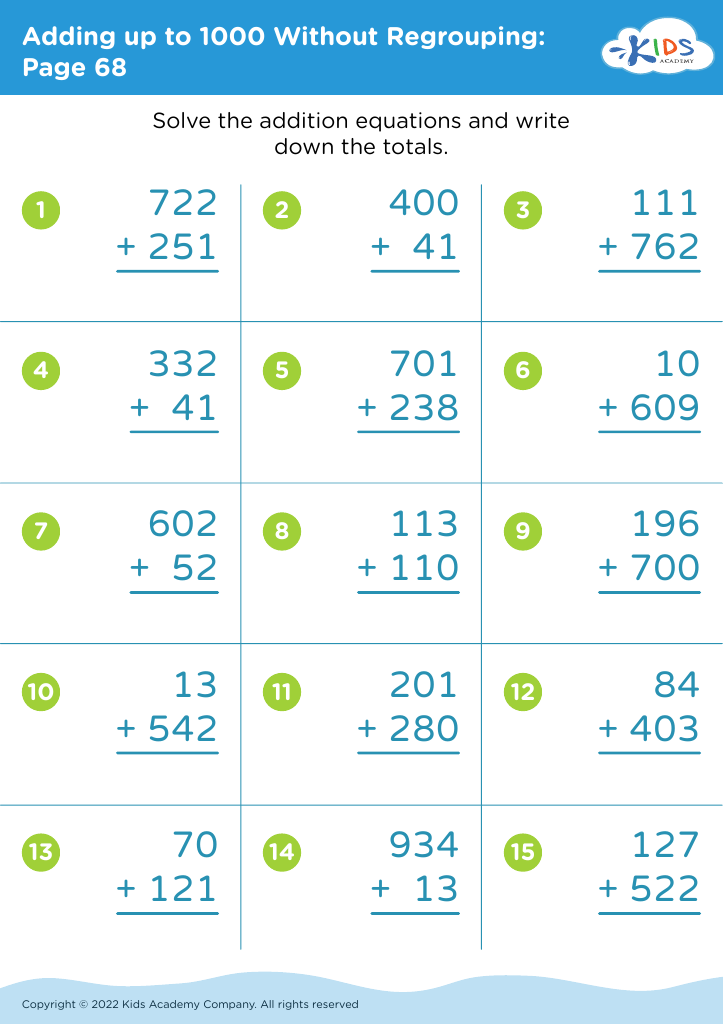
Boost your child's counting confidence with our "Improving Counting Skills: Adding up to 1000" worksheets designed for ages 5-9. These engaging, printable worksheets make learning fun, helping young learners master essential math skills. Through a variety of exercises, children will practice addition, build number recognition, and develop the ability to count up to 1000. Each worksheet is tailored to support and challenge students, fostering a love for math while enhancing their counting proficiency. Perfect for both classroom and home use, these activities are an excellent resource for parents and teachers aiming to improve their students' foundational math abilities.



Improving counting skills and the ability to add numbers up to 1000 for children aged 5–9 is crucial for building a strong foundation in mathematics. Early numeracy skills are fundamental to a child's overall cognitive development and future academic success. When children enhance their counting skills and understand basic addition and subtraction, they are better equipped to tackle more complex mathematical problems later in their educational journey.
Developing these skills early on also boosts a child's confidence and love for learning. It promotes critical thinking, problem-solving abilities, and logical reasoning. In practical terms, math skills are essential for everyday tasks that children will encounter, from handling money to understanding time.
Moreover, proficiency in early math skills is strongly correlated with better performance in other subjects, such as science and engineering. Teachers and parents who prioritize these skills enable children to establish patterns, recognize sequences, and fine-tune their motor and cognitive development. Incorporating counting practices and engaging arithmetic activities at an early age makes learning enjoyable and builds a lifelong affinity for the subject.
By prioritizing counting skills and arithmetic up to 1000, parents and teachers are helping lay the groundwork for children to become competent, confident learners who are better prepared for future academic challenges and everyday problem-solving.








