Pattern recognition Adding up to 1000 Worksheets for Ages 5-9
3 filtered results
-
From - To
Discover our engaging "Pattern Recognition Adding up to 1000 Worksheets," designed specifically for children ages 5-9. These worksheets help young learners enhance their math skills through interactive exercises that focus on recognizing numerical patterns, building essential foundational skills for addition and subtraction. Kids will enjoy completing fun activities that reinforce their understanding of sequences and relationships between numbers, while boosting their confidence in mathematics. Perfect for homeschooling or classroom use, our worksheets align with educational standards, making learning enjoyable and effective. Equip your child with the tools they need to succeed in math through our thoughtfully designed pattern recognition worksheets!
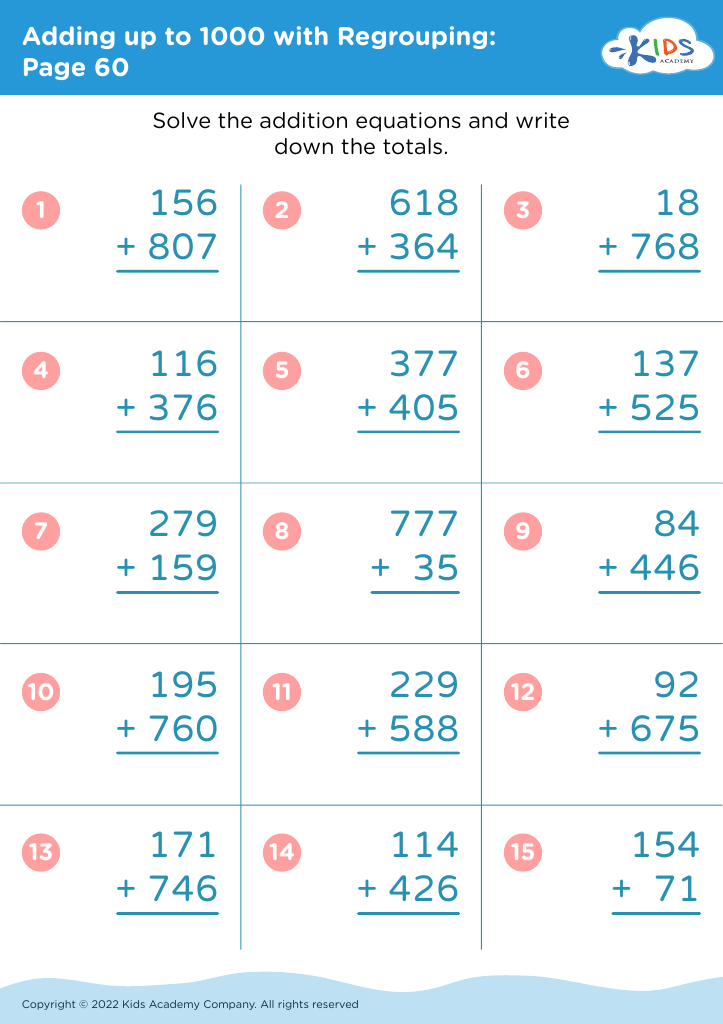
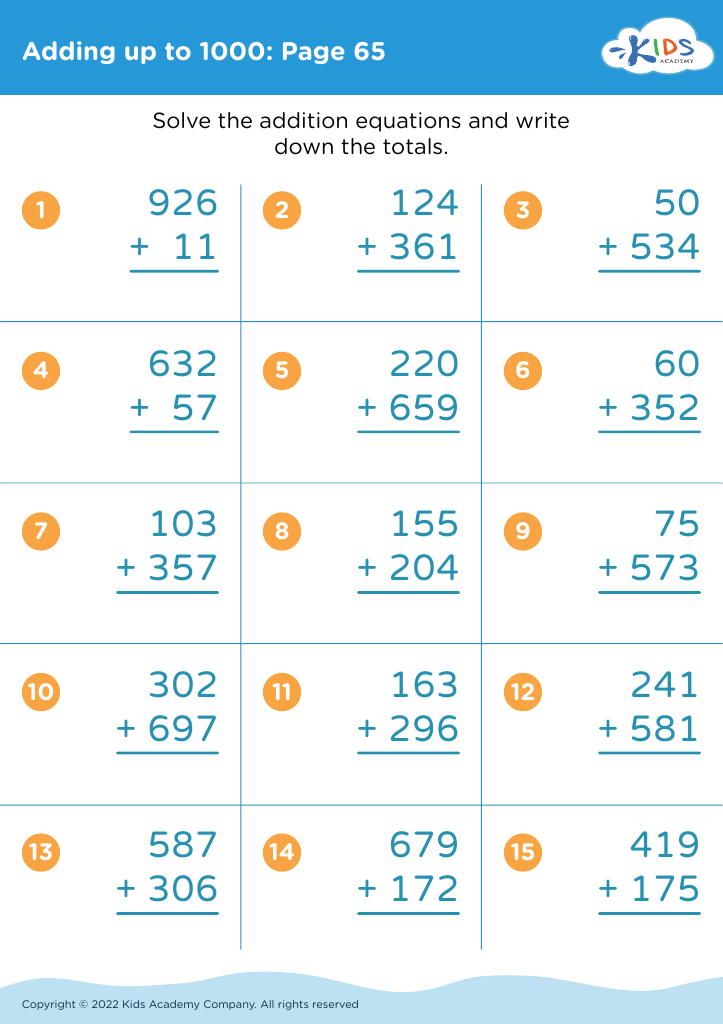
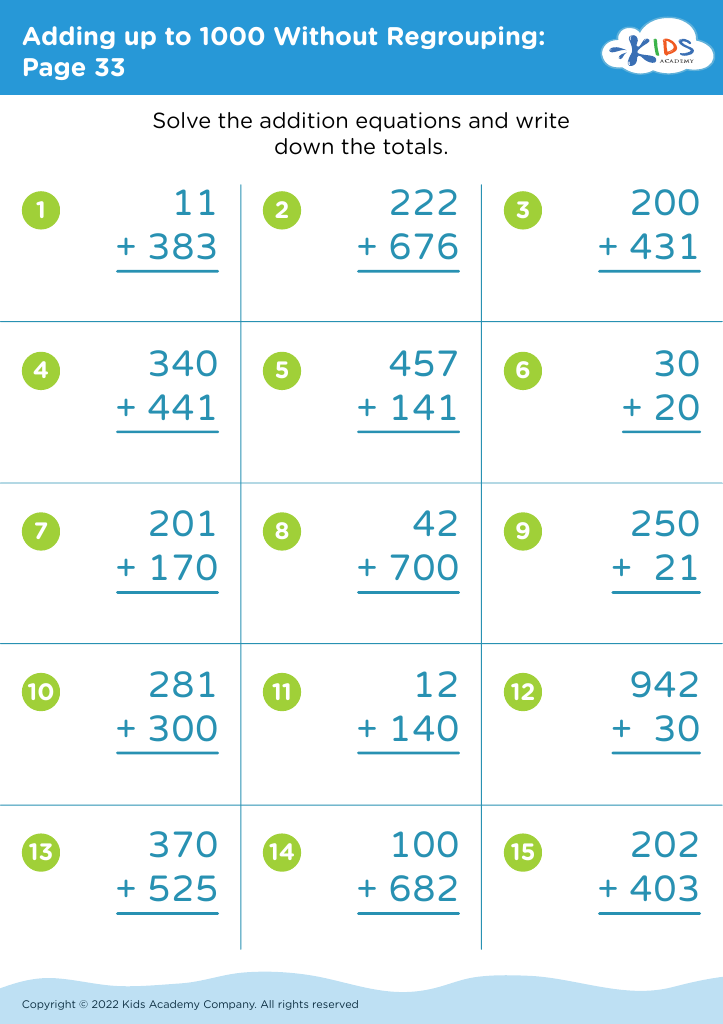



Pattern recognition, particularly in the context of adding up to 1000, is an essential skill for children aged 5-9. Parents and teachers should prioritize this concept for several reasons. Firstly, pattern recognition helps children to develop critical thinking and problem-solving skills. By identifying numerical patterns and relationships, children can understand addition concepts better and learn to make predictions, which enhances their mathematical reasoning.
Moreover, recognizing patterns simplifies complex tasks. For example, learning that numbers can combine in certain regular ways to reach 1000 enables students to tackle larger sums by breaking them down into manageable parts. This not only boosts their confidence but also lays a strong foundation for more advanced math topics in the future.
Additionally, fostering pattern recognition aids in the development of cognitive skills. It encourages children to make connections and see the bigger picture in mathematics, promoting deeper understanding rather than rote memorization. Finally, as kids become adept at recognizing and creating numerical patterns, they gain valuable skills that extend beyond math, influencing areas such as science, art, and daily problem-solving. Encouraging these skills from an early age prepares them for lifelong learning and makes math a more enjoyable subject.








