
Enhance logical thinking Math Worksheets for Ages 5-9
4 filtered results
Difficulty Level
Grade
Age
-
From - To
Subject
Activity
Standards
Boost your child's logical reasoning with our Math Worksheets for ages 5-9. At Kids Academy, we design engaging activities that go beyond basic arithmetic, fostering critical thinking and problem-solving skills. Our worksheets are carefully crafted to challenge young minds while making learning fun. From number patterns to spatial awareness, each activity is designed to develop essential math foundations. Perfect for at-home practice or as a classroom supplement, our resources help children build confidence in their math abilities. Begin your child’s journey towards enhanced logical thinking and academic success with our expert-designed materials today!
Favorites
With answer key
Interactive
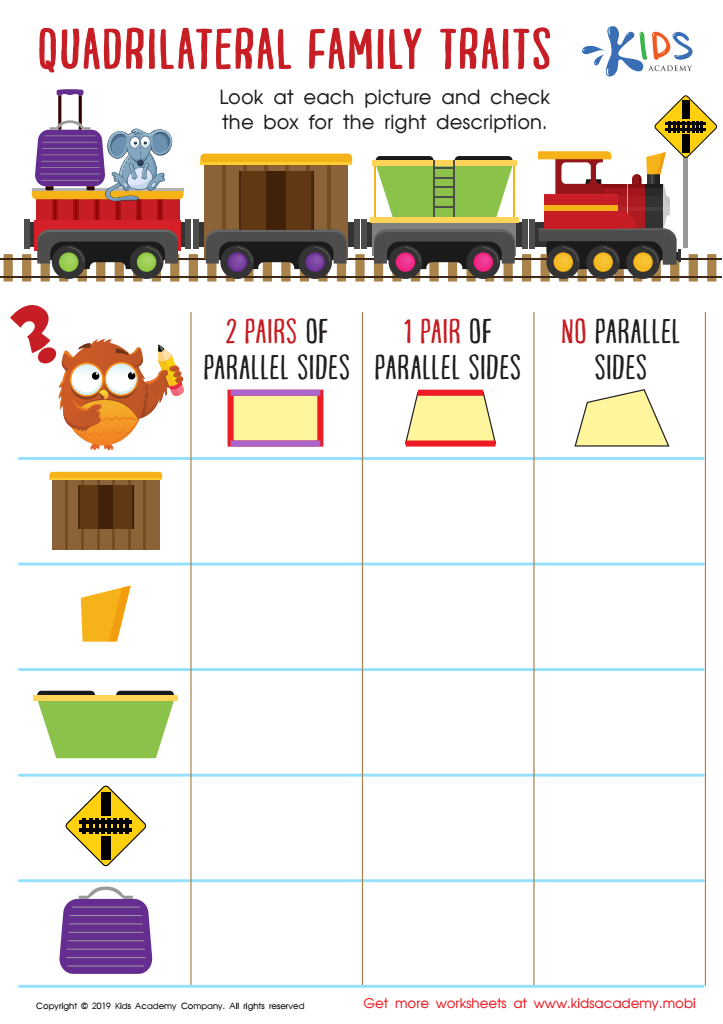
Quadrilateral Family Traits Worksheet
Review with your students what a quadrilateral is: four sides and angles. Now, go through the worksheet with them. Look at the pictures and help them check the boxes to identify the shapes.
 Assign to My Students
Quadrilateral Family Traits Worksheet
Worksheet
Join Kids Academy for Free
Who is primarily going to use this learning content?








Enhancing logical thinking through math for children ages 5-9 is crucial for their overall intellectual development. During these formative years, the brain is exceptionally receptive to new concepts and skills. Engaging in mathematical activities strengthens cognitive functions that transcend beyond math itself, including problem-solving abilities, critical thinking, and analytical skills. These are foundational skills important not just for academic success but for navigating daily life situations.
For parents and teachers, promoting logical thinking through math nurtures a child’s growing capacity to reason, recognize patterns, and make sense of the world around them. Early exposure to math challenges builds perseverance and resilience, as children learn to tackle problems systematically and creatively. This mental discipline fosters a growth mindset, encouraging children to view challenges as opportunities for learning.
Moreover, a strong foundation in logical thinking prepares children for future educational opportunities in subjects such as science, technology, engineering, and math (STEM). It enhances their ability to understand complex concepts and ideas they will encounter later in their education. By actively supporting logical thinking in math, parents and teachers set the stage for lifelong learning, curiosity, and intellectual confidence, ensuring children are well-equipped for their future academic and personal endeavors.








