
Understand sequencing Math Worksheets for Ages 5-9
3 filtered results
Difficulty Level
Grade
Age
-
From - To
Subject
Activity
Standards
Explore our engaging sequencing math worksheets designed for children ages 5-9! These worksheets help young learners develop essential skills in ordering numbers, patterns, and logical thinking. With fun visuals and interactive activities, children can easily grasp the concept of sequencing while reinforcing their math abilities. Our resources are carefully crafted to cater to various learning styles, making them perfect for both classroom and home use. Whether your child is just starting to learn about sequences or needs extra practice, these worksheets provide a solid foundation for future math success. Help your child thrive in mathematics with our comprehensive sequencing activities!
Favorites
With answer key
Interactive
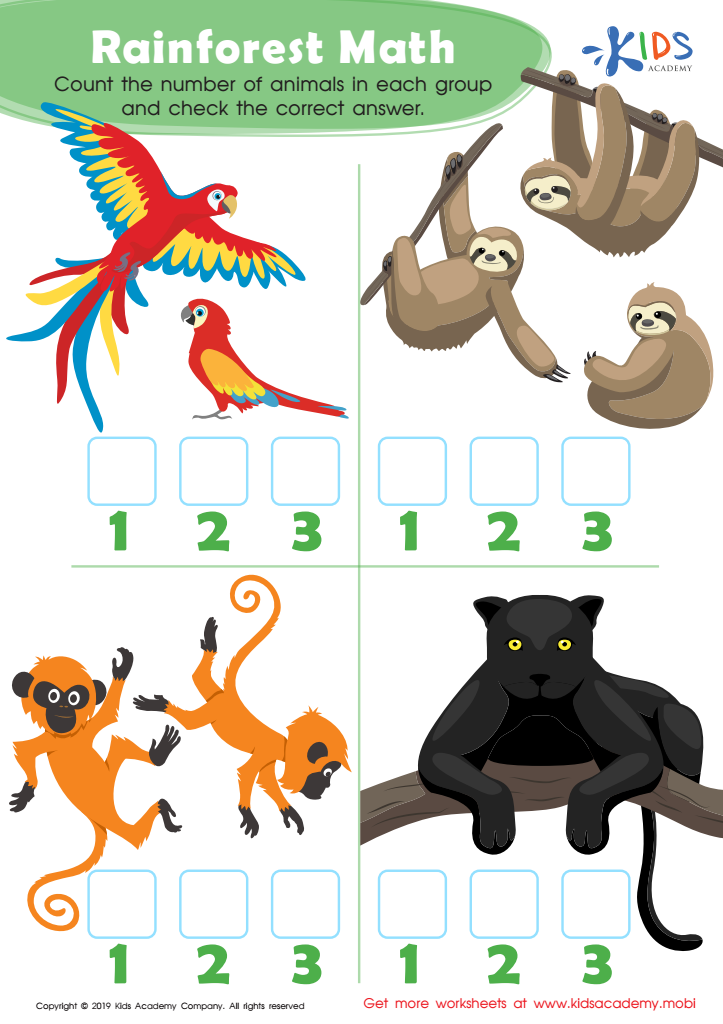
Rainforest Math Worksheet
Kids love learning about rainforest animals! This worksheet helps them with counting and number sense. It features recognizable rainforest animals and asks children to choose the correct number from the answer choices. It's a fun way for children to build their skills - without even knowing it!
 Assign to My Students
Rainforest Math Worksheet
Worksheet
Join Kids Academy for Free
Who is primarily going to use this learning content?



.jpg)




Understanding sequencing in math is vital for young learners aged 5-9 as it forms the foundation for their problem-solving skills and logical reasoning. Sequencing involves recognizing patterns, organizing numbers, and deciphering steps in a process, all of which are crucial for a child’s mathematical development. When children grasp the concept of sequencing, they become better equipped to handle more complex operations, such as addition, subtraction, and eventually multiplication and division.
For parents and teachers, focusing on sequencing helps foster critical thinking and cognitive skills. Through activities that promote sequencing, such as solving math problems step-by-step or creating number patterns, children learn to approach challenges methodically and develop a strong mathematical intuition. Additionally, they gain confidence in their abilities, which positively impacts their overall academic performance and love for learning.
Research has shown that mastering these foundational skills in early education leads to greater success in higher-level math in later years. Consequently, parents and educators play a crucial role in supporting this development through engaging activities, interactive play, and intentional practice. Prioritizing sequencing not only benefits math skills but also enhances a child’s capability in other subjects, making it a fundamental focus for early learners.








