
Mathematical reasoning Skip Counting Worksheets for Ages 5-9
3 filtered results
Difficulty Level
Grade
Age
-
From - To
Subject
Activity
Standards
Enhance your child's mathematical reasoning with engaging skip counting worksheets designed for ages 5-9! Our collection encourages early learners to develop a strong foundation in patterns and sequencing through fun and interactive exercises. These worksheets feature colorful illustrations and relatable contexts, making learning joyfully captivating. By practicing skip counting, children strengthen their number sense and improve their abilities in addition and subtraction. Perfect for home or classroom use, our printable worksheets cater to various skill levels, ensuring that every child can progress at their own pace. Support your little mathematician's development and watch them thrive in math!
Favorites
With answer key
Interactive
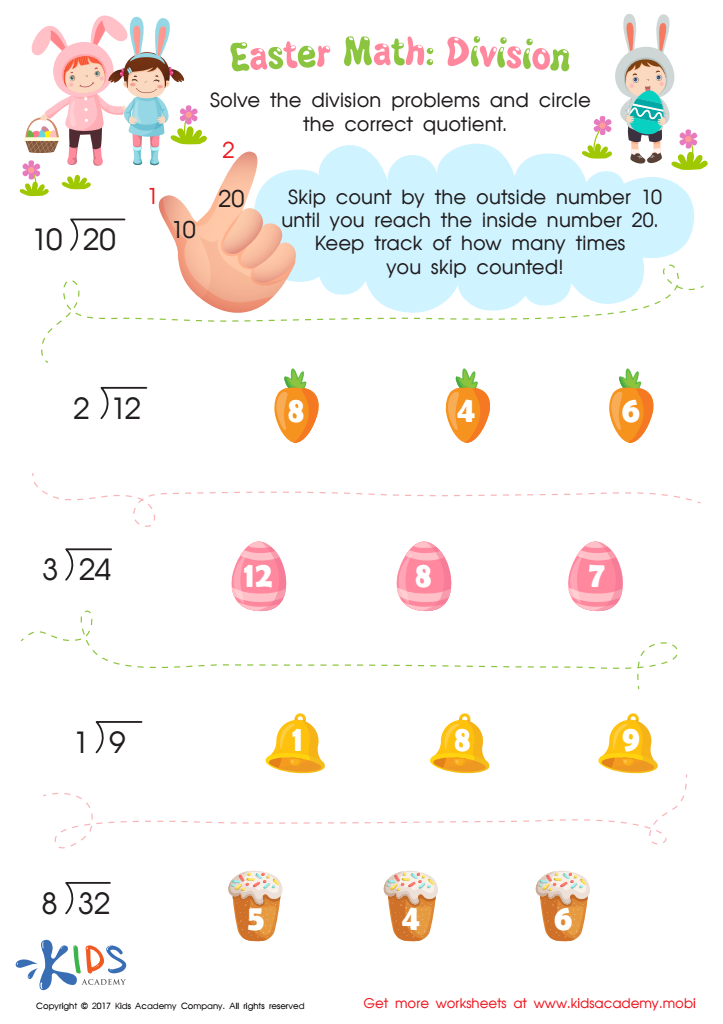
Division Worksheet
Try this Easter-themed PDF worksheet for grade 3: perfect for teaching division with a fun, new trick! It's full of bright, colorful pictures your child will love, and it's as easy as skip counting to solve the problems.
 Assign to My Students
Division Worksheet
Worksheet
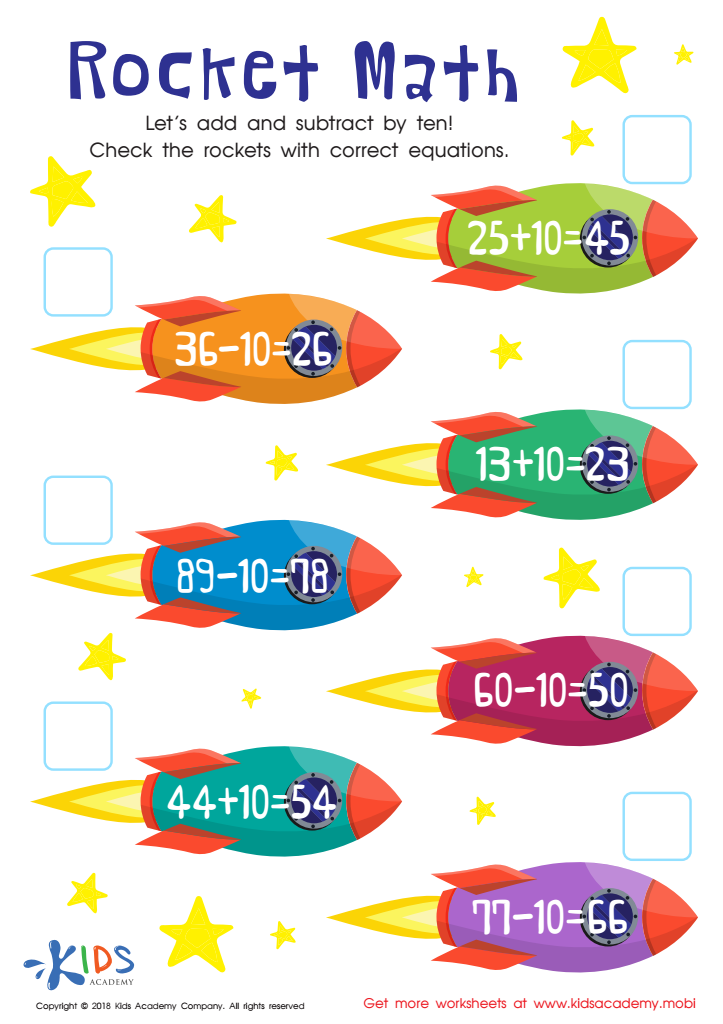
Rocket Math Worksheet
Your students will be math wizards in no time as they blast off on this exciting and colorful PDF worksheet. They'll use the 10s strategy to practice addition and subtraction, and they'll learn to skip count forwards and backwards. Keep them engaged and make learning fun!
Rocket Math Worksheet
Worksheet
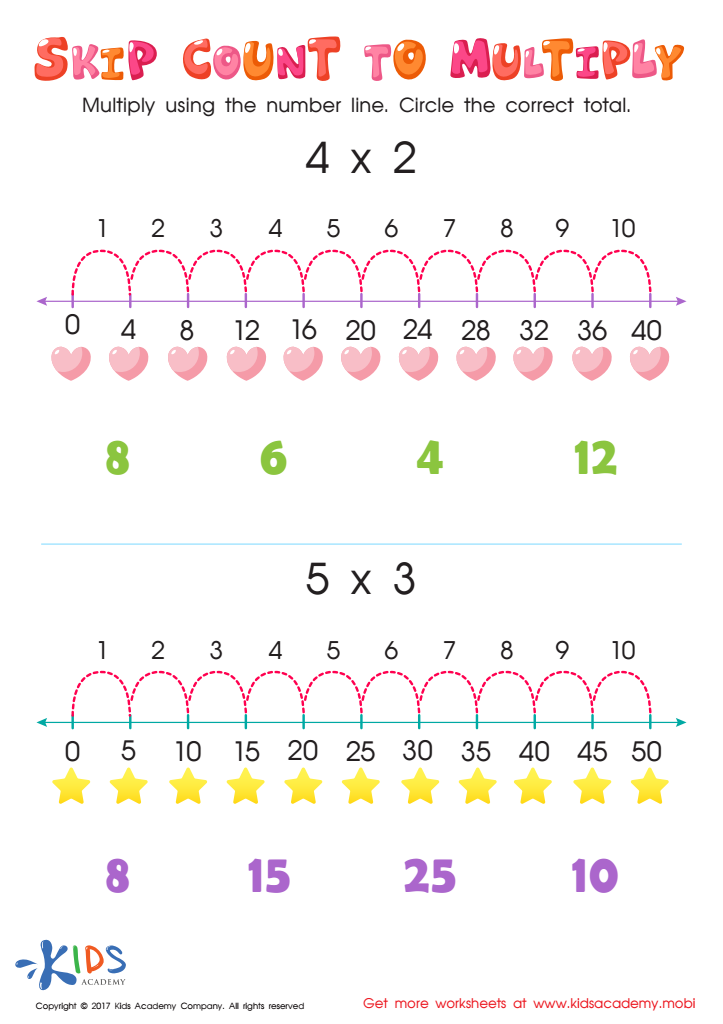
Skip Count Multiplication Worksheet
This colorful worksheet helps kids multiply by skip counting on a number line. Kids gain a better understanding of multiplication by seeing how the answer is calculated.
Skip Count Multiplication Worksheet
Worksheet
Join Kids Academy for Free
Who is primarily going to use this learning content?








Mathematical reasoning, particularly through skip counting, plays a crucial role in the developmental foundation of young learners aged 5-9. Skip counting involves counting forward or backward in intervals (e.g., twos, fives, tens), and serves as a key building block for more complex mathematical concepts. Parents and teachers should prioritize skip counting to foster children’s number sense and enhance their mathematical fluency.
Firstly, skip counting helps children recognize patterns in numbers, which is essential for understanding multiplication and division. By practicing this skill, children can more easily grasp concepts such as grouping and equal shares, which directly relate to real-life situations. Additionally, it promotes mental math, as children become more comfortable manipulating numbers without relying solely on calculators or written methods.
Furthermore, engaging in skip counting activities aids in the development of critical thinking and problem-solving skills. This active engagement can enhance overall cognitive functioning, setting a strong foundation not just for mathematics, but for subjects across the curriculum.
Ultimately, encouraging skip counting at home and in the classroom cultivates a positive attitude towards mathematics and lays the groundwork for academic success, ensuring that children become confident, adept learners in their educational journey.








