
Mathematical thinking Addition & Subtraction Worksheets for 5-Year-Olds
3 filtered results
Difficulty Level
Grade
Age
-
From - To
Subject
Activity
Standards
Welcome to our engaging "Mathematical Thinking Addition & Subtraction Worksheets" designed specifically for 5-year-olds! These worksheets foster early numeracy skills, helping young learners develop a solid understanding of addition and subtraction concepts. Through fun activities and colorful visuals, children will enhance their problem-solving abilities while building confidence in math. Our resources not only align with educational standards but also encourage critical thinking and reasoning. Perfect for home or classroom use, these worksheets provide a stimulating environment for little math enthusiasts to explore and enjoy learning. Start their mathematical journey today and watch them thrive in the world of numbers!
Favorites
With answer key
Interactive
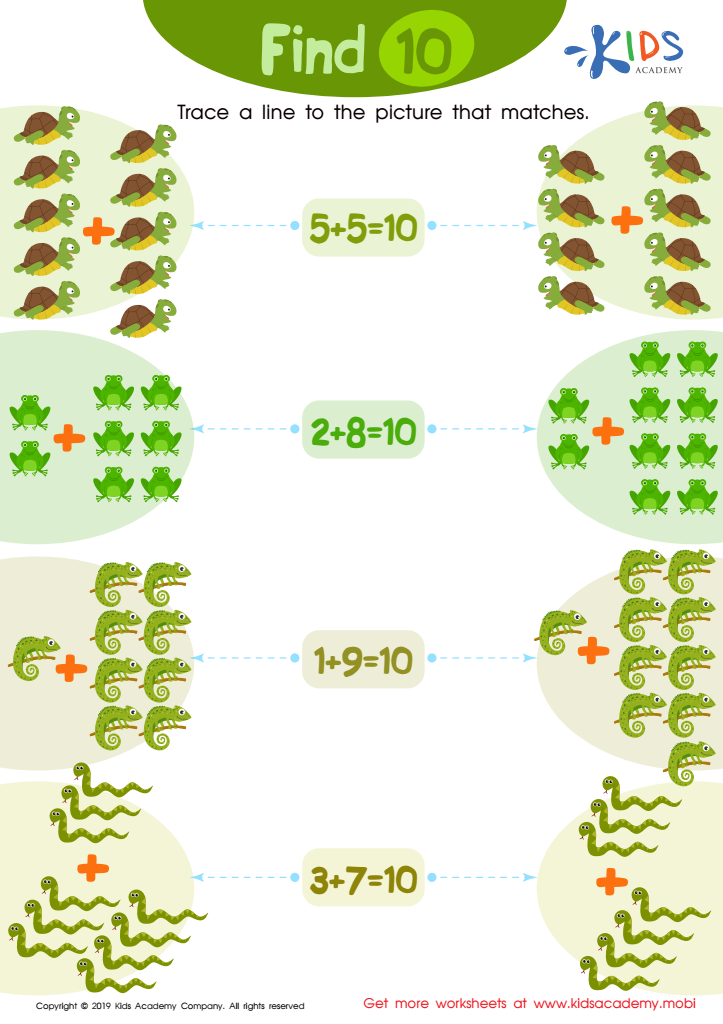
Find 10 Worksheet
Counting can be tricky, but your kids can master it with regular practice. Here's a fun activity to help: count the animals, then trace a line to the pictures that matches. With these tips, math will be an easy walk in the park.
 Assign to My Students
Find 10 Worksheet
Worksheet
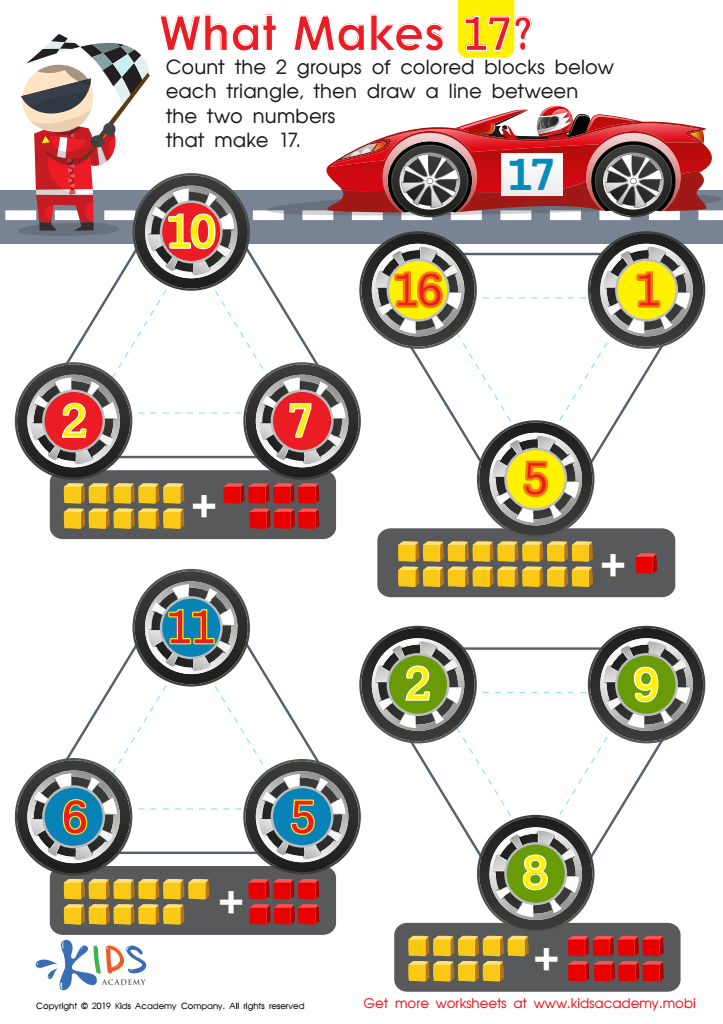
What Makes 17 Worksheet
Practice makes perfect! Let your kindergartners explore addition using this worksheet. Count the blocks in each triangle to reach the same total of 17, and draw a line between the two numbers. Once they get the hang of it, nothing will be too difficult!
What Makes 17 Worksheet
Worksheet
Join Kids Academy for Free
Who is primarily going to use this learning content?








Nurturing mathematical thinking in young children, particularly in addition and subtraction, is essential for their cognitive development and lifelong learning. For 5-year-olds, understanding these basic operations lays the foundation for critical thinking, problem-solving, and reasoning skills. Early exposure to math concepts helps children develop a number sense, enabling them to recognize patterns and relationships, which is crucial for future learning in more complex math topics.
Parents and teachers play a vital role in fostering this mathematical mindset. They can create a rich learning environment by integrating playful activities that encourage hands-on experiences with numbers—such as counting objects, using toys for simple addition and subtraction, and engaging in playful math games. This approach makes learning enjoyable and helps children grasp fundamental concepts more effectively.
Moreover, a strong foundation in math can boost children's confidence, motivating them to tackle more challenging subjects as they advance. Studies have shown that early math skills are predictive of later success, not just in academics but also in everyday life, from managing finances to logical decision-making. By emphasizing addition and subtraction skills in preschool, we lay a robust groundwork for future learning, ensuring that children develop both their mathematical abilities and their overall potential.








