
Visual-motor skills Addition & Subtraction Worksheets for 5-Year-Olds
3 filtered results
Difficulty Level
Grade
Age
-
From - To
Subject
Activity
Standards
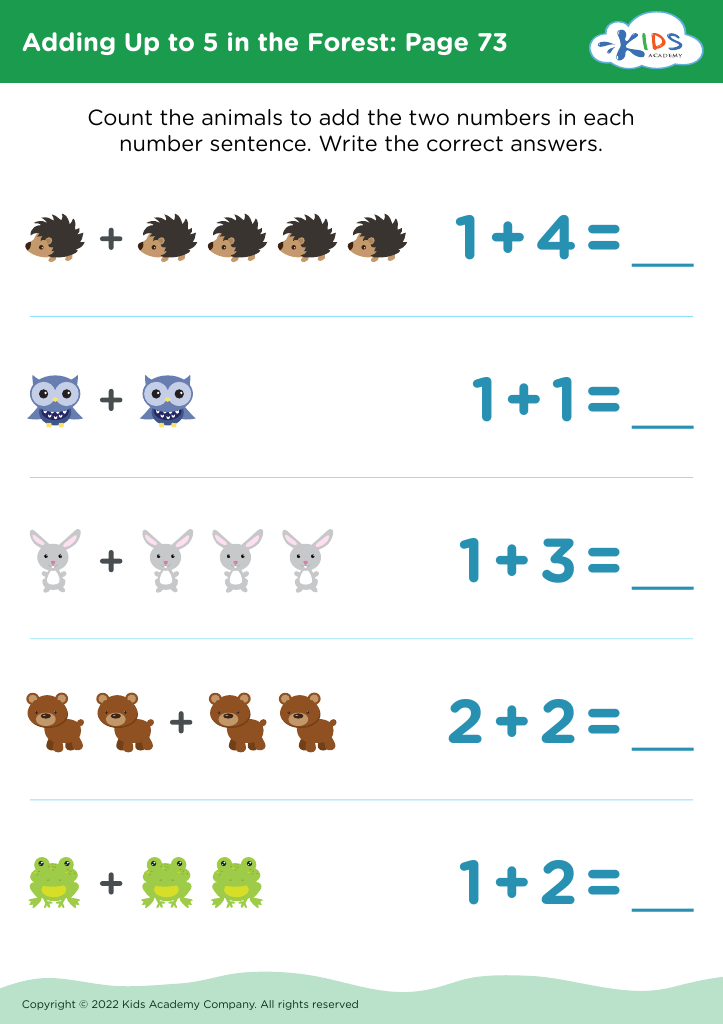
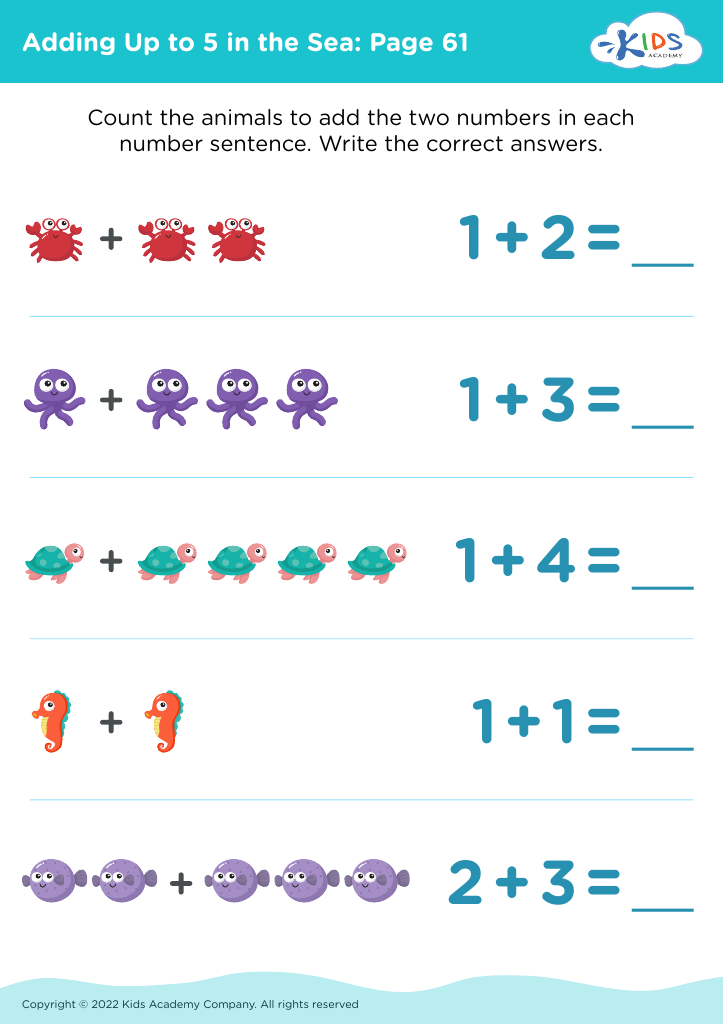
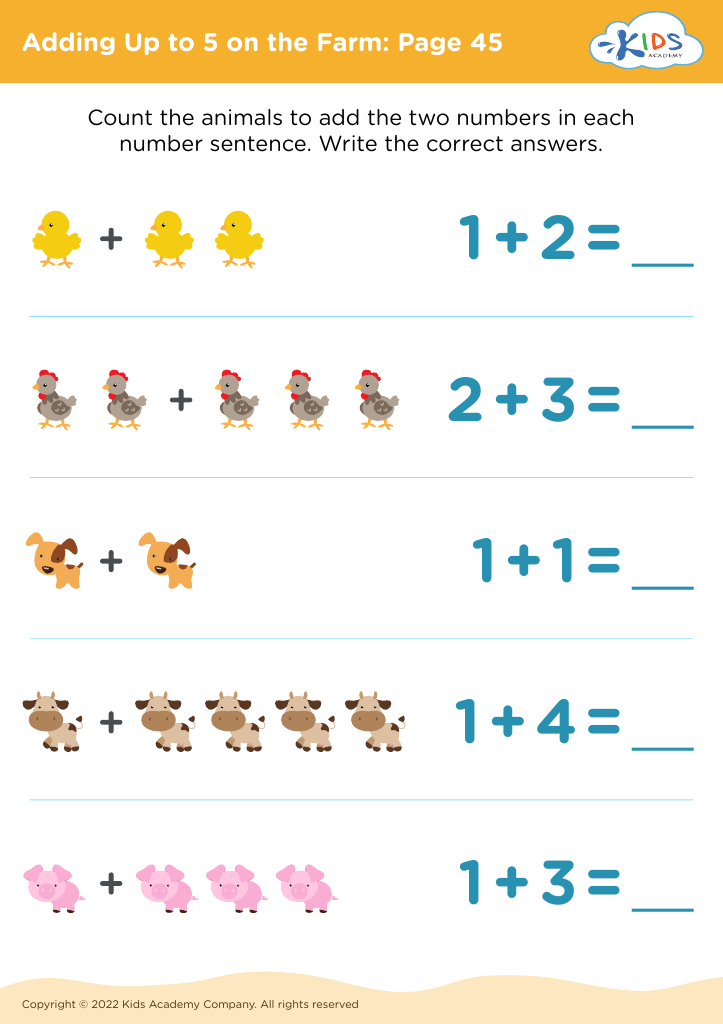
Enhance your child's math proficiency with our Visual-Motor Skills Addition & Subtraction Worksheets for 5-Year-Olds! Crafted to develop both fine motor abilities and mathematical acuity, these engaging worksheets guide young learners through basic addition and subtraction problems while simultaneously refining their hand-eye coordination. Each activity is thoughtfully designed to make learning fun and effective, helping kids build a solid foundation for future math success. Suitable for homeschoolers and classroom settings, our worksheets are a perfect blend of education and entertainment, ensuring that your child stays motivated and progresses steadily in their early math journey.
Favorites
With answer key
Interactive
Join Kids Academy for Free
Who is primarily going to use this learning content?








Visual-motor skills are critical for the early mathematical development of 5-year-olds because they bridge the gap between visual perception and motor actions. For parents and teachers, fostering these skills can significantly impact a child's ability to perform basic addition and subtraction, which are foundational for later math success.
When children engage in activities like drawing numbers, counting objects, and solving simple math problems, they develop hand-eye coordination and the ability to process visual information accurately. This process underpins the understanding of mathematical concepts such as number relationships, spatial awareness, and sequence learning. For instance, accurately tracing numbers not only aids mathematical handwriting but enhances cognitive recognition of number pairs needed for addition and subtraction.
Visual-motor integration also influences a child's performance in other academic and everyday tasks. Poor visual-motor skills can lead to misinterpretations of problem instructions or improperly aligned math computations, resulting in frustration and lowered self-esteem. Therefore, parents and teachers should integrate playful, interactive activities, such as puzzles, matching games, and hands-on counting exercises, to nurture these skills.
By focusing on visual-motor development early, parents and teachers ensure children build a solid mathematical foundation, fostering not only academic success but also confidence and a positive attitude towards learning.








