
Analyzing patterns Worksheets for Ages 6-9
3 filtered results
Difficulty Level
Grade
Age
-
From - To
Subject
Activity
Standards
Explore our engaging "Analyzing Patterns Worksheets" tailored for ages 6-9! Designed to enhance critical thinking and observational skills, these worksheets introduce young learners to the fascinating world of patterns. Children will enjoy fun-filled activities that encourage them to identify, create, and extend various patterns through colors, shapes, and numbers. Our interactive resources aim to promote cognitive development while making learning enjoyable. Perfect for both classroom and home use, these worksheets support key mathematical concepts and foster creativity. Dive into a world of discovery and watch your child's analytical abilities flourish. Join us in making pattern recognition an exciting adventure!
Favorites
With answer key
Interactive
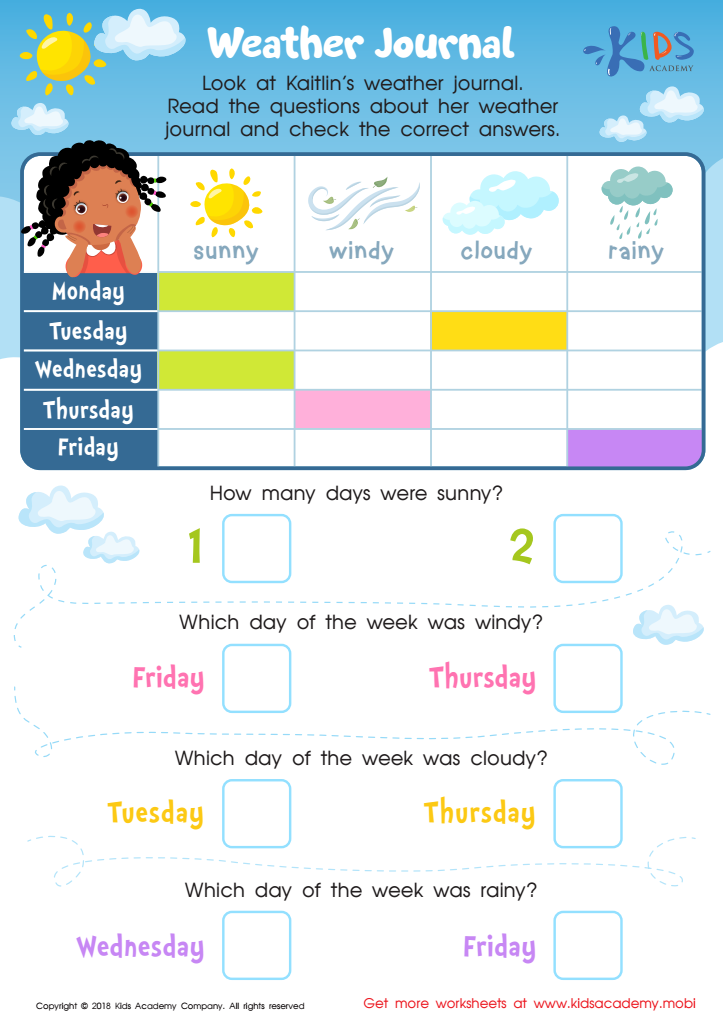
Weather Journal Worksheet
Kaitlin keeps a weather journal. Encourage your child to do the same! Look at Kaitlin's journal with them, and have them note the weather for each day. Read aloud the questions and check the correct answers.
 Assign to My Students
Weather Journal Worksheet
Worksheet
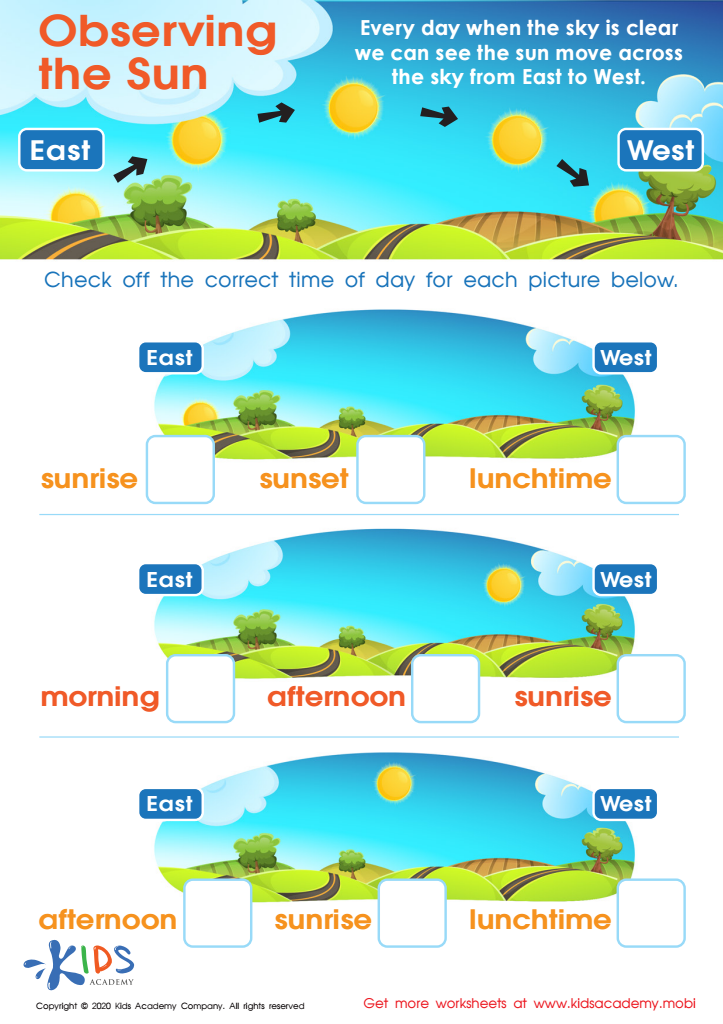
Observing the Sun Worksheet
Observe the image of the sun's progression with your child and use it to complete this free printable worksheet from Kids Academy. Have your kid look at the pictures on the left and check off the numbers in the correct order from sunrise to sunset! This will expand their science knowledge and help them understand when it's time to rise, reach its highest point during midday and set again in the West.
Observing the Sun Worksheet
Worksheet
Join Kids Academy for Free
Who is primarily going to use this learning content?






Analyzing patterns is a fundamental skill for children aged 6-9, one that serves as a building block for their future learning in mathematics, science, and critical thinking. At this developmental stage, children are naturally curious and eager to make connections, making it the ideal time to introduce them to the concept of patterns.
For parents and teachers, recognizing and encouraging pattern analysis fosters cognitive development. It enhances children's ability to identify similarities and differences, promoting logical reasoning. When children understand patterns, they gain essential problem-solving skills, which are applicable in both academic and real-world scenarios.
Learning to analyze patterns also boosts a child’s confidence and motivation. As they discover and replicate patterns, they experience a sense of achievement, encouraging a love for learning. Additionally, early exposure to patterns helps lay the groundwork for more complex mathematical concepts like sequences and functions, which are crucial in higher education.
Furthermore, examining patterns is not limited to mathematics; it permeates subjects such as language arts and art. By fostering pattern recognition, parents and teachers equip children with essential tools for understanding and navigating the world around them, ensuring they develop into holistic learners.








