
Practice problem-solving Worksheets for Ages 6-9
5 filtered results
Difficulty Level
Grade
Age
-
From - To
Subject
Activity
Standards
Explore our engaging Practice Problem-Solving Worksheets designed specifically for children aged 6 to 9! These worksheets nurture critical thinking and enhance reasoning skills through fun and interactive activities. Each worksheet presents age-appropriate challenges that stimulate young minds, fostering logical reasoning and creative solutions. From puzzles to real-world scenarios, our resources help kids apply problem-solving techniques in diverse situations, making learning enjoyable and effective. Perfect for classroom or home use, these worksheets provide an excellent way to build confidence and independence in young learners. Get ready to empower your child with essential skills they'll use throughout their educational journey!
Favorites
With answer key
Interactive
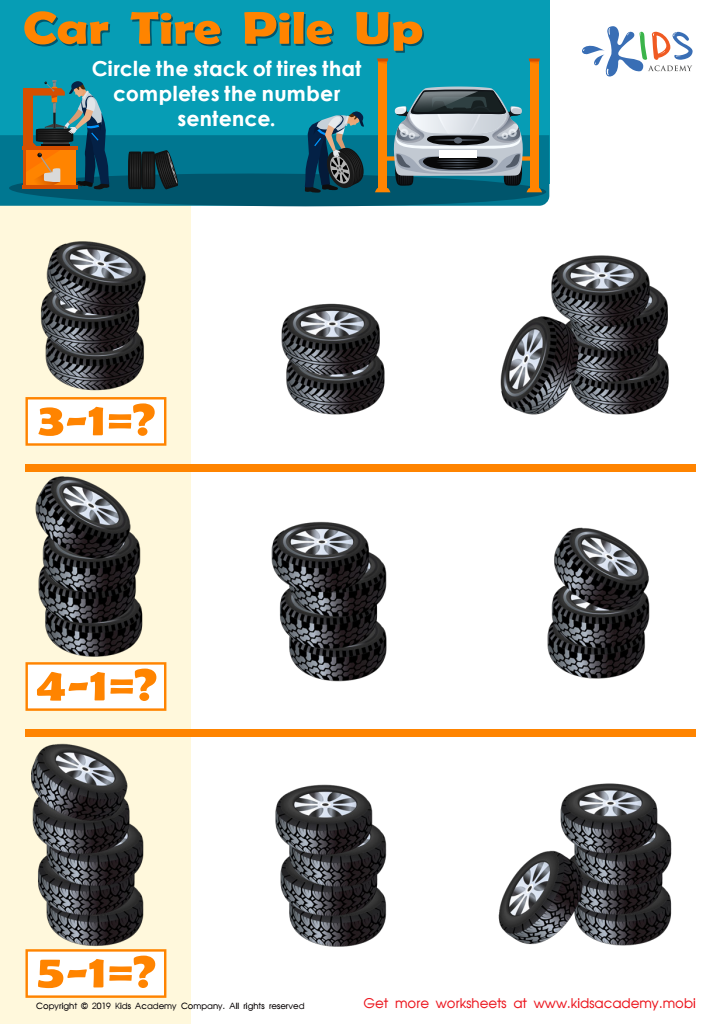
Car Tire Pile Up Worksheet
Examine the pic with your kids. Can they recognize the items piled up? The tires are organized in different quantities. Equations are on the left. Have your children work out the equations, counting the tire stacks to identify the correct answer.
 Assign to My Students
Car Tire Pile Up Worksheet
Worksheet
Join Kids Academy for Free
Who is primarily going to use this learning content?








Parents and teachers should prioritize problem-solving skills for children aged 6 to 9 because these skills lay the foundation for critical thinking and independent learning. At this age, children are naturally curious and eager to engage with the world around them. By encouraging them to practice problem-solving, adults can help cultivate their ability to analyze situations, think logically, and develop a structured approach to challenges.
Developing problem-solving skills enhances cognitive abilities, enabling children to grasp mathematical concepts more effectively, understand cause-and-effect relationships, and foster creativity. When kids learn to tackle problems—be it a math equation, a social conflict, or a science experiment—they become more resilient and confident in their abilities.
Moreover, strong problem-solving skills translate into better decision-making and adaptability—traits essential for success in both academic and real-world scenarios. As children encounter various dilemmas, they gain experience and discernment, enabling them to handle future challenges with greater ease.
Additionally, effective problem-solving often involves collaboration and communication, skills that encourage teamwork and social interaction. This holistic development is vital for nurturing well-rounded individuals who can contribute positively to their communities and navigate life's complexities. For these reasons, fostering problem-solving skills should be a priority for both parents and teachers.








