Understanding Sequences Adding up to 1000 with Regrouping Worksheets for Ages 6-9
4 filtered results
-
From - To
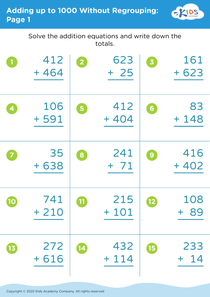
Unlock the world of mathematics for young learners with our "Understanding Sequences Adding up to 1000 with Regrouping Worksheets." Designed for ages 6-9, these engaging worksheets help children grasp the concept of sequences while mastering addition. With a focus on regrouping, students will develop essential skills in number sequences, enhancing their problem-solving abilities. Each worksheet incorporates fun exercises that challenge kids to add numbers seamlessly, fostering a solid foundation in math. As they work through varied problems, children build confidence and improve their critical thinking. Perfect for classroom or at-home learning, these resources make math enjoyable and accessible for budding mathematicians!
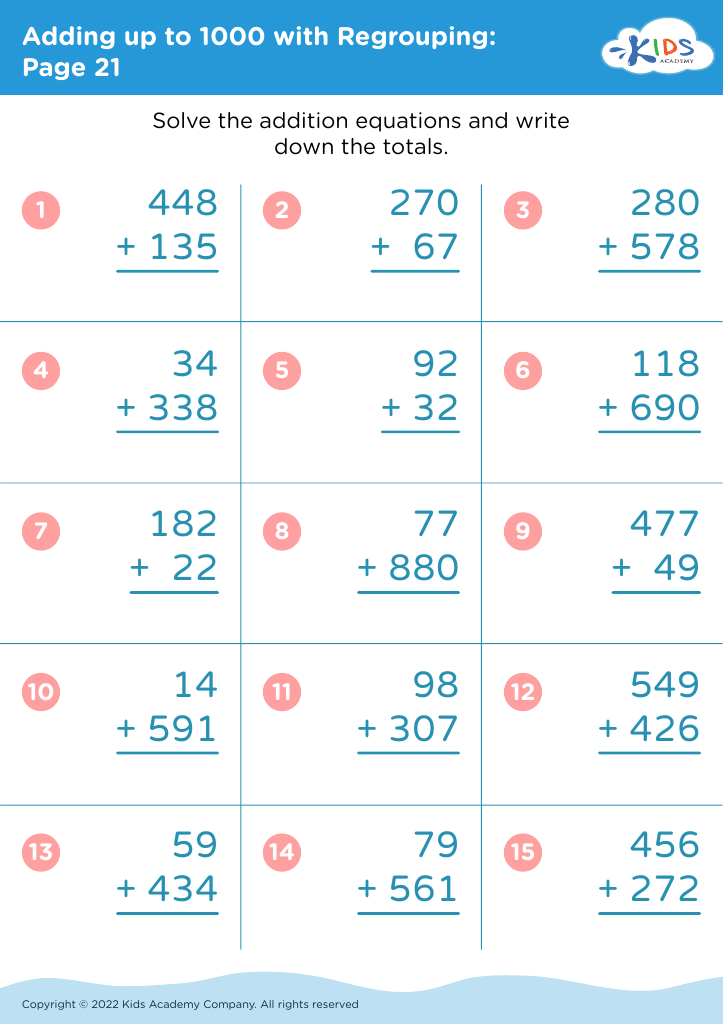
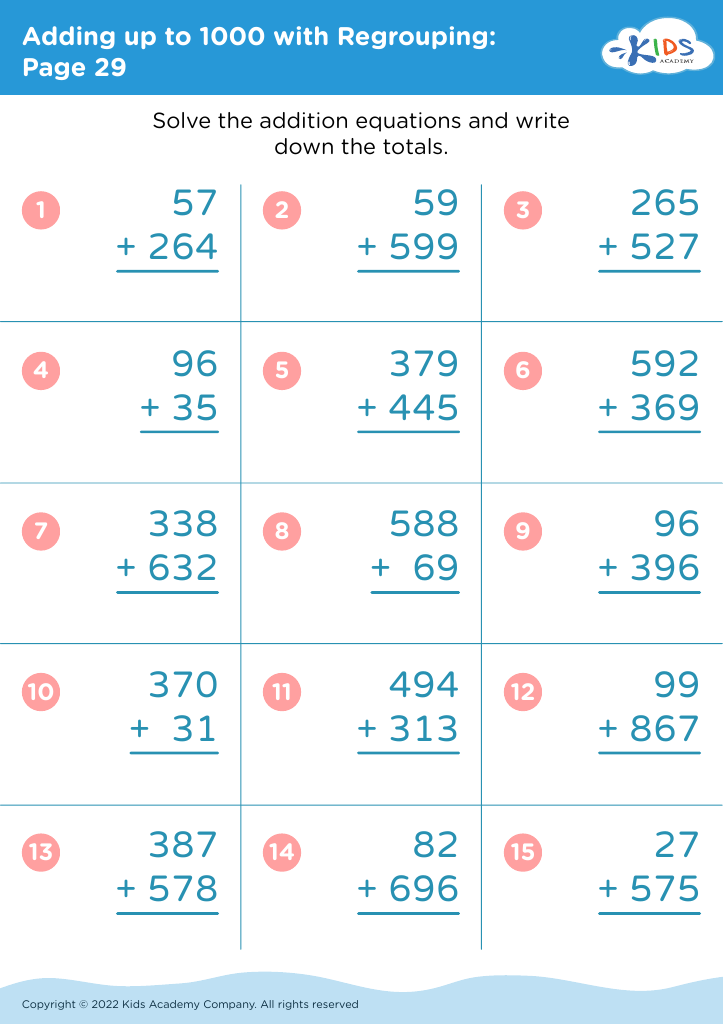
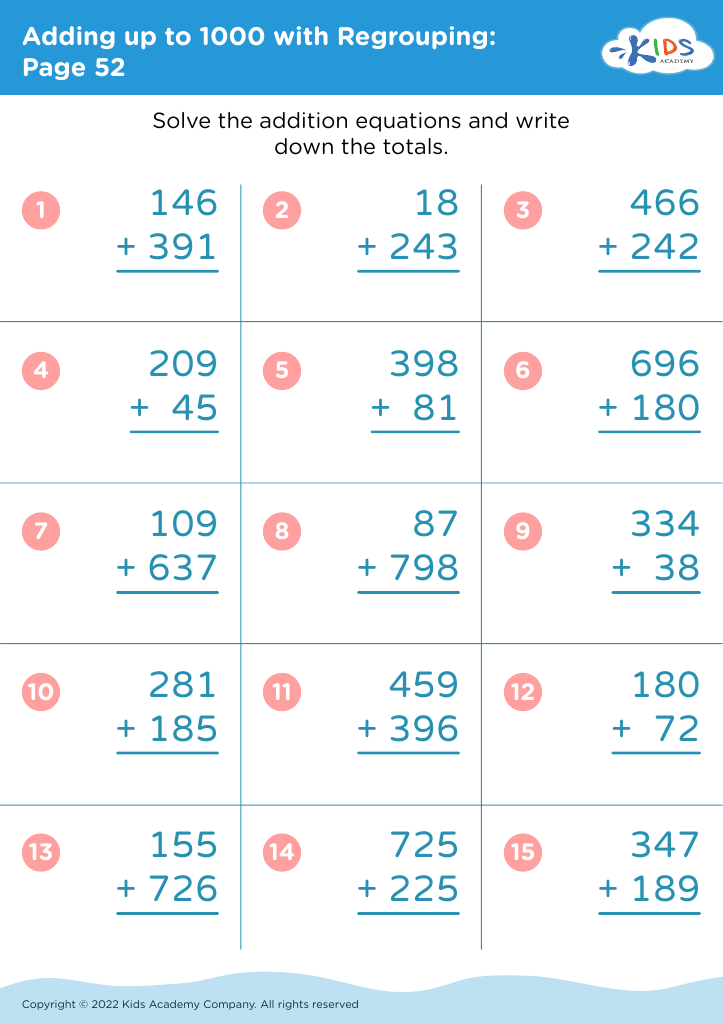
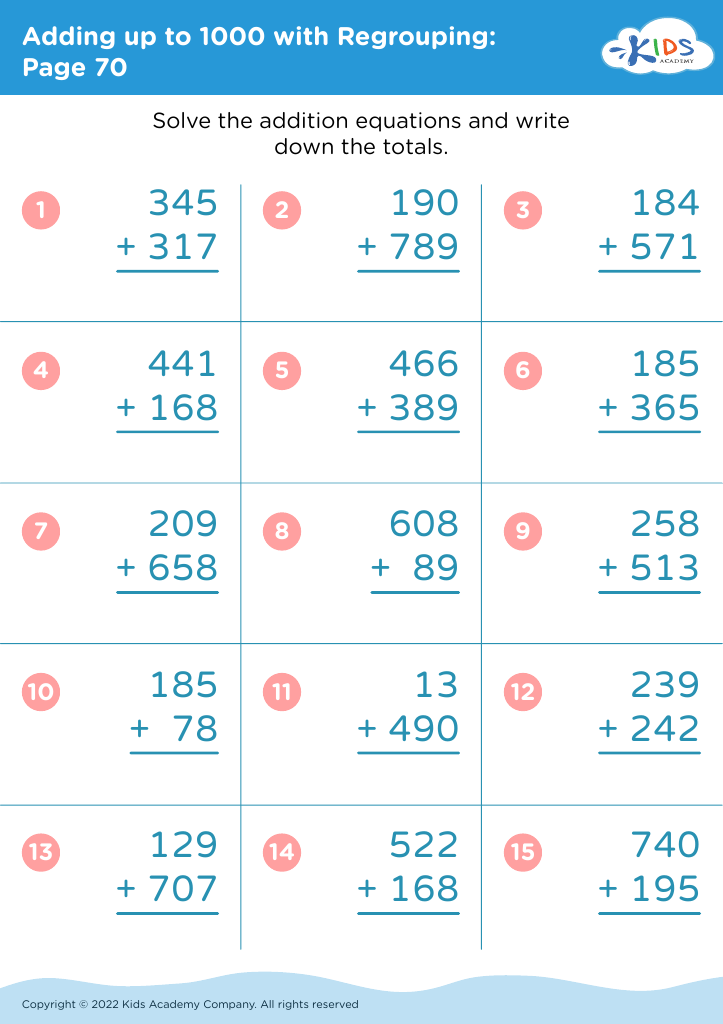


Understanding sequences that add up to 1000 with regrouping is essential for children aged 6-9, as it develops foundational mathematical skills critical for their academic growth. At this early stage, children are introduced to key concepts such as place value, addition, and number patterns. Grasping sequences maximizes their ability to manipulate numbers, fostering a stronger comprehension of arithmetic operations while also enhancing their problem-solving abilities.
Regrouping, often referred to as carrying in addition, may seem daunting but encourages logical thinking and flexibility in approaches to math. Teaching children how to regroup effectively prepares them for more complex mathematical concepts they'll encounter later in school, ensuring a solid groundwork in number sense.
Moreover, practical applications of sequences can be found in everyday situations, making math relevant and engaging. By emphasizing these skills, teachers and parents equip children to tackle real-life mathematical challenges confidently. This early intervention in understanding sequences not only enhances mathematical knowledge but boosts overall cognitive development, encouraging perseverance and resilience in problem-solving. Thus, both teachers and parents should prioritize promoting a robust understanding of sequences and regrouping within children, as it paves the way for their continued success in math and beyond.