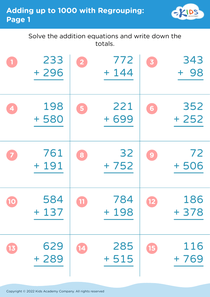
Develop counting skills Adding up to 1000 Without Regrouping Worksheets for Ages 6-9
3 filtered results
-
From - To
Unlock your child's potential with our "Develop Counting Skills: Adding Up to 1000 Without Regrouping Worksheets" tailored for ages 6-9. Our engaging, easy-to-follow worksheets are designed to deepen understanding and boost confidence in addition. Perfect for young learners, these activities focus on adding large numbers without regrouping, helping children master crucial skills needed for higher-level math. Fun graphics and step-by-step instructions make learning enjoyable and effective. Whether for classroom use or extra practice at home, our dedicated resources offer the perfect blend of education and entertainment. Equip your child today for a bright mathematical future!
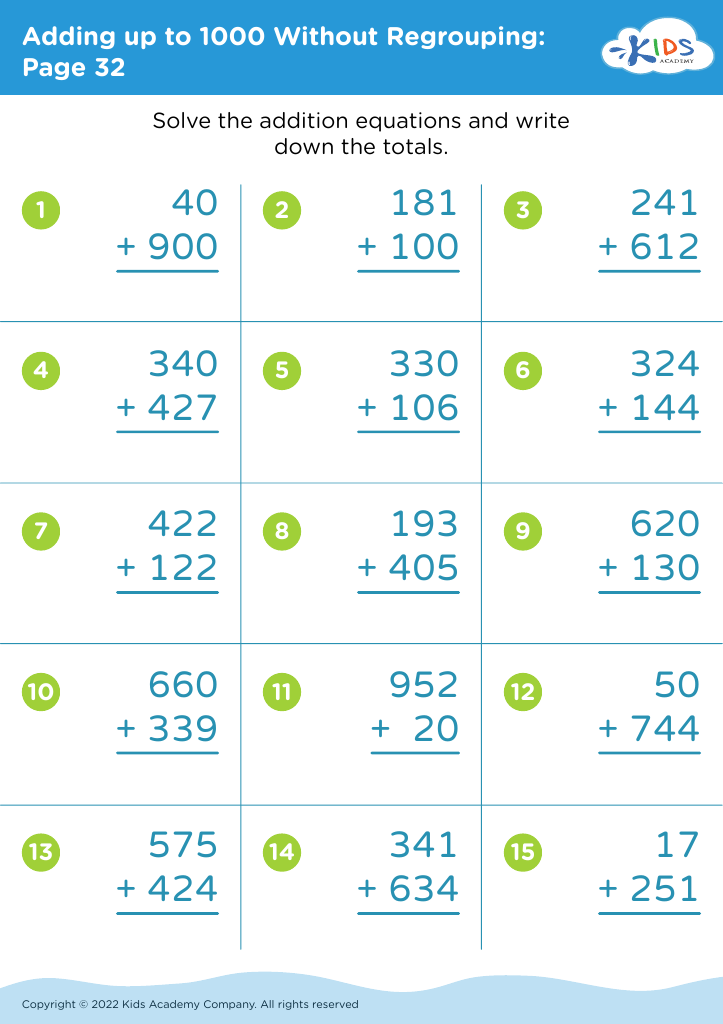
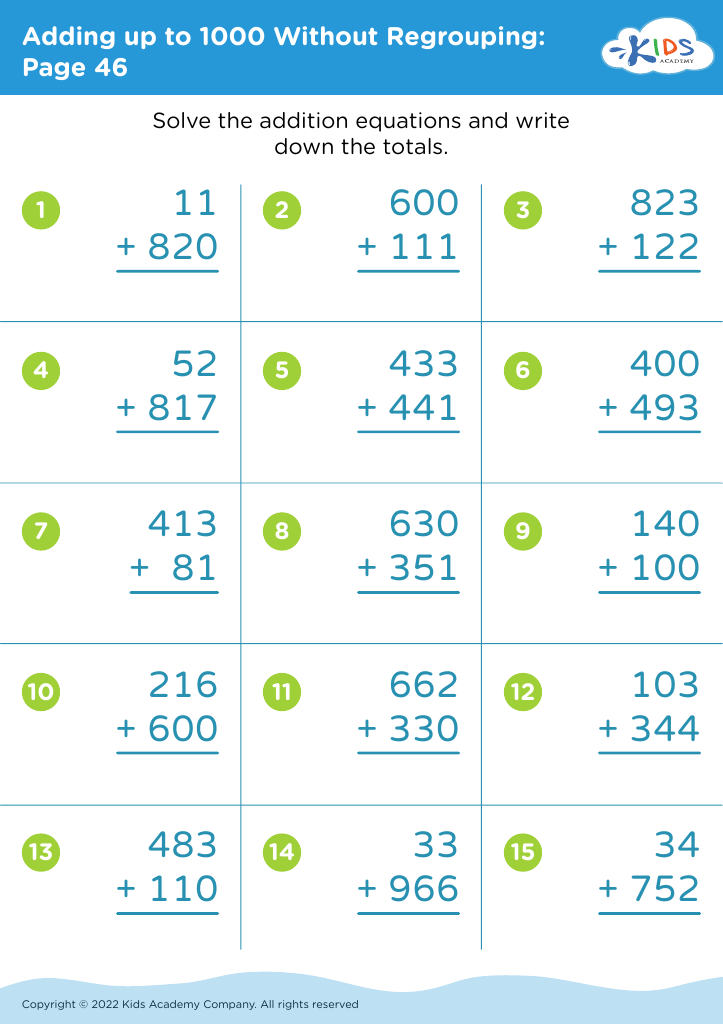
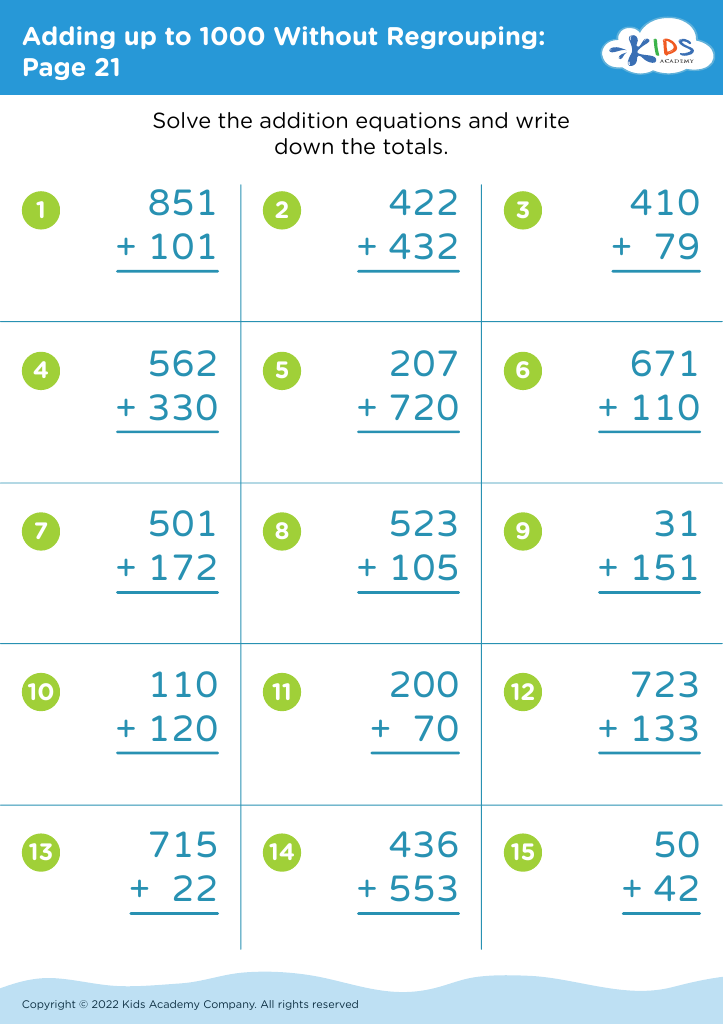


Developing counting skills and the ability to perform addition up to 1000 without regrouping in children aged 6-9 is crucial for their mathematical foundation and overall cognitive development. During these formative years, children are rapidly attaining fundamental skills that will underpin their future learning experiences.
Counting and simple addition without regrouping lay down an essential understanding of numerical relationships and place value. This foundational knowledge is critical for more advanced mathematical concepts like subtraction, multiplication, and division. Additionally, mastering these skills enhances children’s logical thinking and problem-solving abilities, which are applicable across various subjects beyond math.
Equipping children with strong counting and addition skills also builds their confidence and reduces math anxiety. With a solid grasp of numbers, students feel more capable and prepared to tackle complex problems in the future, fostering a positive attitude towards learning. Controlling numbers and operations without confusion enhances their competence and reinforces further academic progress.
Parents and teachers can use engaging activities and practical applications to nurture these skills. By incorporating counting and addition exercises in everyday contexts, such as counting objects or adding items in a shopping list, adults help children see math’s relevance in daily life. This practical approach anchors learning in real-world experiences, making it both meaningful and enjoyable.