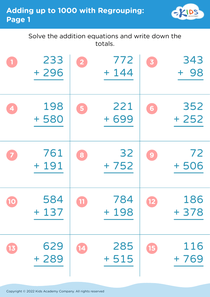
Fine Motor Skills Adding up to 1000 Without Regrouping Worksheets for Ages 6-9
3 filtered results
-
From - To
Enhance your child's fine motor skills while mastering addition with our "Adding Up to 1000 Without Regrouping" worksheets, specifically designed for ages 6-9. These engaging worksheets combine essential math practice with activities that promote hand-eye coordination, dexterity, and concentration. Children will enjoy tracing, coloring, and manipulating various elements while learning to add numbers confidently without regrouping. Our thoughtfully created resources ensure that young learners build a strong mathematical foundation while developing their motor skills in a fun, interactive way. Perfect for home or classroom use, these worksheets are an effective tool for creating confident, capable young mathematicians!
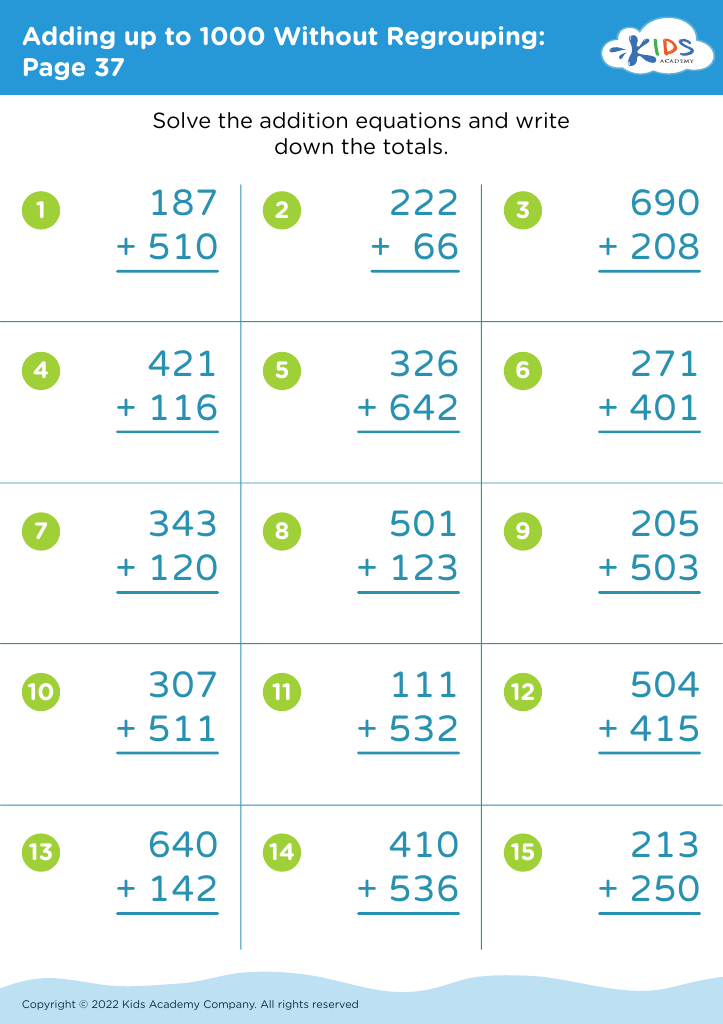
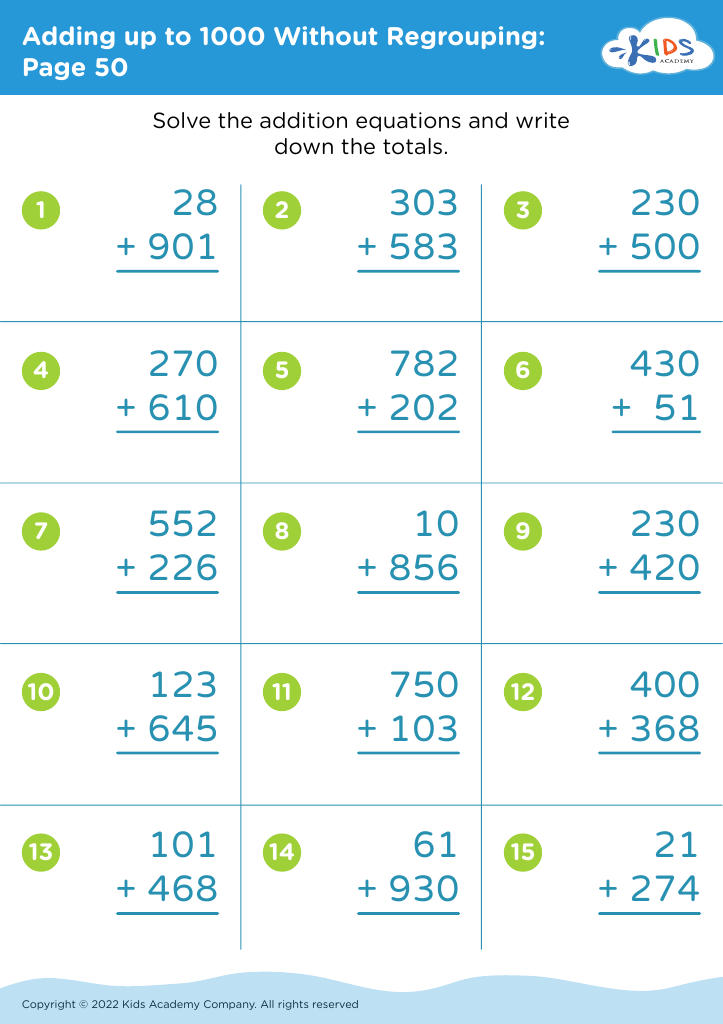
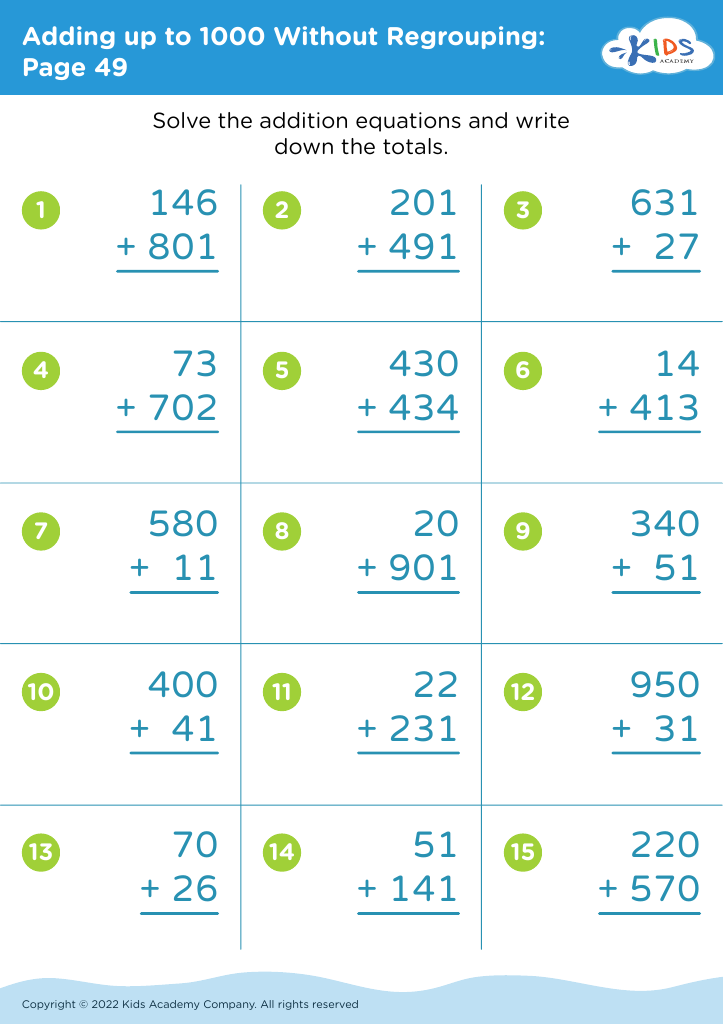


Fine motor skills encompass the small movements of the hands and fingers that are crucial for various everyday tasks, from writing to using utensils. For children aged 6-9, the development of these skills is particularly important as they are consolidating foundational concepts in mathematics, such as multi-digit addition, and they begin to tackle problems like adding up to 1000 without regrouping.
Parents and teachers should care about this because the ability to perform fine motor tasks directly impacts a child’s confidence and competency in academic tasks, including writing numbers and organizing their work. When children struggle with fine motor skills, they may find it challenging to neatly align numbers, keep their work organized, or write legibly, all of which can interfere with their mathematical performance.
Moreover, as children engage in activities that bolster their fine motor skills, such as drawing, cutting, or playing with small objects, they are simultaneously enhancing their cognitive abilities, fine-tuning their hand-eye coordination, and reinforcing their mathematical understanding. By recognizing this connection, parents and teachers can better support kids in building both motor and math skills, laying a strong foundation for future learning throughout their academic journey.