Understanding division Adding up to 1000 Without Regrouping Worksheets for Ages 6-9
3 filtered results
-
From - To
Welcome to our "Understanding Division Adding Up to 1000 Without Regrouping" worksheets designed for children aged 6-9! These engaging and interactive resources aim to strengthen your child's understanding of division concepts alongside addition mastery. Our worksheets guide young learners as they practice dividing numbers confidently, developing foundational skills essential for mathematical success. Each activity focuses on breaking down complex ideas into manageable parts, fostering a deeper comprehension of how numbers operate. Perfect for classroom use or at-home practice, our worksheets will ensure your child gains the confidence needed to tackle division problems with ease. Start exploring today and watch their skills flourish!
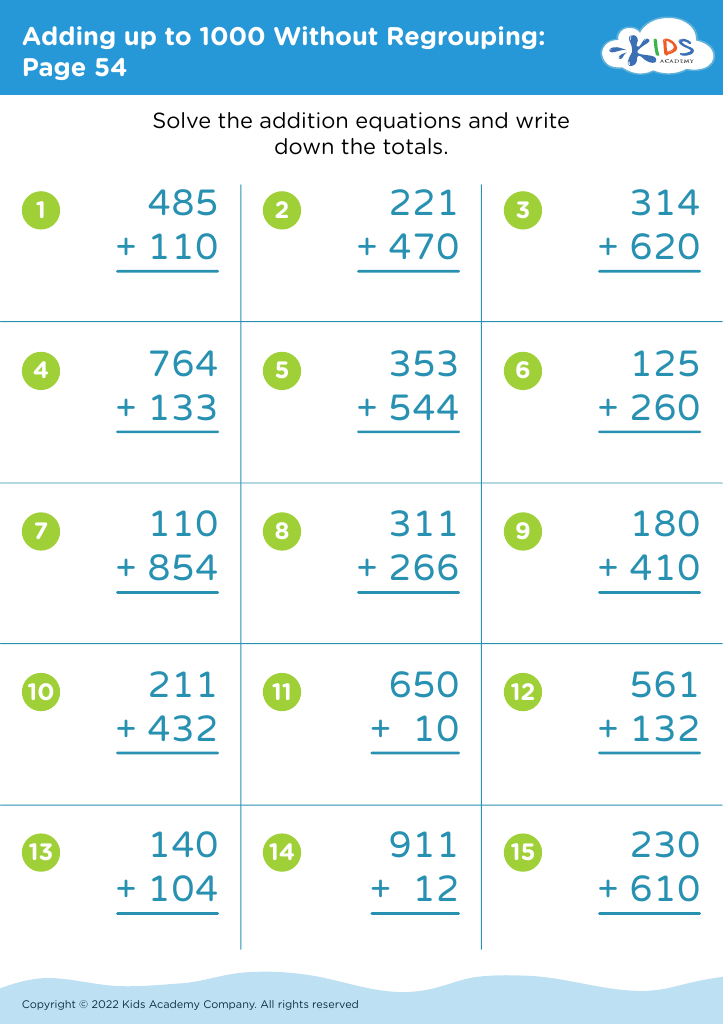
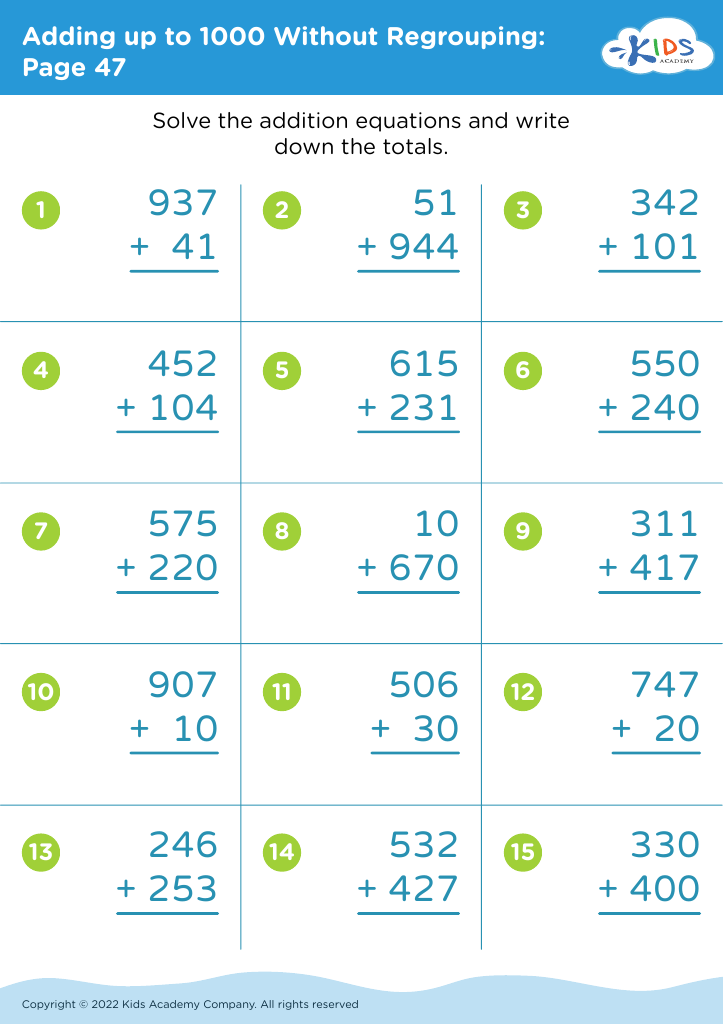
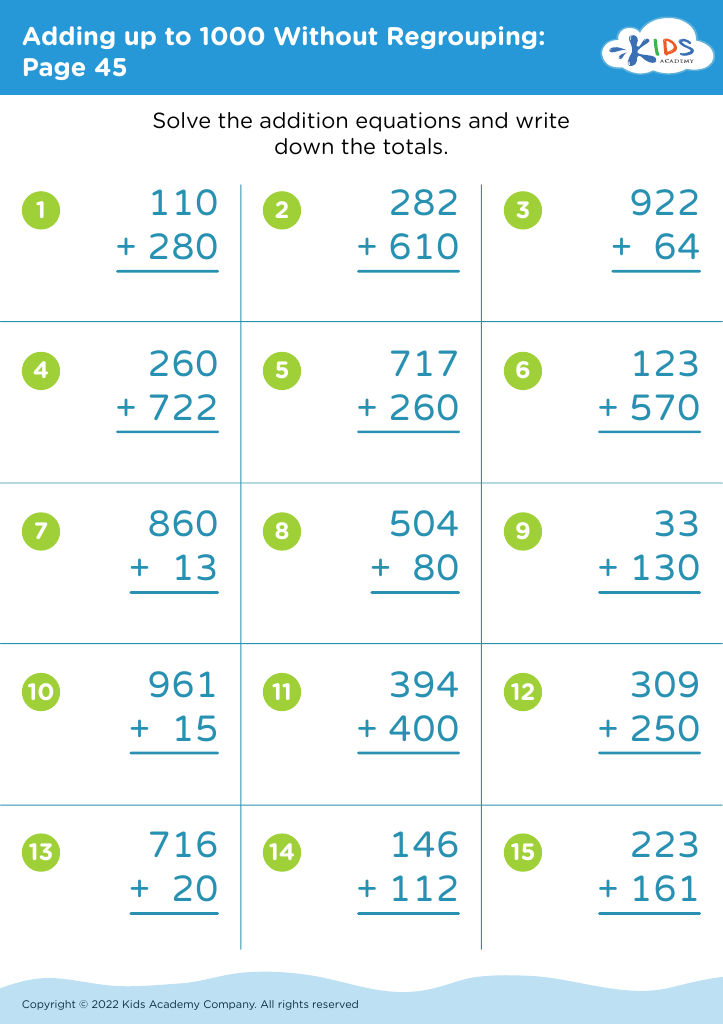


Understanding division, particularly adding up to 1000 without regrouping, is essential for children ages 6-9 as it lays the foundation for critical mathematical concepts they will encounter later in their education. At this developmental stage, children are starting to grasp the connections between numbers, and mastering division helps them understand how to separate items into equal groups, fostering problem-solving and logical thinking skills.
When students learn to add up to 1000 without regrouping, they develop fluency in basic arithmetic, which builds their confidence and efficiency in handling numbers. This confidence is crucial as they encounter more complex math concepts in upper grades. Furthermore, grasping these foundational skills prepares them for real-life applications, such as managing money or sharing resources, making math more relevant and engaging.
Teachers and parents should care about these skills because they support overall cognitive development and academic success. By promoting a strong understanding of division and addition strategies, they empower children to tackle math challenges head-on and cultivate a positive attitude toward learning. Encouraging mastery at this stage can foster lifelong learning habits and pave the way for future achievements in mathematics and beyond.