Number identification Adding up to 1000 Worksheets for Ages 6-9
3 filtered results
-
From - To
Discover our engaging "Number Identification Adding Up to 1000 Worksheets" designed for children aged 6-9. These worksheets focus on enhancing number recognition, counting skills, and addition proficiency within the range of 1 to 1000. Bright and colorful exercises keep young learners motivated while they practice identifying numbers, understanding number sequences, and solving addition problems. Perfect for both classroom and home use, these resources promote foundational math skills essential for academic success. Ideal for reinforcing classroom learning, our worksheets provide a fun and interactive way for children to improve their number identification capabilities. Explore our collection today and support your child's math journey!
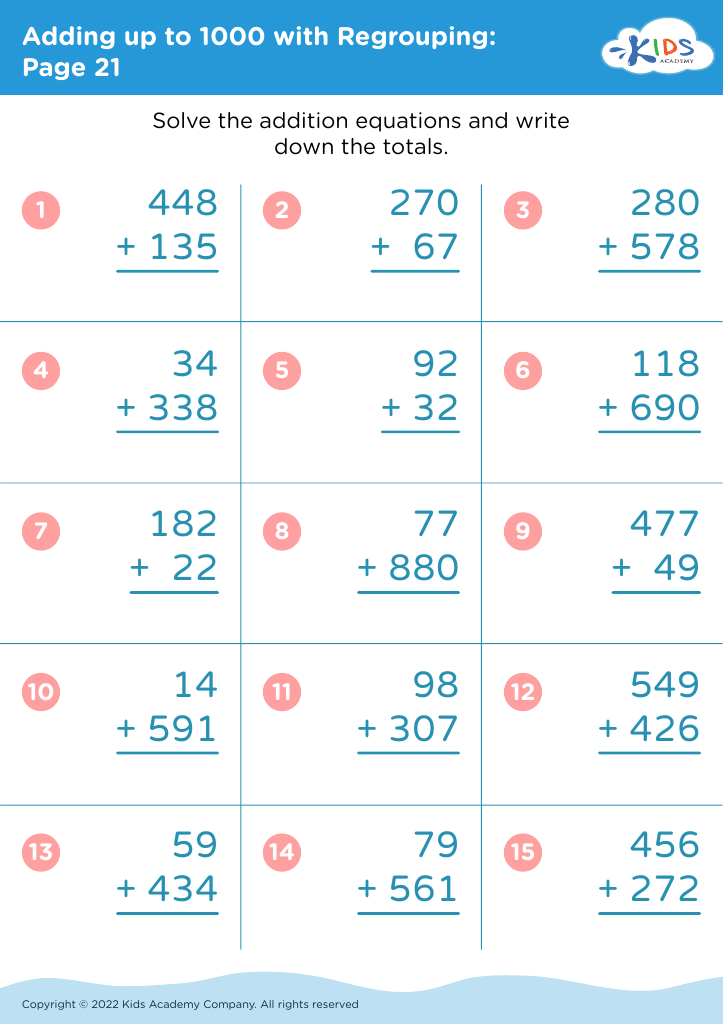
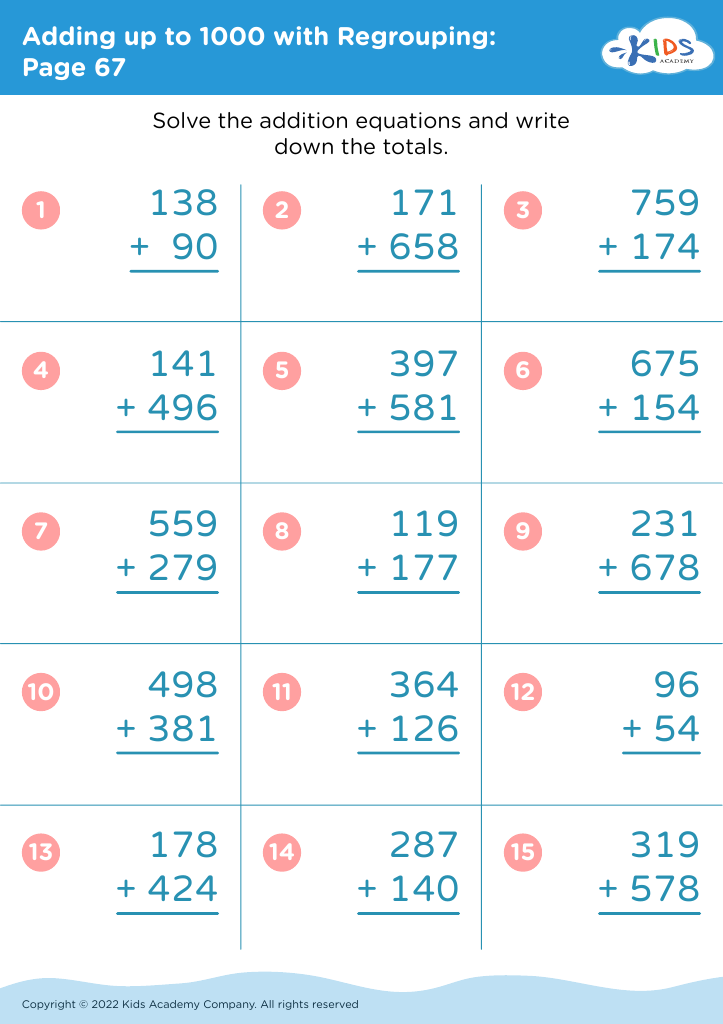
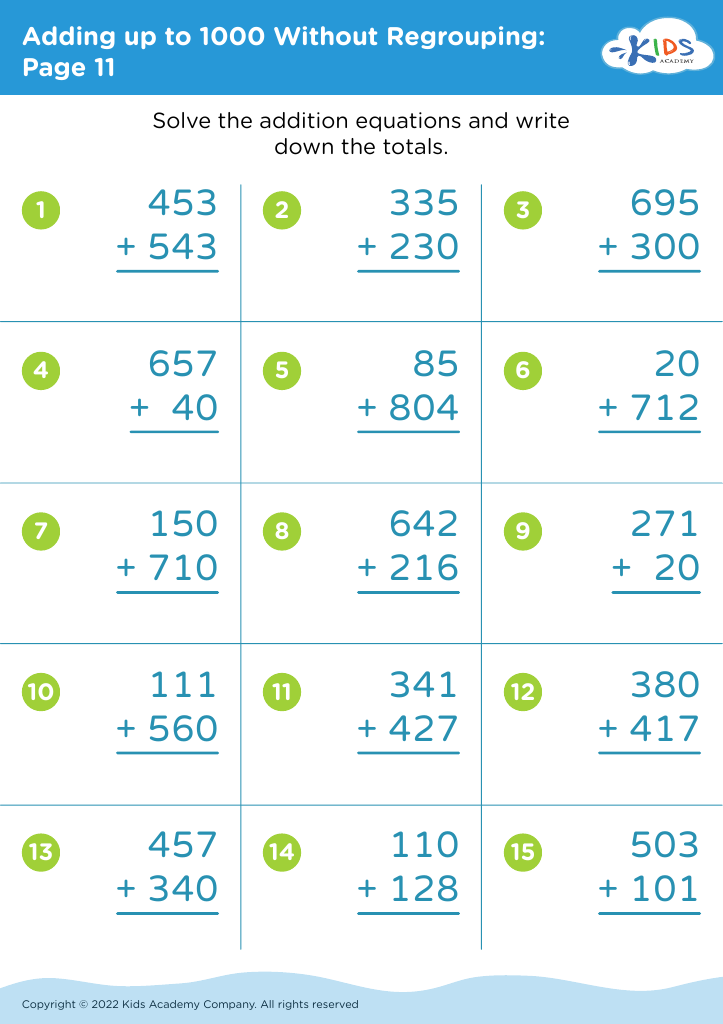



Number identification and addition skills up to 1000 are foundational for children aged 6-9, making them crucial for parents and teachers to emphasize. Mastering these concepts enables young learners to develop a strong numerical sense, enhancing their overall mathematical proficiency and problem-solving abilities.
Understanding number identification lays the groundwork for advanced math concepts. As children learn to recognize and manipulate numbers, they build confidence in handling everyday math tasks, from simple counting to managing budgets. Early arithmetic skills also promote logical reasoning and critical thinking, encouraging children to approach problems with a quantitative mindset.
Additionally, these skills correlate with performance in higher-level math, which impacts standardized test scores and academic achievement. Parents and teachers should notice the relationship between strong foundational skills and long-term educational success. Building solid competencies at an early stage helps children face more complex mathematical challenges in the future.
By engaging with and supporting children in developing their number identification and addition skills, adults play an essential role in promoting foundational learning that can open doors to future opportunities, fostering not only mathematical aptitude but also instilling a positive attitude toward learning as a lifelong journey.








