
Pattern identification Addition & Subtraction Worksheets for Ages 6-9
3 filtered results
Difficulty Level
Grade
Age
-
From - To
Subject
Activity
Standards
Enhance your child's math skills with our Pattern Identification Addition & Subtraction Worksheets, specifically designed for ages 6-9. These carefully curated worksheets are an excellent tool for reinforcing addition and subtraction concepts through pattern recognition. They offer engaging activities that help children identify and predict numerical patterns while solving math problems. Each worksheet is developed by educators to boost critical thinking and problem-solving skills in young learners. Ideal for both classroom use and homeschooling, our resources make learning math fun and effective. Download now for a comprehensive approach to mastering addition and subtraction while fostering a love for numbers!
Favorites
With answer key
Interactive
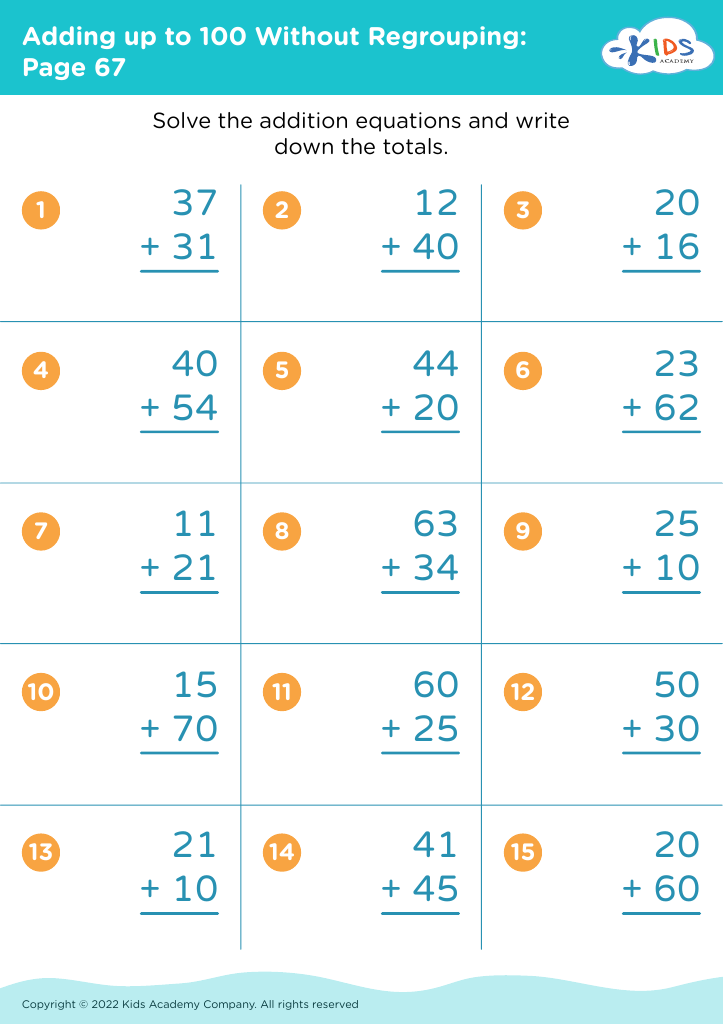
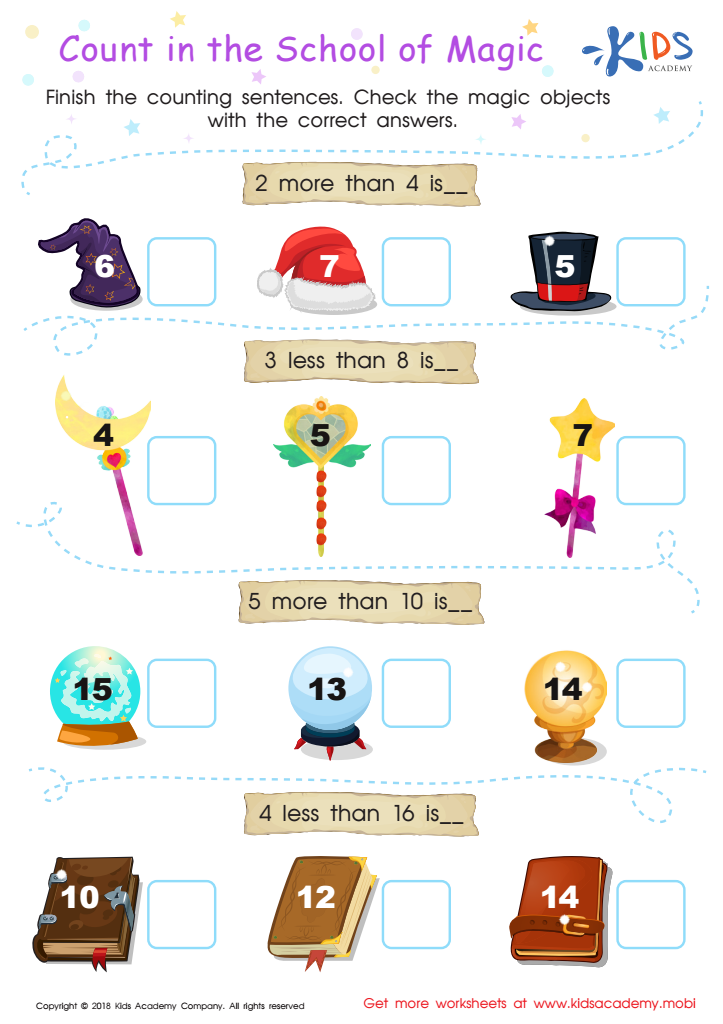
Count in the School of Magic Worksheet
Your math learners can explore the School of Magic with this worksheet. They'll read equations with addition and subtraction numbers under 20, count back and forth to find the answer, then complete the counting sentences. Fun pictures and easy accuracy make it an enjoyable and successful learning experience.
 Assign to My Students
Count in the School of Magic Worksheet
Worksheet
Join Kids Academy for Free
Who is primarily going to use this learning content?








Pattern identification in addition and subtraction is a fundamental skill for children ages 6-9, as it lays the groundwork for understanding more complex mathematical concepts. Recognizing patterns helps students make sense of numerical relationships and develop a deeper comprehension of mathematical operations beyond mere memorization.
For example, when students identify a pattern in addition like adding 2, 4, 6, 8, they recognize a predictable sequence which can strengthen their mental math skills. This ability extends to real-life situations, aiding in everyday problem-solving and logical thinking. Similarly, grasping patterns in subtraction enhances their inverse operation skills, building a bridge to understanding subtraction as undoing addition.
Moreover, fostering pattern recognition in early grades boosts cognitive development and harbors a positive attitude toward math. It encourages children to be analytical and enhances critical thinking as they seek out and apply patterns. This skill is foundational for advanced topics such as algebra, where patterns and relationships are key.
Incorporating pattern activities in the curriculum can also make math more engaging and enjoyable. Games, puzzles, and hands-on exercises capture children’s interest, making learning both fun and meaningful. By prioritizing pattern identification in addition and subtraction, parents and teachers not only support mathematical proficiency but also cultivate life-long learning skills.








