
Mathematical thinking Addition Worksheets for Ages 6-9
3 filtered results
Difficulty Level
Grade
Age
-
From - To
Subject
Activity
Standards
Unlock your child's mathematical potential with our engaging Addition Worksheets designed for ages 6-9. These educational resources help young learners enhance their mathematical thinking through fun and interactive activities. Each worksheet is carefully crafted to build foundational skills in addition, boosting problem-solving abilities and encouraging logical reasoning. Perfect for classroom or at-home learning, our worksheets cater to various skill levels to ensure steady progress. Empower your child to excel in math with our expertly designed, grade-appropriate addition exercises that make learning both effective and enjoyable. Visit Kids Academy and watch your child's confidence grow with each solved problem!
Favorites
With answer key
Interactive
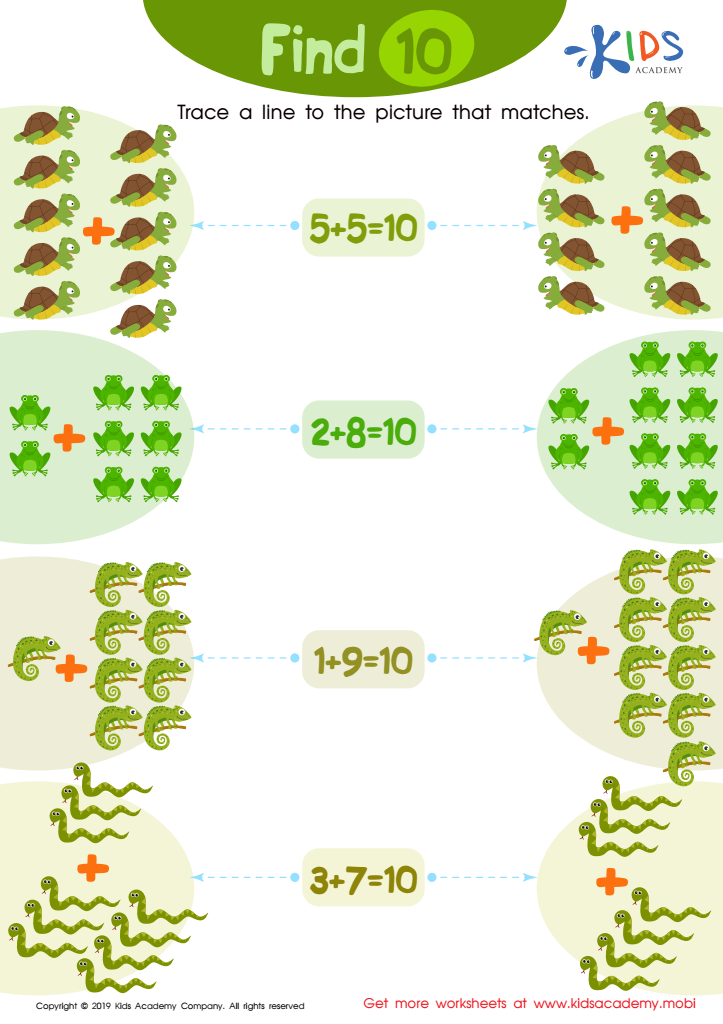
Find 10 Worksheet
Counting can be tricky, but your kids can master it with regular practice. Here's a fun activity to help: count the animals, then trace a line to the pictures that matches. With these tips, math will be an easy walk in the park.
 Assign to My Students
Find 10 Worksheet
Worksheet
Join Kids Academy for Free
Who is primarily going to use this learning content?








Mathematical thinking, particularly in addition, is foundational for children aged 6-9. During these critical early years, understanding basic addition helps establish essential cognitive skills that aid in problem-solving and logical reasoning. Proficiency in addition promotes confidence in math, encouraging a positive attitude towards the subject, which is crucial for long-term academic success.
Addition is the building block for more advanced mathematics topics, such as subtraction, multiplication, and division. When children grasp the concept of adding numbers, they develop number sense—an intuitive understanding of numbers and their relationships. This serves as a cornerstone for learning because it allows students to later grasp more complex concepts with ease.
Moreover, early competence in mathematical thinking fosters critical thinking skills. It teaches children to identify patterns, make connections, and approach problems methodically. These skills are not confined to mathematics but are transferable to other academic subjects and real-world situations.
From a developmental perspective, engaging with addition problems helps enhance a child's mental arithmetic, boosting memory and cognitive abilities. Parents and teachers who invest in nurturing mathematical thinking perform a transformational role, ensuring that students are prepared and self-assured as they advance through their educational journey and face increasingly challenging concepts.








