Mental math skills Mixed Times Tables Worksheets for Ages 6-9
3 filtered results
-
From - To
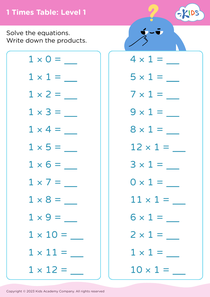
Boost your child's math confidence and efficiency with our "Mental Math Skills Mixed Times Tables Worksheets" designed for ages 6-9. These engaging, printable worksheets help young learners practice multiplication in a fun and interactive way. By tackling various times tables, kids can strengthen their mental math abilities, enhance problem-solving skills, and improve speed and accuracy. Ideal for both classroom and home learning, our worksheets present challenging yet achievable exercises that capture children's interest. Encourage a love for math and build a strong foundation for future mathematical concepts with these essential resources! Perfect for honing essential skills and making learning enjoyable!
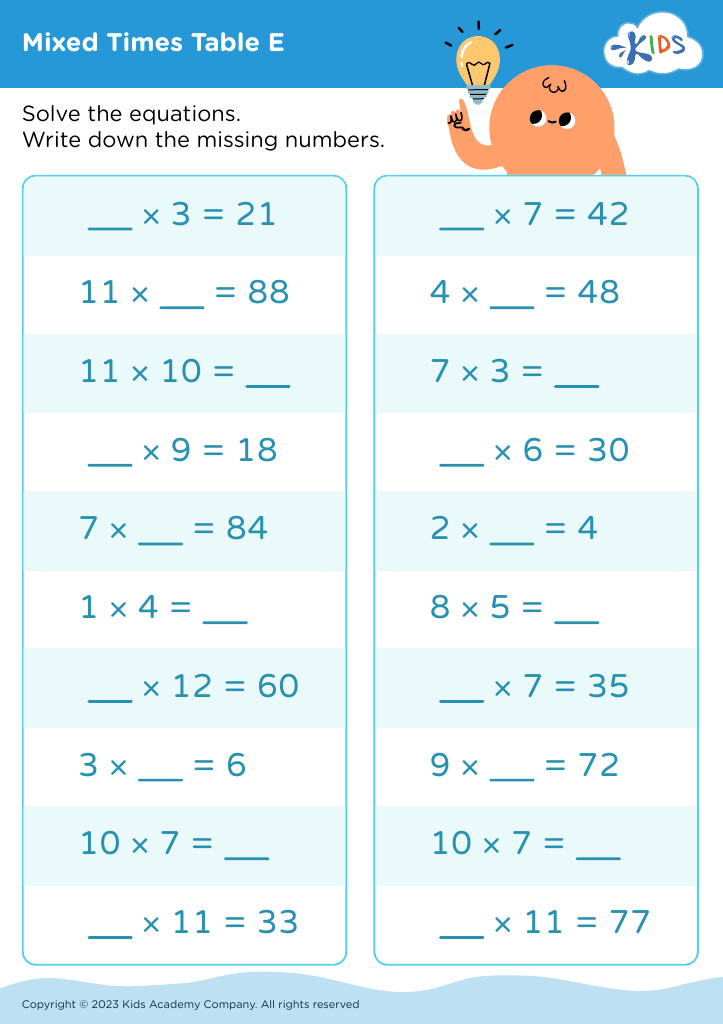
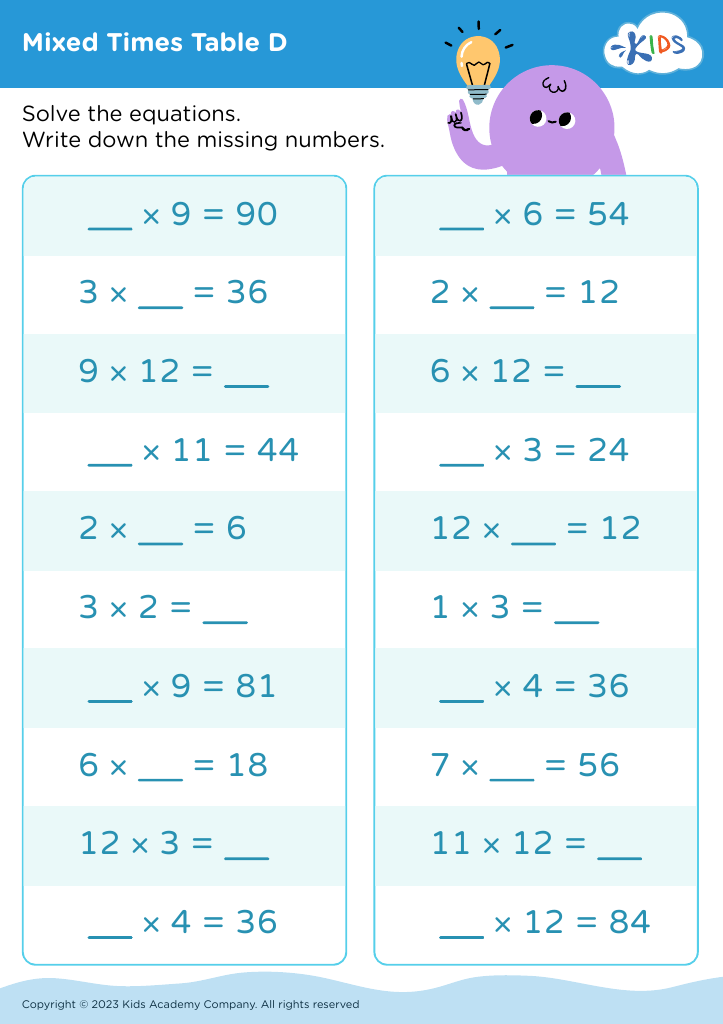
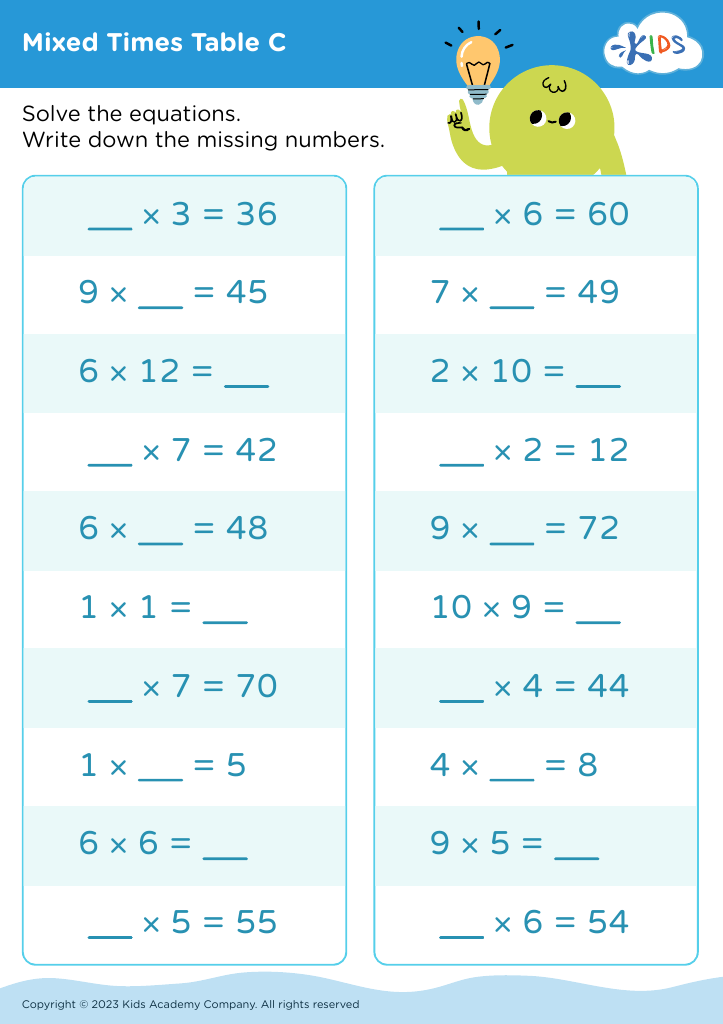


Mental math skills, particularly in the realm of mixed times tables, are crucial for children aged 6-9 as they lay a strong foundation for future mathematical success. Parents and teachers should prioritize these skills for several reasons. First, mental math enhances cognitive development, promoting critical thinking and problem-solving abilities. When children learn to rapidly recall multiplication facts, they not only become more adept at calculations but also boost their confidence in handling math-related tasks.
Additionally, proficiency in mixed times tables promotes fluency in mathematics, allowing children to transition smoothly between various math concepts such as division, fractions, and even measurements. As mathematical concepts grow increasingly complex in later grades, a solid grasp of basic multiplication will significantly ease the learning curve.
Moreover, mental math skills foster better performance in academic environments. Children who feel secure in their math abilities are more likely to engage actively in class and participate in discussions, enhancing their overall learning experience. Lastly, cultivating these skills at an early age helps children appreciate the applicability of math in everyday life, from cooking to budgeting, instilling a lifelong understanding of the importance and relevance of mathematics. Thus, investing in mental math skills is an investment in a child's holistic educational journey.