
Basic science knowledge Worksheets for Ages 7-8
3 filtered results
Difficulty Level
Grade
Age
-
From - To
Subject
Activity
Standards
Boost your child's curiosity and foundational knowledge with our Basic Science Knowledge Worksheets for Ages 7-8. These printable resources are designed to excite young minds with engaging, age-appropriate science topics. From exploring plant life cycles to understanding basic physics concepts, each worksheet supports active learning through hands-on activities and colorful illustrations. Perfect for consistent use at home or to supplement classroom lessons, our science worksheets build essential skills and spark a lifelong love for discovery. Unlock the joy of learning for your budding scientist today! Download, print, and watch them thrive.
Favorites
With answer key
Interactive
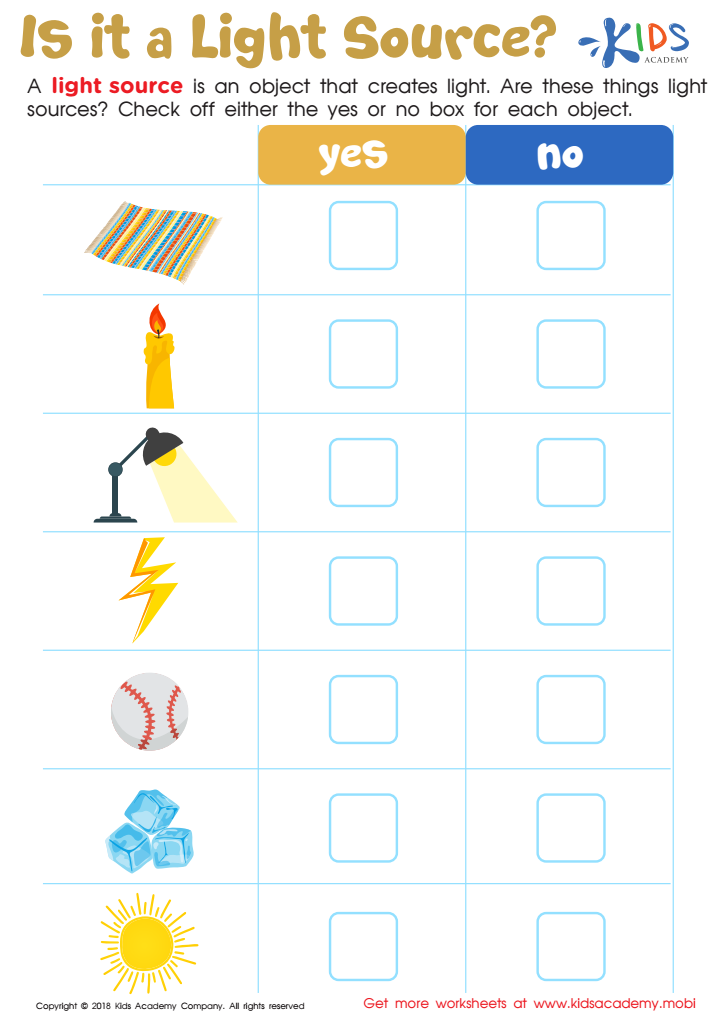
Is It a Light Source? Worksheet
This worksheet is a fun way to teach kids about light sources. Children must identify natural sources like the sun and lightning, and man-made sources such as candles and lamps. Ask them to look at each object and check the box to indicate if it's a light source or not.
 Assign to My Students
Is It a Light Source? Worksheet
Worksheet
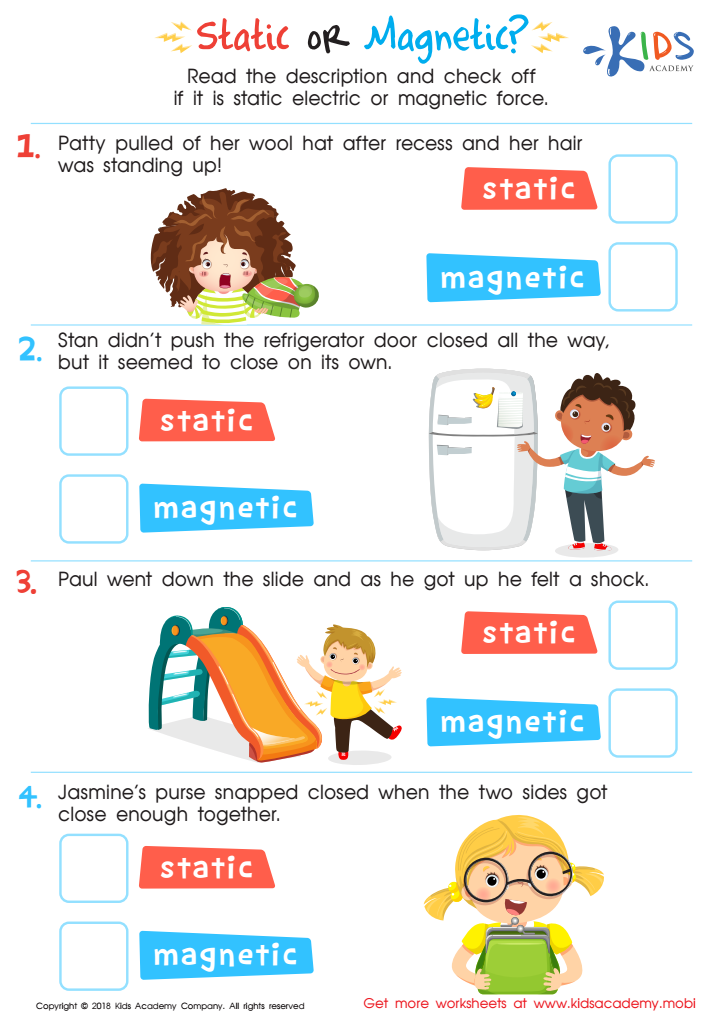
Static or Magnetic Printable Worksheet
Ever wondered if a situation involved static or magnetic force? This printable worksheet has the answer! Read the scenarios and check out the illustrations to decide which force is in play for each. Learn about these two amazing forces with this fun activity!
Static or Magnetic Printable Worksheet
Worksheet
Join Kids Academy for Free
Who is primarily going to use this learning content?







Basic science knowledge is crucial for children aged 7-8 as it forms the foundation for critical thinking and problem-solving skills essential for their future learning. At this age, children are naturally curious and have a high capacity for absorbing new information. Introducing them to basic science concepts not only satisfies their curiosity but also encourages a lifelong passion for learning.
Understanding basic science helps children make sense of the world around them. For instance, learning why plants grow and why the sky is blue can foster a deeper appreciation for nature and the environment. This knowledge also enables children to ask questions, hypothesize, and seek evidence-based answers, skills that are invaluable beyond the classroom.
Additionally, early exposure to science strengthens foundational skills in other areas, such as mathematics and literacy. Science activities often involve counting, measuring, reading, and writing, thereby integrating various subjects and enhancing overall academic performance.
For parents, supporting their child's scientific education nurtures their development and opens up opportunities for shared activities that strengthen familial bonds. For teachers, it means actively engaging students with hands-on experiments and interactive lessons that make learning fun. Ultimately, cultivating an interest in science at an early age sets children on a path of exploration and continuous discovery, crucial for personal and intellectual growth.








