Comparing weights Worksheets for Ages 7-8
3 filtered results
-
From - To
Introducing "Comparing Weights Worksheets for Ages 7-8" from Kids Academy! These engaging printables are designed to help young learners develop essential math and science skills by comparing the weights of different objects. Through a variety of fun activities and exercises, children will learn how to use scales, understand balance, and grasp the concept of heavier and lighter. Each worksheet promotes critical thinking and problem-solving, making learning interactive and enjoyable. Perfect for classroom use or at-home practice, these worksheets are an excellent resource for enhancing your child's understanding of measurement concepts and their applications in everyday life.
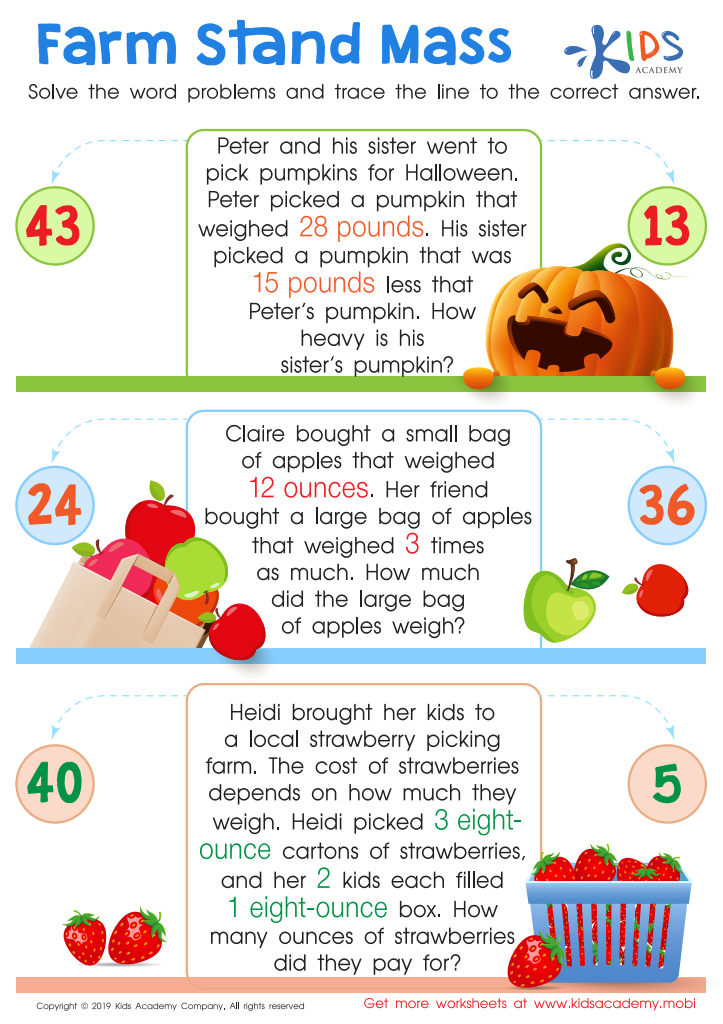
Farm Stand Mass Worksheet
 Assign to My Students
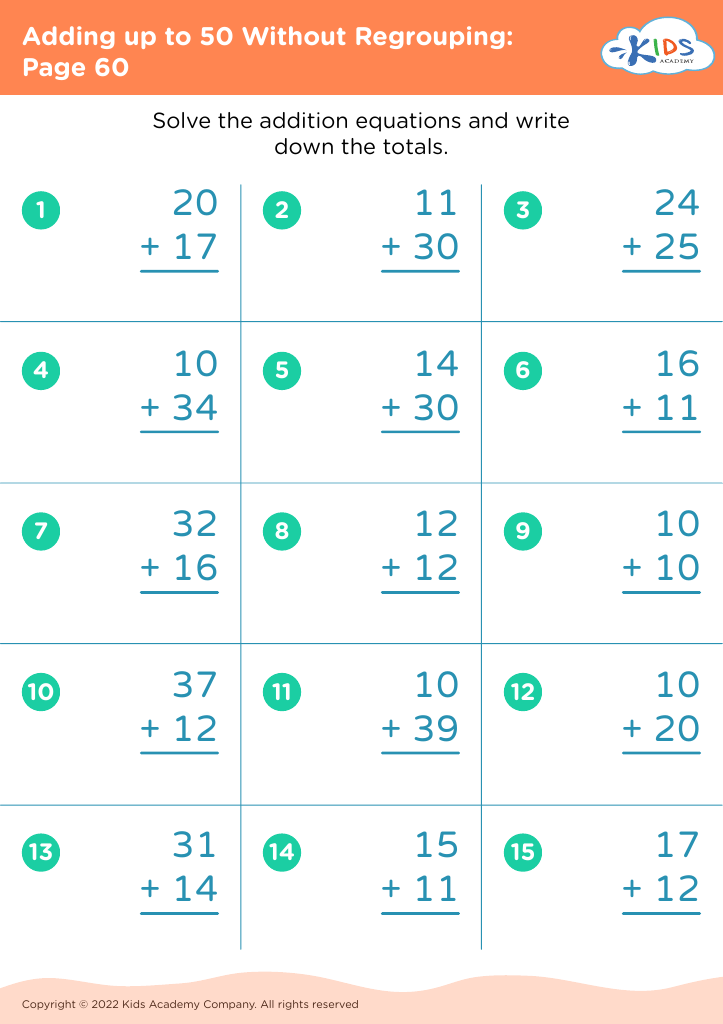
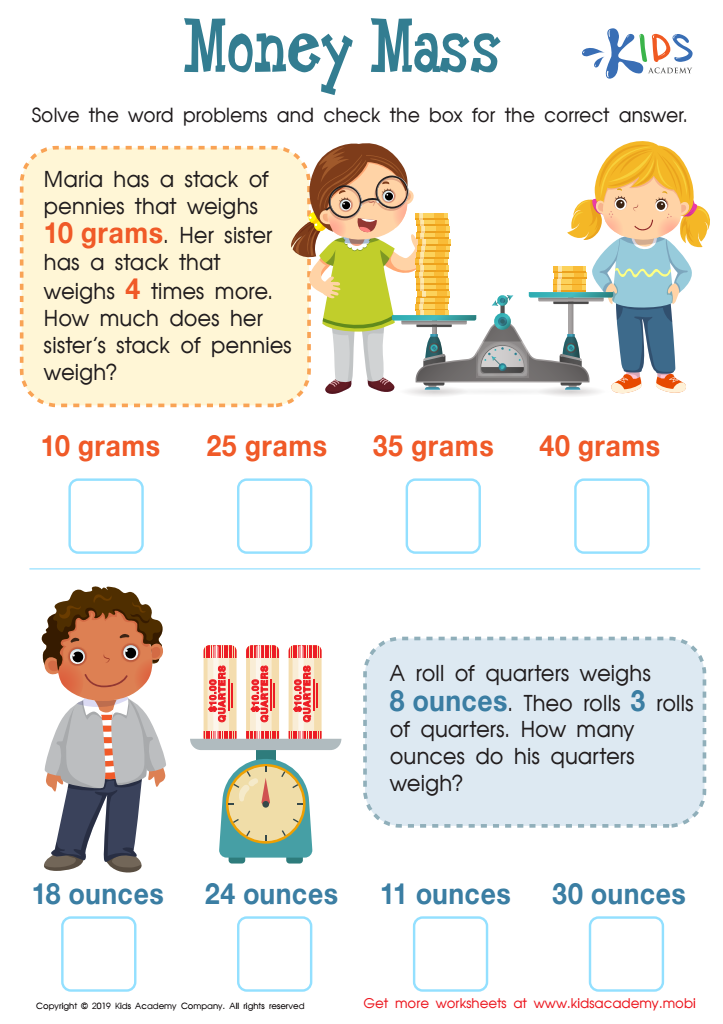
Money Mass Worksheet






Teaching children aged 7-8 about comparing weights is essential for several reasons, and parents and teachers play a crucial role in this educational phase. First, understanding weights is a practical life skill. Children encounter various objects daily, and discerning heavier from lighter items helps them make sense of their world and operate more independently, such as when packing a school bag or helping with groceries.
Secondly, comparing weights bolsters mathematical and scientific thinking. Recognizing, comparing, and contrasting weights nurtures critical thinking and problem-solving skills. These activities lay the groundwork for understanding more complex concepts in subjects like physics and engineering later on.
Moreover, engaging in hands-on activities that involve weights, such as using balances and scales, can boost children's fine motor skills and spatial awareness. Real-world applications help ground abstract concepts, making learning more engaging and meaningful.
Finally, discussing weights can improve language and communication skills. As students describe their observations and engage in discussions, they expand their vocabulary and learn to articulate their reasoning clearly.
In summary, introducing weight comparison exercises encourages cognitive development, practical skills, and academic growth, making it a fundamental topic for young learners to grasp under the thoughtful guidance of parents and teachers.








