
Mathematical thinking Worksheets for Ages 7-8
4 filtered results
Difficulty Level
Grade
Age
-
From - To
Subject
Activity
Standards
Unlock the power of problem-solving with our Mathematical Thinking Worksheets designed for ages 7-8. Curated to spark curiosity and boost analytical skills, each worksheet engages young learners in fun and challenging exercises that develop critical thinking. From pattern recognition to logical reasoning, your child will explore diverse mathematical concepts in an interactive way. Perfect for classroom use or homeschooling, these worksheets not only enrich math understanding but also foster a love for exploring new ideas. Empower your child's math journey with engaging activities that make learning both effective and enjoyable. Try Kids Academy today for endless learning adventures!
Favorites
With answer key
Interactive
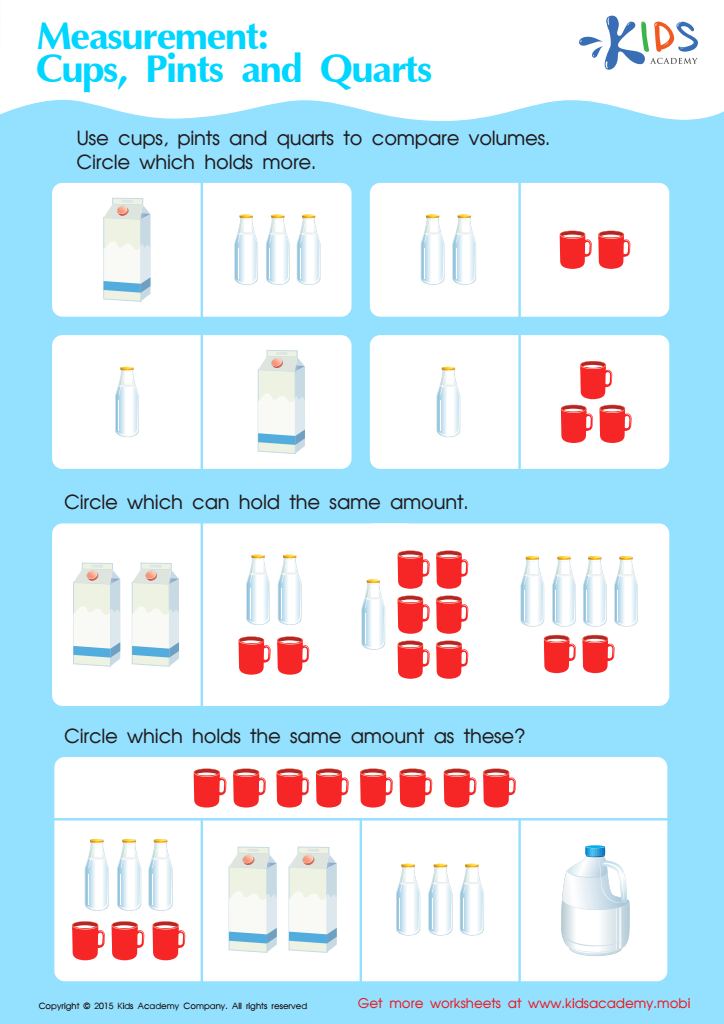
Measurement: Compare Volumes Worksheet
Compare volumes with Kids Academy and have fun! (80 words)
Practice measuring with Kids Academy and have fun! Compare volumes in pictures and circle which holds more. Keep learning with free math worksheets available on our website. Enjoy the process and have fun!
 Assign to My Students
Measurement: Compare Volumes Worksheet
Worksheet
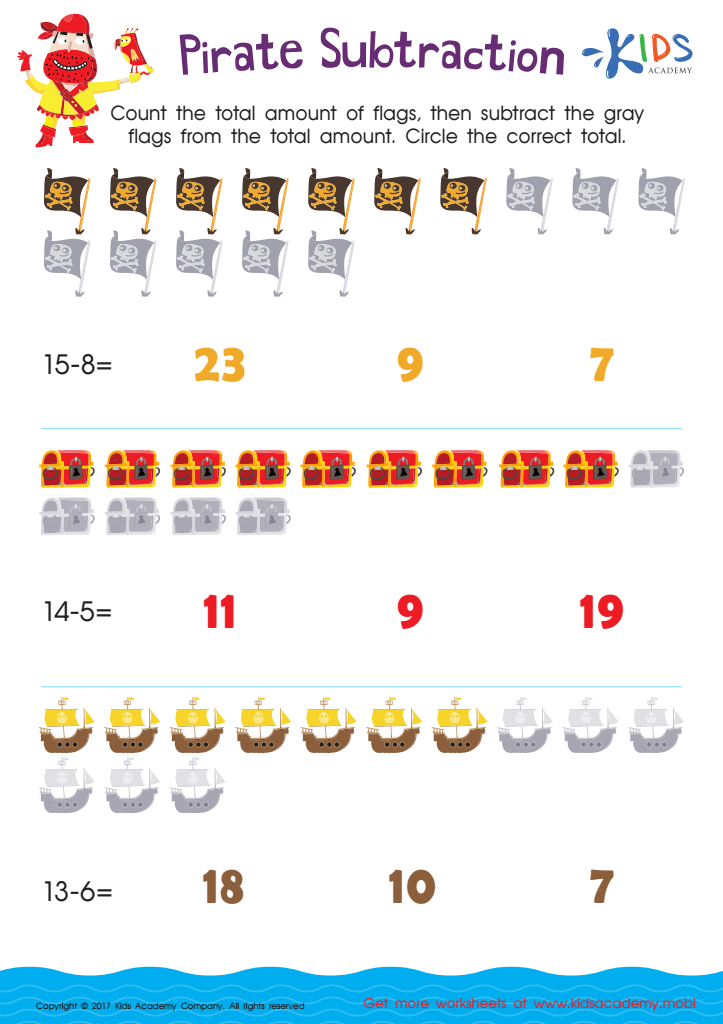
Pirate Subtraction Substraction Worksheet
Ahoy! Learn to subtract with pirate-themed math fun! This worksheet has ships and treasure chests to help your little one understand subtraction using a helpful strategy. Colorful illustrations make it a great learning experience.
Pirate Subtraction Substraction Worksheet
Worksheet
Join Kids Academy for Free
Who is primarily going to use this learning content?







.jpg)
Mathematical thinking is pivotal for children aged 7-8 as it lays the foundation for future learning in all STEM (Science, Technology, Engineering, and Mathematics) disciplines. At this developmental stage, children's cognitive abilities are expanding, allowing them to grasp abstract concepts, reason logically, and solve problems effectively. By nurturing mathematical thinking, parents and teachers help students develop critical problem-solving skills that are essential both in academics and in real-world situations.
Furthermore, fostering mathematical skills in early years encourages a positive relationship with the subject, reducing math anxiety and building confidence. It teaches children to identify patterns, engage in logical reasoning, and approach problems systematically. These abilities are not just limited to math but also enhance cognitive processes required in other subjects, promoting overall academic success.
In addition, early mathematical competence is correlated with higher achievement later in life. Students who develop strong math skills at a young age are often better equipped to tackle complex subjects as they progress through school. Thus, emphasizing mathematical thinking at ages 7-8 can have long-term benefits, giving children the tools they need to excel in a world that values analytical and quantitative skills. Investing in mathematical education today sets the stage for a brighter, more capable future generation.








