Problem solving enhancement Worksheets for Ages 7-8
3 filtered results
-
From - To
Boost your child's critical thinking skills with our "Problem Solving Enhancement Worksheets" designed specifically for ages 7-8. These fun and engaging worksheets encourage young learners to tackle various challenges, promoting logical reasoning, creativity, and confidence. Each activity is thoughtfully crafted to stimulate cognitive development through engaging puzzles, riddles, and real-life problems that children will enjoy solving. As they work through these exercises, kids will learn to break down complex tasks, develop strategic approaches, and think outside the box. Perfect for enhancing classroom learning or for use at home, our worksheets make problem solving an exciting adventure for your young learners!
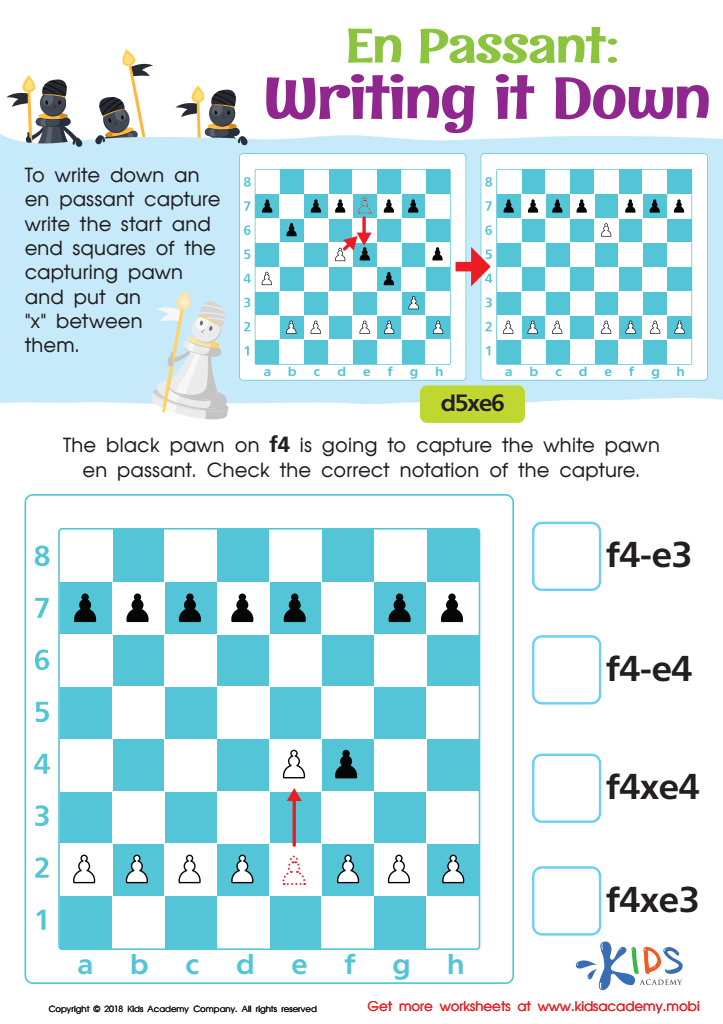
En Passant: Writing it Down Worksheet
 Assign to My Students

Notation of Checkmate Worksheet








Problem-solving skills are essential for children aged 7-8 as they lay the foundation for critical thinking, creativity, and adaptability throughout their education and life. At this developmental stage, children are ready to tackle more complex tasks, and enhancing their problem-solving abilities equips them with the tools to navigate challenges confidently.
Parents and teachers play a crucial role in nurturing these skills. Engaging children in problem-solving activities fosters logical reasoning, encourages exploration, and promotes resilience when facing obstacles. These experiences teach children to analyze situations, identify possible solutions, and evaluate outcomes, essential skills in academics and everyday life.
Moreover, improved problem-solving capabilities contribute to better performance in subjects like mathematics and science, where logical reasoning is key. Teachers can integrate hands-on activities, collaborative projects, and games that challenge students to think critically and creatively. Parents can reinforce these skills at home through puzzles, real-life problem scenarios, and supportive discussions.
Ultimately, investing in problem-solving enhancement not only boosts children’s academic success but also instills confidence and independence. By prioritizing this crucial area of development, parents and teachers help cultivate lifelong learners who are prepared to meet the complexities of the world head-on.








