Simplifying Fractions Adding up to 1000 with Regrouping Worksheets for Ages 7-8
3 filtered results
-
From - To
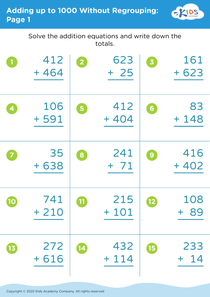
Welcome to our "Simplifying Fractions Adding Up to 1000 with Regrouping Worksheets" designed specifically for ages 7-8! These engaging worksheets help young learners grasp essential math concepts by breaking down fractions in an interactive and fun way. With a focus on simplifying fractions and adding numbers up to 1000, children will enhance their problem-solving and critical thinking skills. Each worksheet offers clear instructions and visual aids, making it easy for educators and parents to support effective learning at home or in the classroom. Encourage your child to master fractions and develop their math confidence today with these dynamic resources!
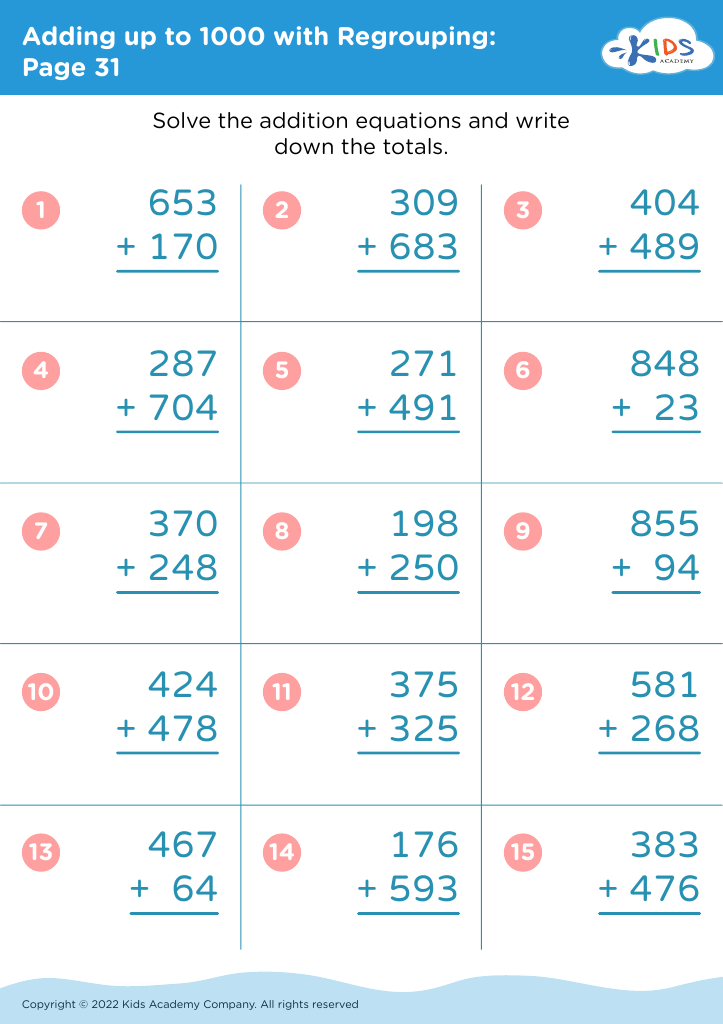
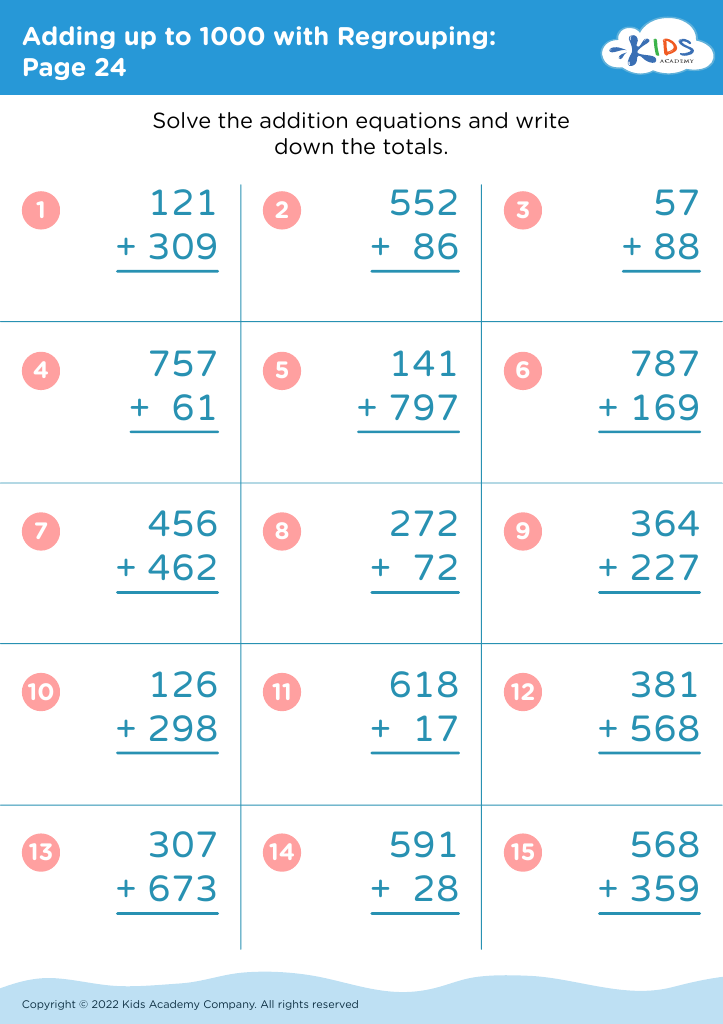
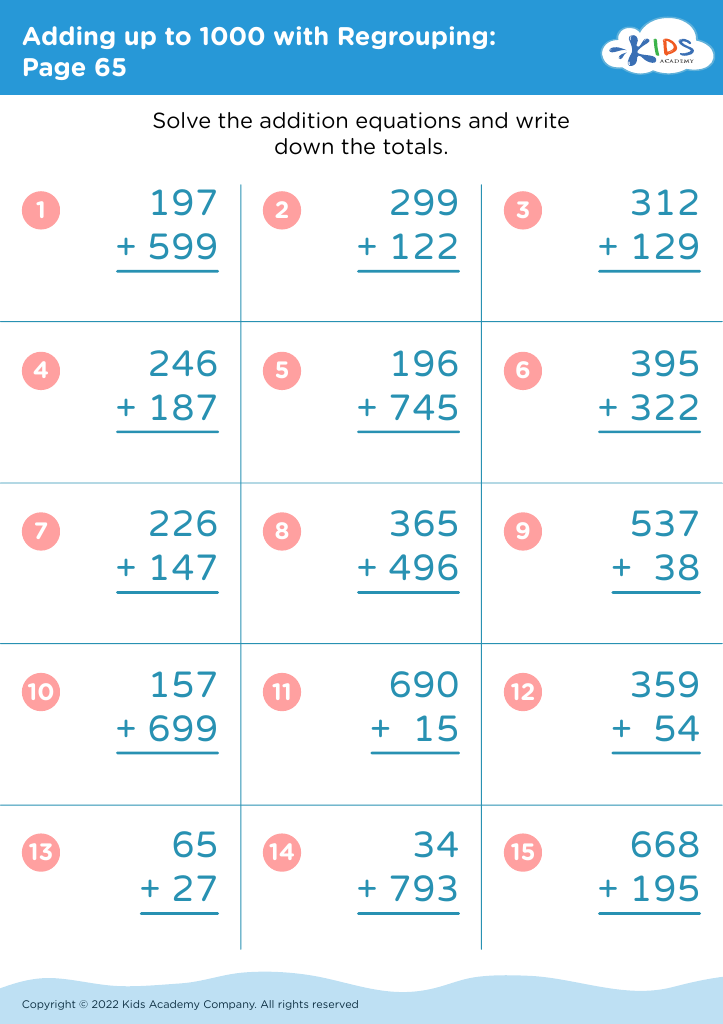


Simplifying fractions and understanding the concept of regrouping are foundational skills that significantly enhance mathematical comprehension for children aged 7-8. Teaching kids to simplify fractions helps them recognize relationships between numbers, builds number sense, and encourages critical thinking. Simplification makes complex problems more manageable, fostering a sense of achievement as children learn to navigate mathematical challenges with greater ease.
Additionally, when children learn to add fractions that total 1000 through regrouping, they engage in an important cognitive process that promotes flexibility in thinking. This approach not only reinforces their understanding of place value but also improves their computational skills, crucial for their future academic success. Mastery of these concepts also prepares students for more advanced mathematical operations in higher grades, as they become proficient in grouping and regrouping values.
Moreover, these skills encourage collaboration in the classroom as children work together to solve problems, enhancing their communication skills and ability to explain their thinking. By prioritizing the teaching of simplifying fractions and regrouping, parents and teachers play a vital role in building confident, competent mathematicians who are prepared for both academic and real-world problem-solving. Thus, fostering these skills is essential for developing a robust mathematical foundation.