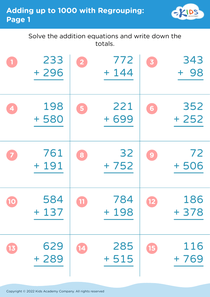
Counting practice Adding up to 1000 Without Regrouping Worksheets for Ages 7-8
4 filtered results
-
From - To
Enhance your child’s arithmetic skills with our Counting Practice Adding up to 1000 Without Regrouping worksheets designed for ages 7-8. These engaging worksheets help young learners practice addition efficiently, building their confidence and number sense. By focusing on sums up to 1000 without the complexity of regrouping, children master essential math skills in a straightforward, easy-to-follow format. Perfect for home or classroom use, each worksheet is crafted to boost accuracy and speed in addition. Foster a love for math in your child with Kids Academy’s enriching and educational materials. Start practicing today and watch their math skills soar!
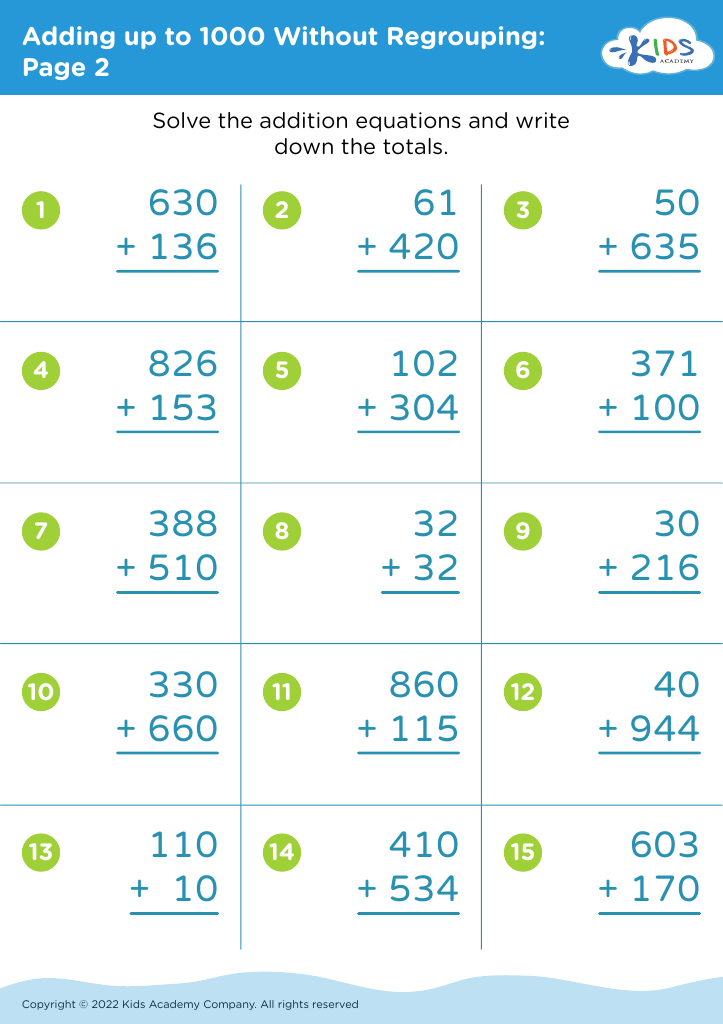
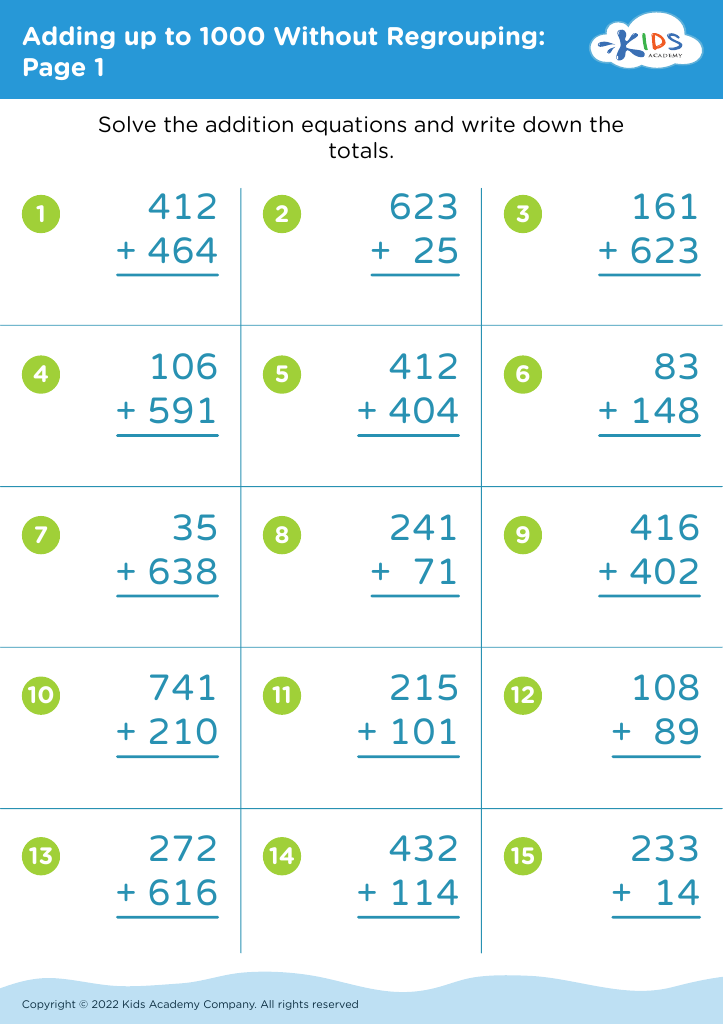
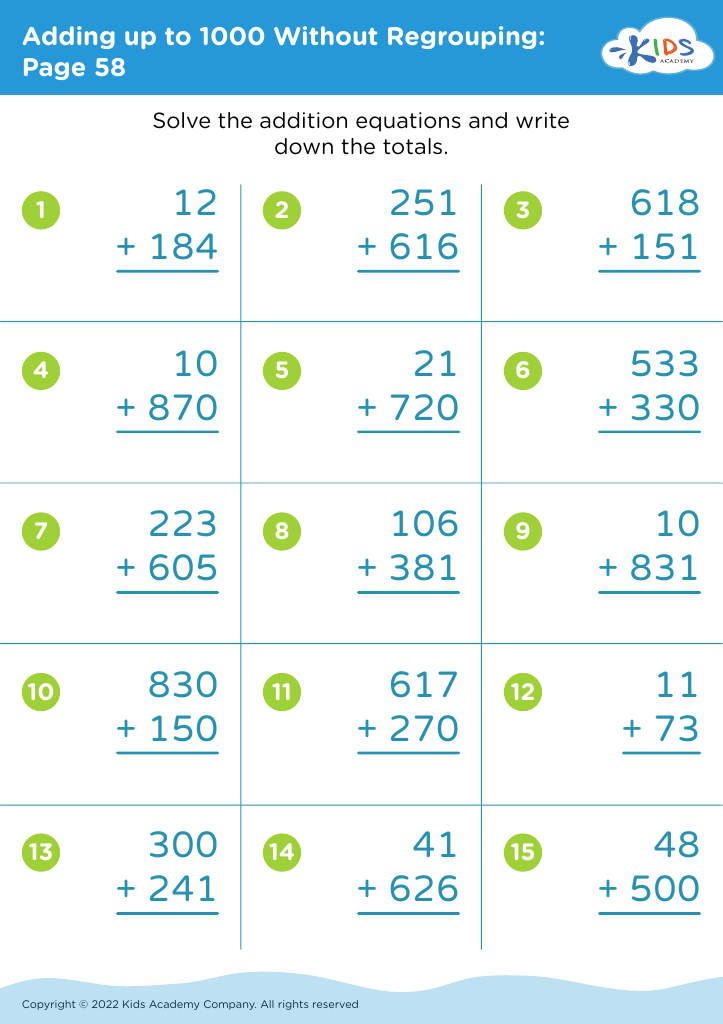
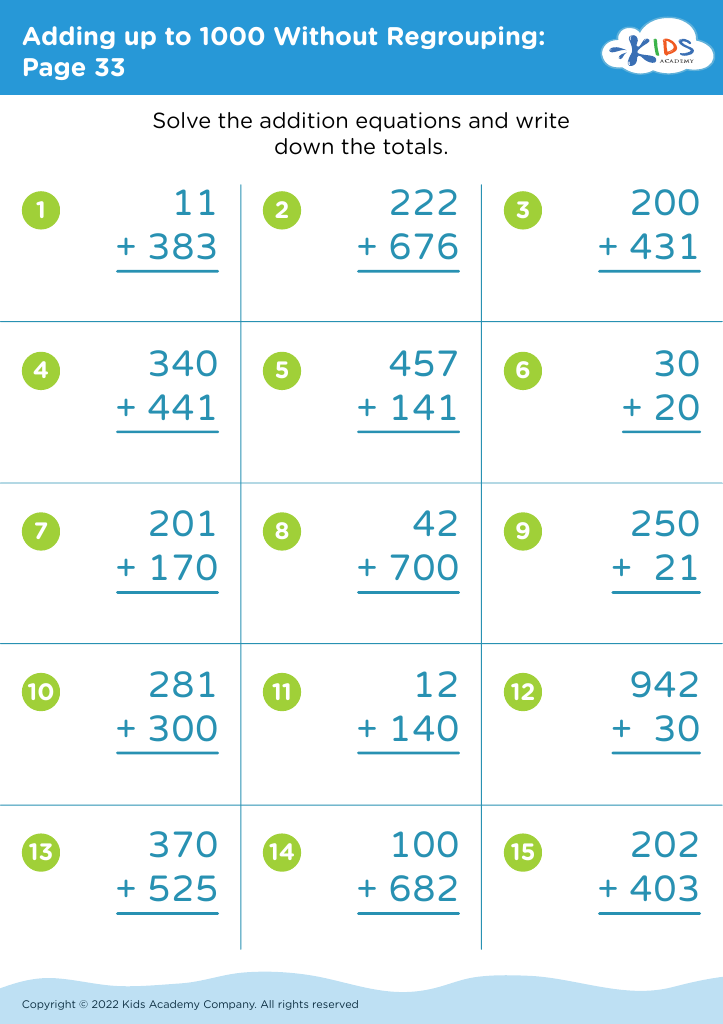


Parents and teachers should prioritize counting practice and adding up to 1000 without regrouping for children ages 7-8 because at this developmental stage, foundational math skills are critical for future academic success. At this age, building a solid understanding of place value, number sense, and basic arithmetic operations helps to form the cognitive underpinnings needed for more advanced mathematics.
Counting and adding up to 1000 without regrouping allows children to become comfortable with large numbers and boosts their confidence in handling more complex calculations. It serves as a bridge between simple addition and more advanced problems that include regrouping (i.e., carrying over digits). Developing these skills early ensures children can efficiently execute operations without hesitation.
Additionally, mastering these concepts enhances problem-solving skills and logical thinking. When children succeed in adding large numbers, they are more prepared for subsequent math topics such as subtraction, multiplication, and division. It also encourages the development of mental math abilities, which are useful in everyday situations.
Moreover, a confident grasp of math at an early age can foster a positive attitude toward the subject, reducing anxiety and stress in the long term. Parents and teachers need to enable children to practice these skills consistently, thereby creating a strong mathematical foundation for their future learning journey.