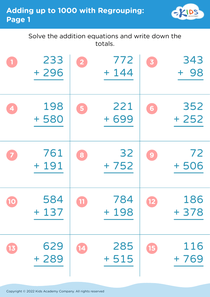
Develop counting skills Adding up to 1000 Without Regrouping Worksheets for Ages 7-8
3 filtered results
-
From - To
Enhance your child's mathematical abilities with our "Adding Up to 1000 Without Regrouping Worksheets" tailored for ages 7-8. These engaging worksheets focus on developing strong counting skills while helping kids master addition within the 1000 range without the need for regrouping. Designed to provide a solid foundation in mathematics, our resources offer diverse exercises that encourage problem-solving and mental math practice. With colorful visuals and interactive challenges, your child will build confidence and fluency in addition. Explore our collection today and support your young learner in achieving numerical proficiency, setting them up for success in future math concepts!
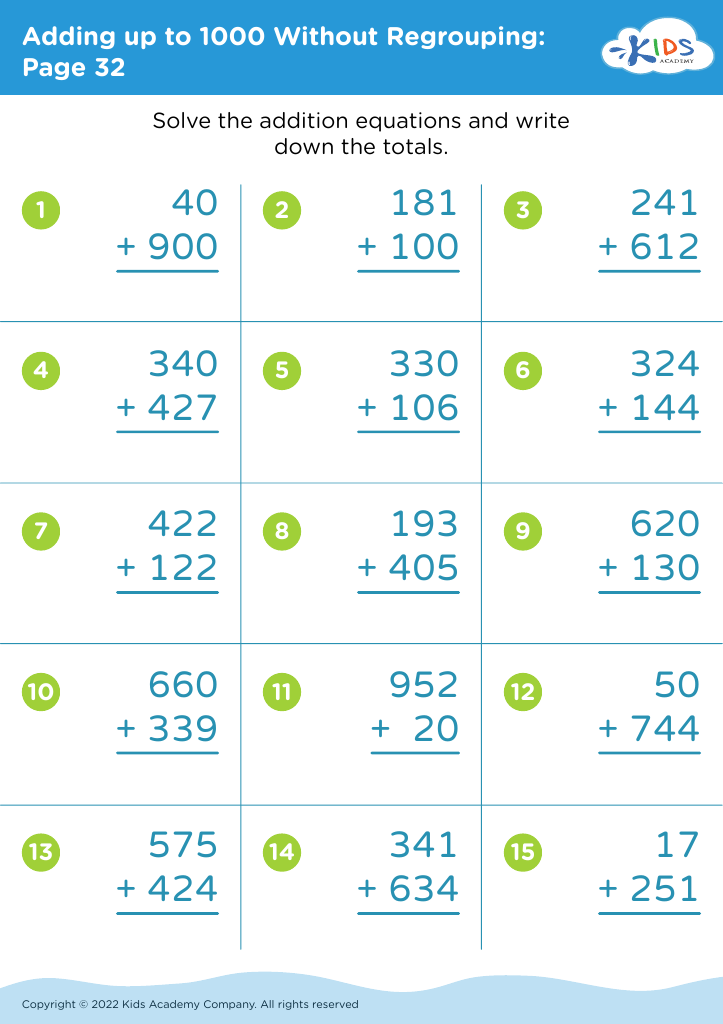
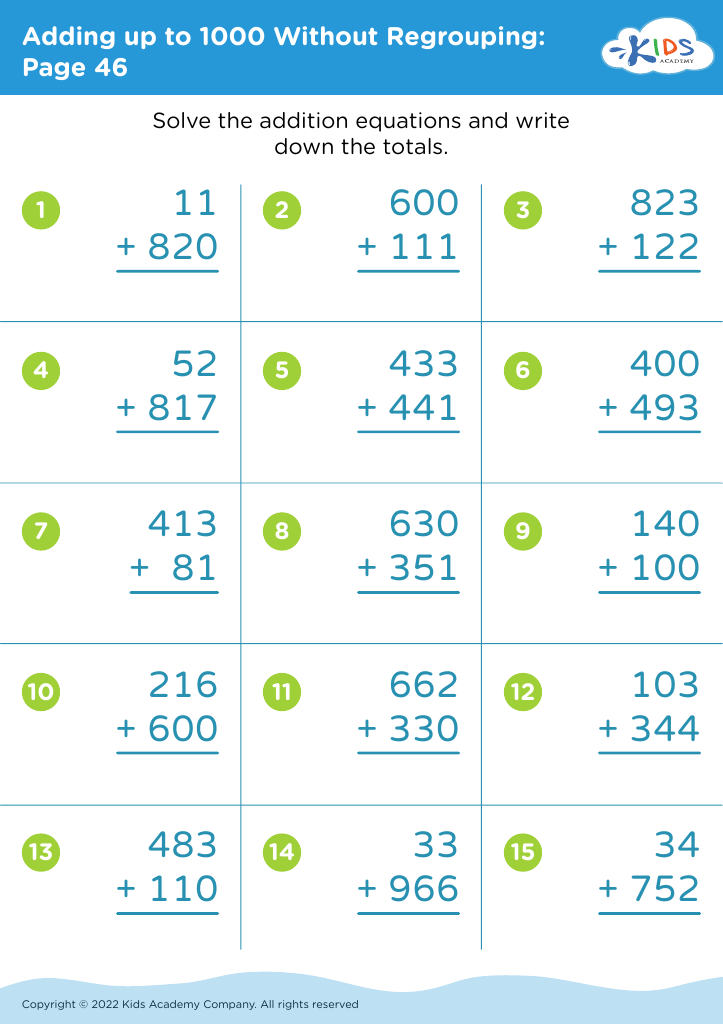
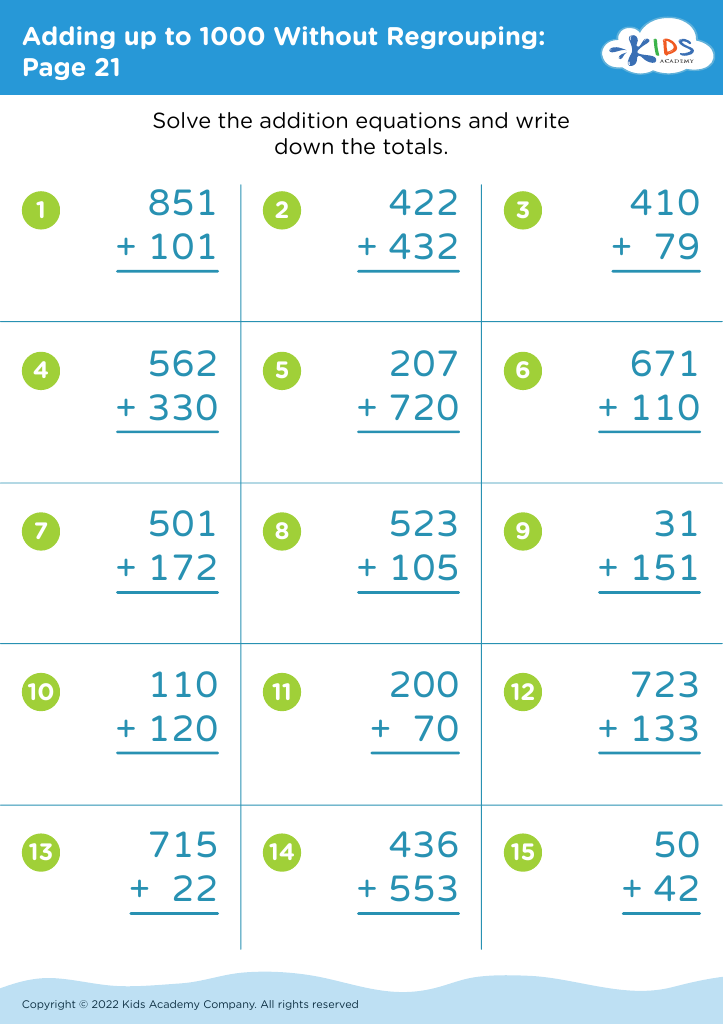


Developing counting skills, particularly those focused on adding up to 1000 without regrouping, is crucial for children aged 7-8. At this stage, children are refining their understanding of numbers and becoming more confident in their mathematical abilities. Mastering addition up to 1000 helps them build a solid foundation for future mathematical concepts, paving the way for more complex operations such as subtraction, multiplication, and even division.
Encouraging children to add without regrouping reinforces their ability to visualize and manipulate numbers, enhancing their mental math skills. This fosters independence, confidence, and a positive attitude toward mathematics. Moreover, these skills support other subjects, as math is integrated into science, art, and everyday problem-solving.
For parents and teachers, promoting these skills sparks enthusiasm for learning and creates opportunities for engaging, hands-on activities, such as math games and real-life applications. Recognizing the importance of counting and addition in everyday life—be it calculating change, measuring ingredients for a recipe, or timing events—helps children understand the relevance of what they learn. Overall, nurturing counting skills equips students with essential tools for academic success and instills lifelong confidence in their math abilities.