Improving math skills Adding up to 1000 Without Regrouping Worksheets for Ages 7-8
3 filtered results
-
From - To
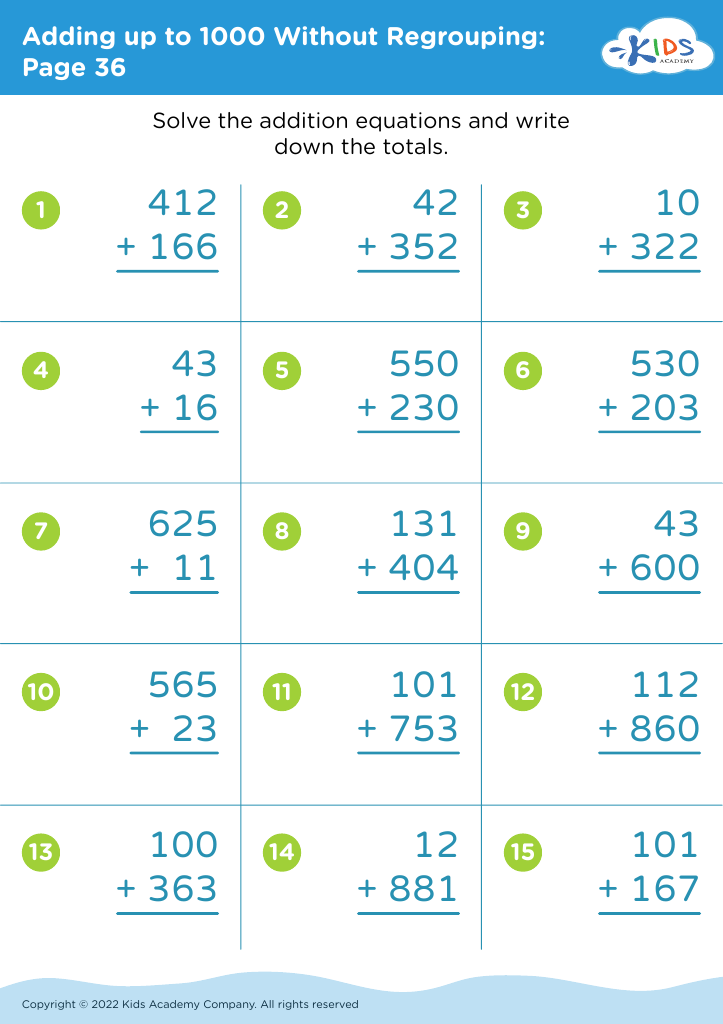
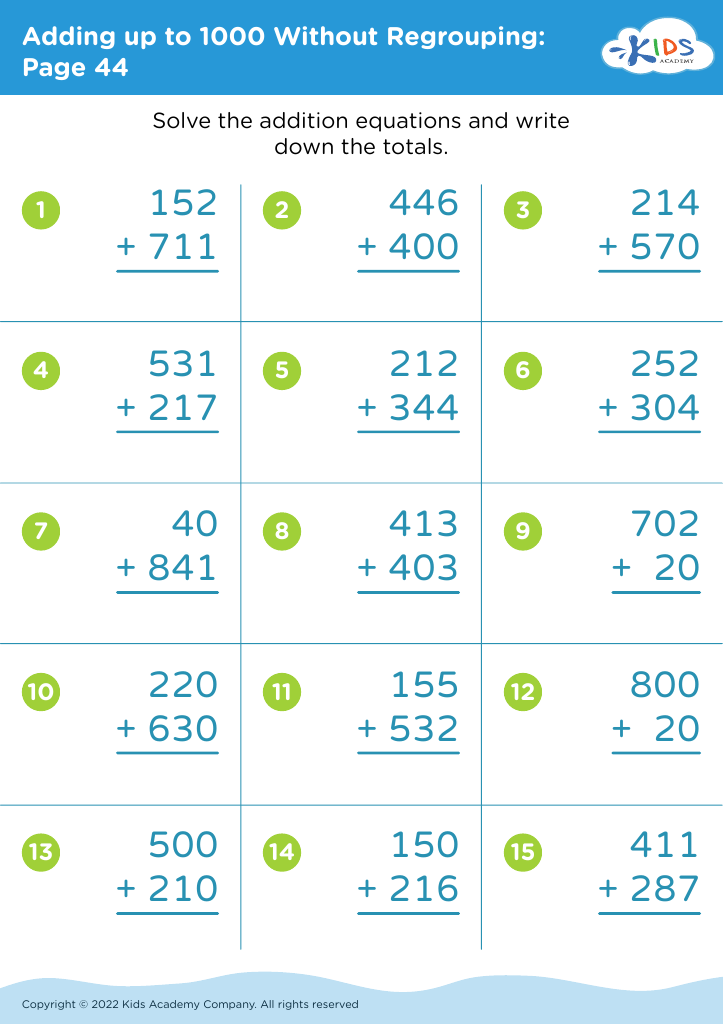
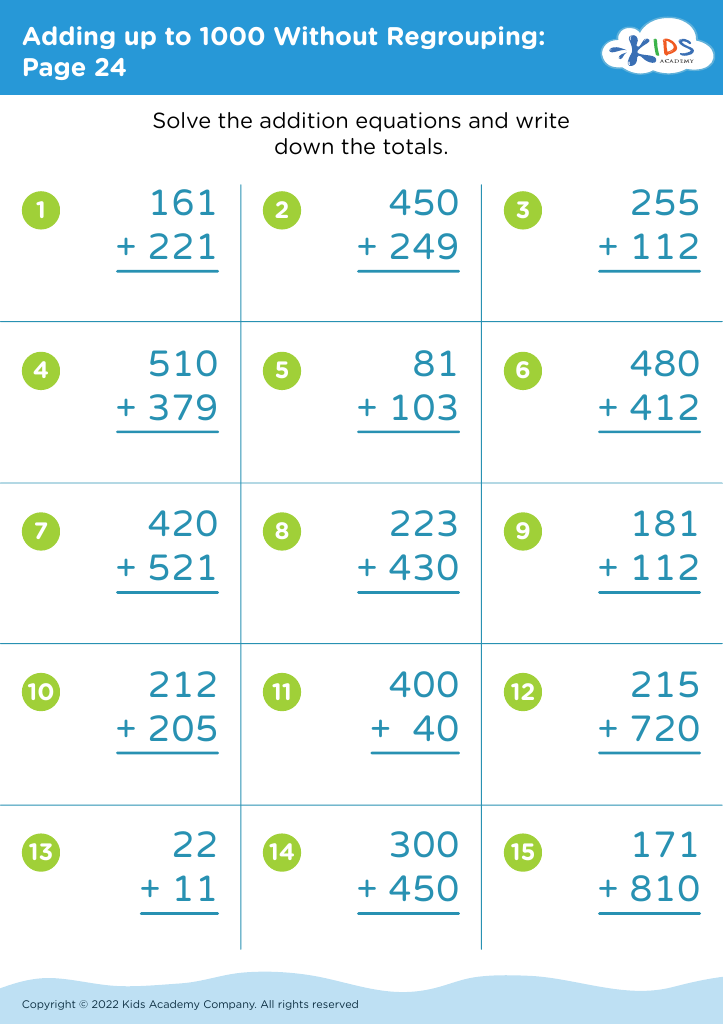
Discover our "Improving Math Skills: Adding Up to 1000 Without Regrouping" worksheets designed for children aged 7-8. These engaging, curriculum-aligned worksheets help young learners strengthen their addition skills by focusing on sums up to 1000 without needing to regroup. Derived from effective teaching methods, each worksheet encourages independent problem-solving while building foundational math knowledge. Our resources are visually appealing and provide abundant practice opportunities, ensuring a thorough understanding of addition concepts. Perfect for classroom use or at-home learning, these worksheets foster confidence in math skills, preparing students for future challenges. Start enhancing your child's mathematical journey today!


Improving math skills like adding up to 1000 without regrouping is crucial for children aged 7-8 for several reasons. Firstly, this foundational skill supports overall numeracy, enhancing children's confidence in handling larger numbers and mental math operations. Mastery of addition at this stage not only reinforces the concept of number sense but also prepares them for more complex mathematical operations in the future, such as multiplication and addition of larger sums.
Moreover, by focusing on skills that allow students to perform calculations without regrouping, parents and teachers can help children build a strong understanding of place value and number relationships. These skills can aid in developing strategies for problem-solving and foster critical thinking.
As children engage in learning these skills, they often experience increased motivation and enjoyment in math, leading to a more positive attitude toward the subject. Furthermore, a solid grasp of addition can have long-lasting effects on academic performance across various subjects, as many concepts in science, economics, and everyday life rely on numerical proficiency.
Ultimately, supporting children in improving their addition skills lays the groundwork for lifelong learning and real-world application, enabling them to navigate everyday transactions confidently.