Recognizing shapes Adding up to 1000 Without Regrouping Worksheets for Ages 7-8
3 filtered results
-
From - To
Unlock your child’s potential with our "Recognizing Shapes Adding up to 1000 Without Regrouping Worksheets," tailored for ages 7-8. These engaging worksheets help young learners master math skills by seamlessly integrating shape recognition and basic addition. Children will practice adding up to 1000 without regrouping, building confidence and accuracy. Our carefully designed exercises reinforce understanding through fun, interactive activities. Each worksheet aims to enhance critical thinking and problem-solving abilities, ensuring development in a stress-free environment. Ideal for classroom use or at-home learning, these worksheets will transform math practice into an enjoyable and productive experience.
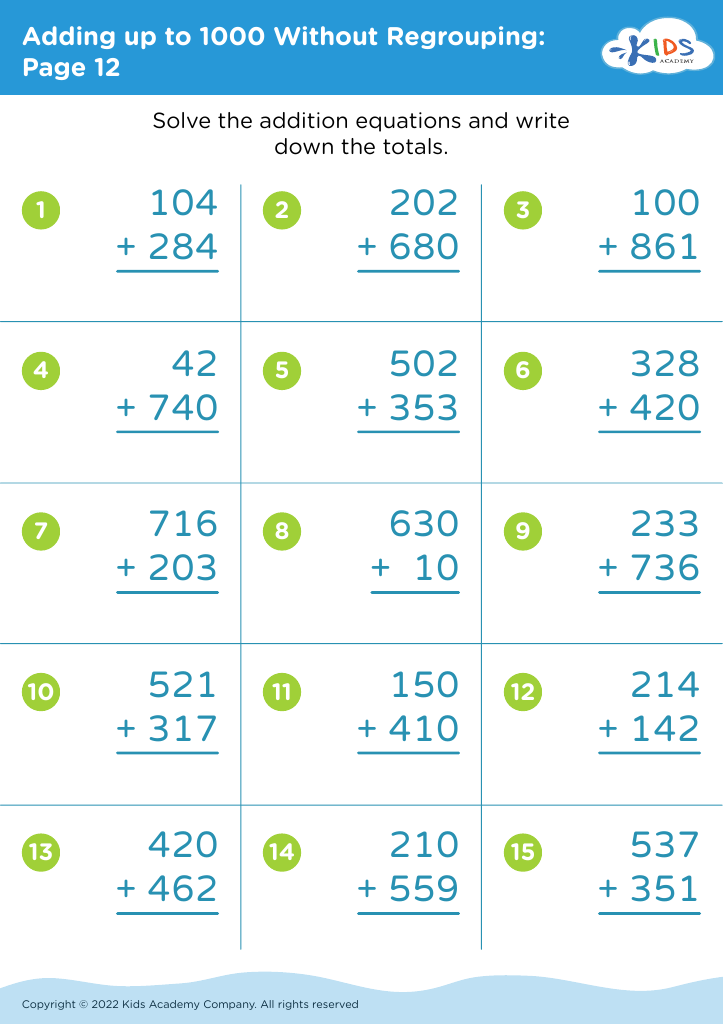
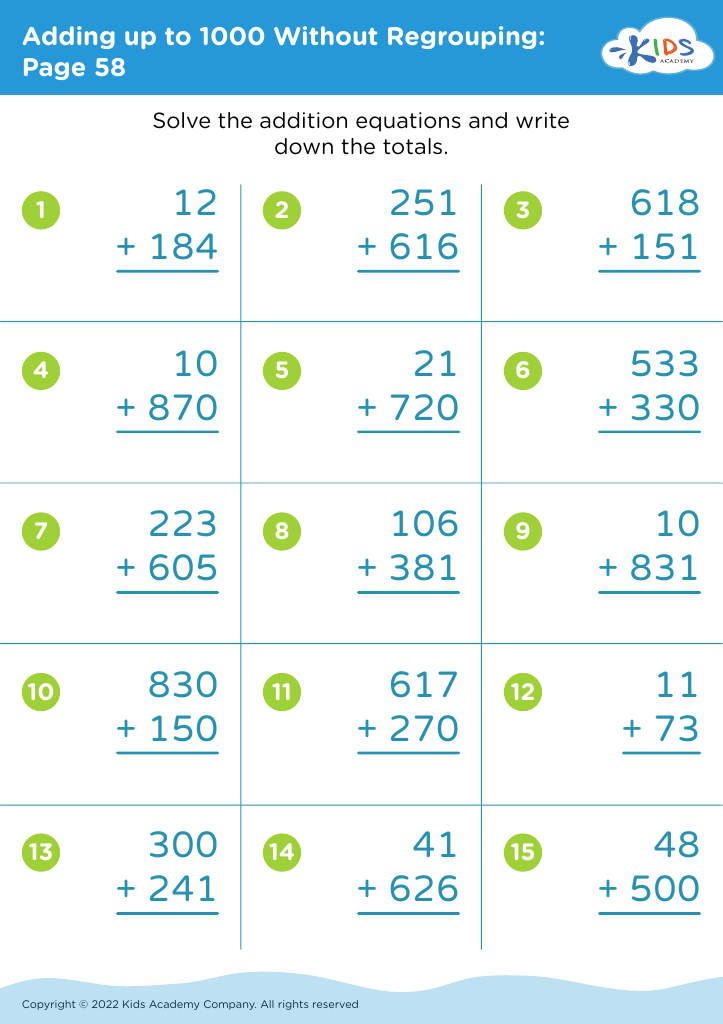
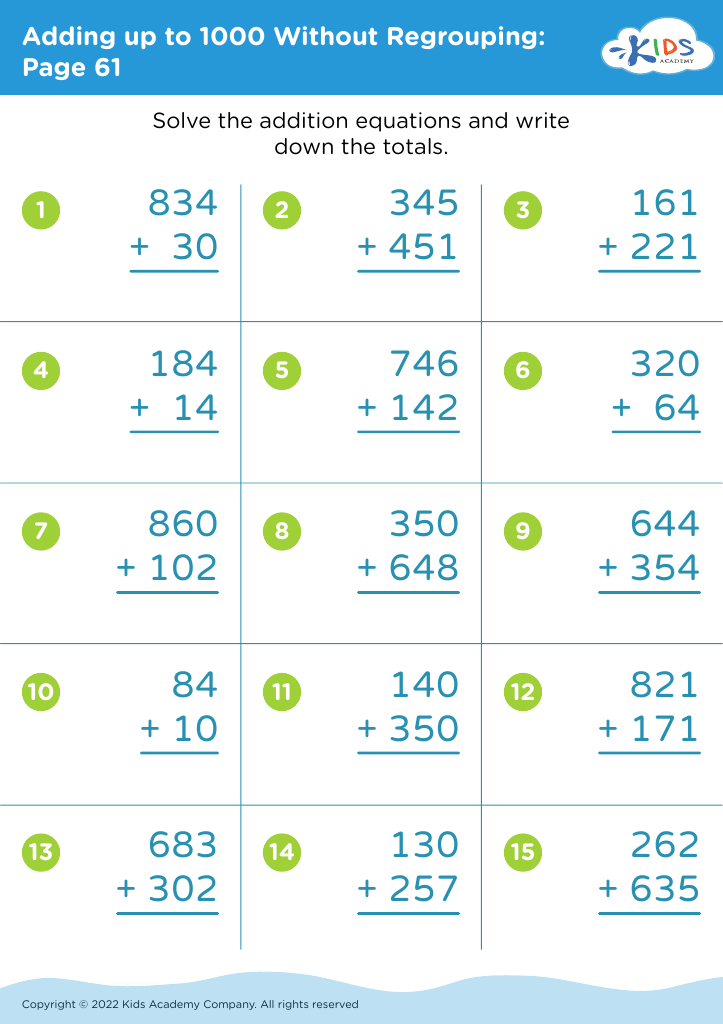


Recognizing shapes and performing arithmetic operations such as adding up to 1000 without regrouping are crucial skills for children aged 7-8 because they form the basis for understanding more complex mathematical concepts. At this developmental stage, recognizing shapes helps children improve their spatial awareness and visual perception, essential skills for problem-solving and logical reasoning across various subjects. It also aids in categorizing and understanding the world around them, which enhances their cognitive development.
Adding up to 1000 without regrouping, on the other hand, builds a strong foundation in basic numeracy skills. This practice encourages number sense, making it easier for children to estimate, measure, and understand the value of numbers. Performing these additions without regrouping ensures that students have a clear grasp of place value and subtractions, eliminating confusion in later mathematical operations.
Engaging in these activities simultaneously nurtures both the geometric and arithmetic reasoning in young minds. This holistic approach not only equips them for future academic success but also instills confidence in their ability to tackle everyday tasks involving math. Therefore, parents and teachers should prioritize these skills to foster well-rounded cognitive development and inspire a lifelong love of learning in their children.