Shape Recognition Adding up to 1000 Without Regrouping Worksheets for Ages 7-8
3 filtered results
-
From - To
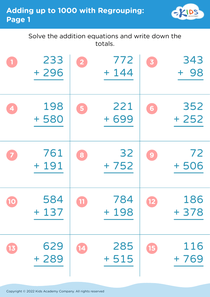
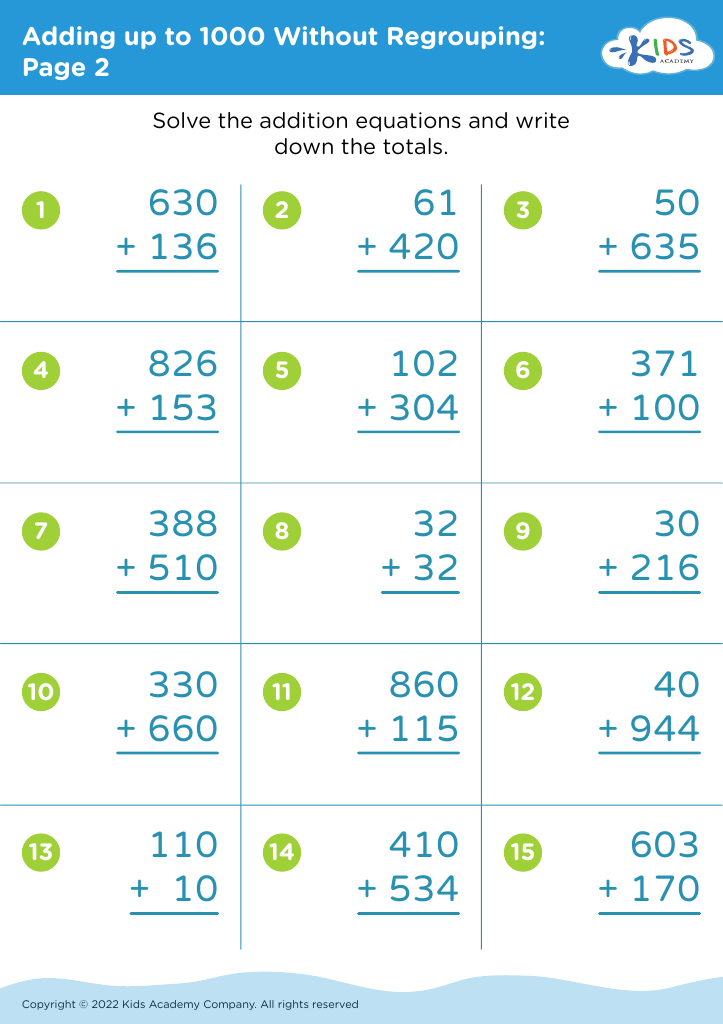
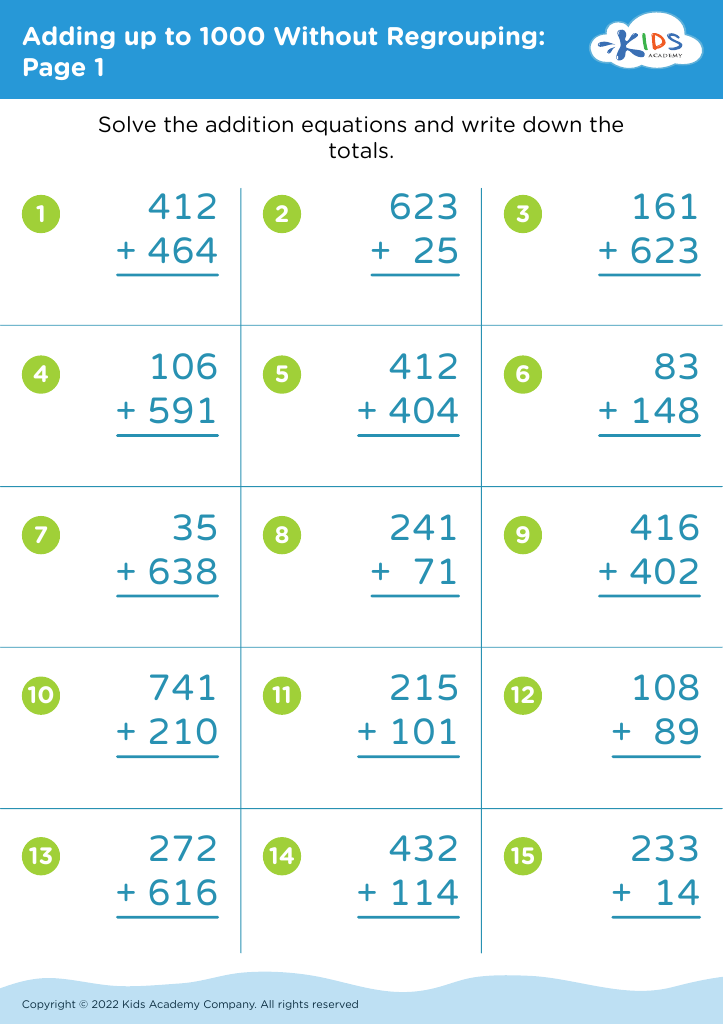
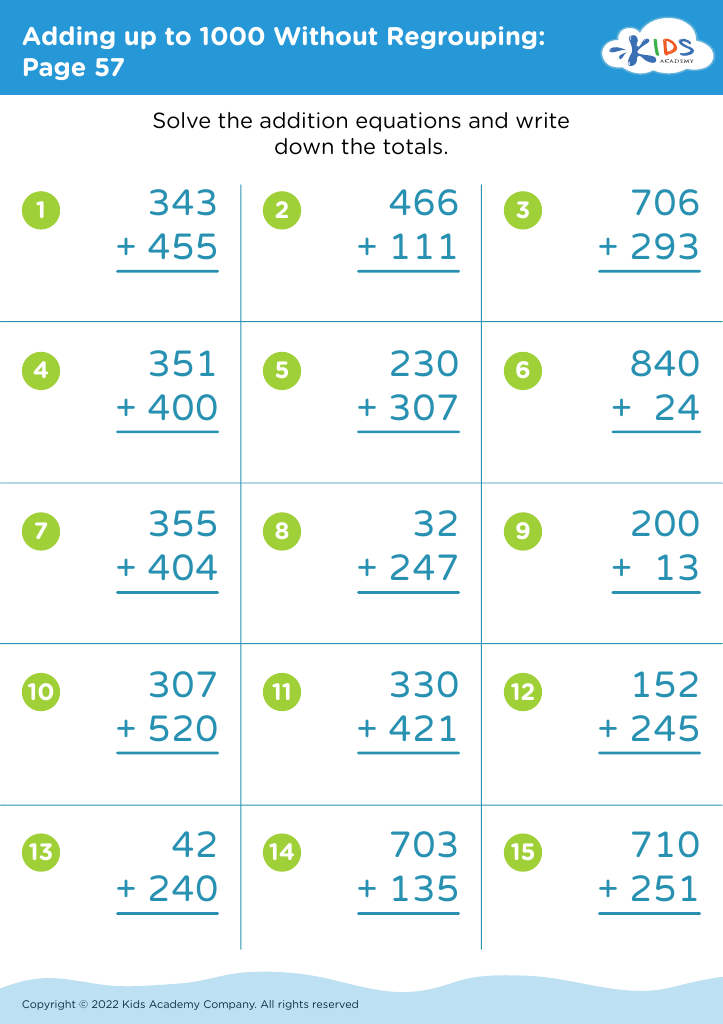
Welcome to our "Shape Recognition Adding up to 1000 Without Regrouping Worksheets" designed specifically for children ages 7-8! These engaging worksheets combine essential math skills with fun shape recognition activities, helping young learners practice adding numbers up to 1000 without regrouping. Each worksheet features interactive exercises that promote critical thinking, number sense, and spatial awareness. By integrating shapes into the addition process, students develop better problem-solving skills while gaining confidence in their mathematical abilities. Perfect for classroom or home use, our worksheets provide a fun, educational experience that strengthens foundational math skills in an enjoyable way. Start your child's learning journey today!


Shape recognition and understanding the concept of adding up to 1000 without regrouping are essential skills for children aged 7-8. These foundational concepts not only enhance children’s mathematical skills but also develop critical cognitive abilities that benefit their overall learning.
Firstly, shape recognition aids in spatial awareness and creativity. It helps children identify and categorize various geometric shapes, which forms the basis for more complex mathematical concepts in later grades. Recognizing shapes in their environment encourages observational skills, enhances problem-solving abilities, and enables them to make connections between math and the real world.
Secondly, mastering addition up to 1000 without regrouping is a vital building block for future numerical concepts. This skill fosters mental math abilities, leading to a strong understanding of numbers and arithmetic. It promotes number sense, crucial for grasping higher-level math, such as multiplication and division, making calculations faster and easier.
When parents and teachers prioritize these skills, they contribute to a solid educational foundation, fostering confidence and classroom success. Ultimately, shape recognition and addition are not just about numbers and shapes; they cultivate logical reasoning, critical thinking, and creativity that support children both inside and outside the classroom.