Develop critical thinking Adding up to 1000 Worksheets for Ages 7-8
3 filtered results
-
From - To
Boost your child’s arithmetic prowess and cognitive skills with our "Adding up to 1000 Worksheets" designed for ages 7-8. These engaging worksheets focus on developing critical thinking while enhancing your child's addends comprehension. Through a variety of problem-solving activities, children learn to navigate adding large numbers efficiently. Each worksheet is carefully crafted to challenge young minds and promote logical reasoning, laying a robust foundation for future math success. Ideal for both school and home practice, this series turns learning into an enjoyable adventure. Watch your child’s confidence soar as they master the art of addition!
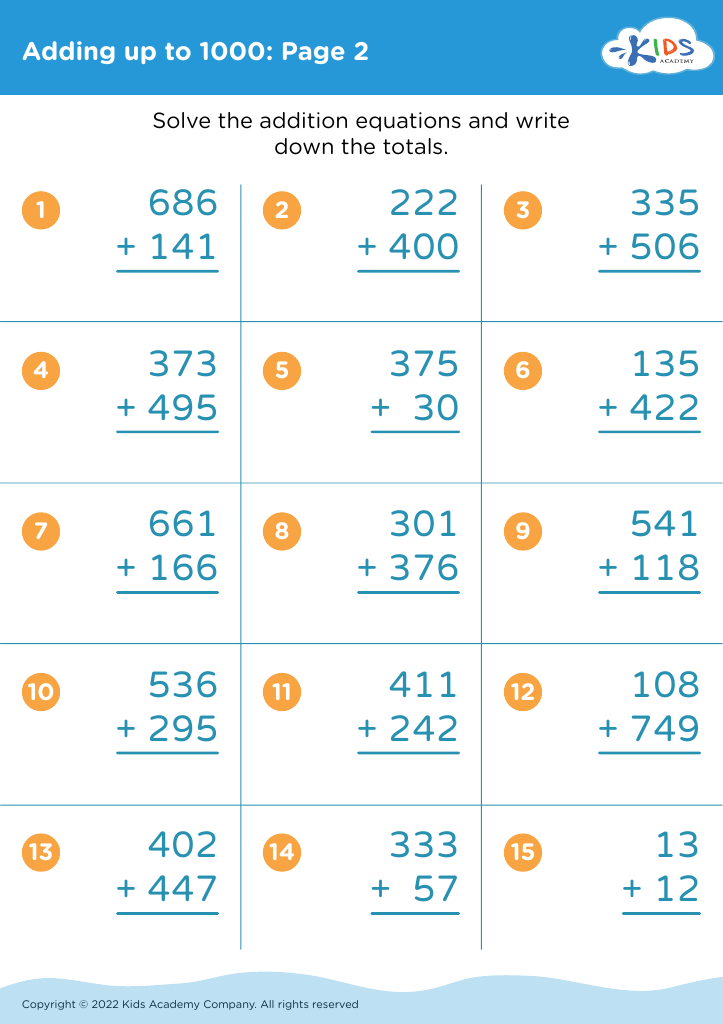
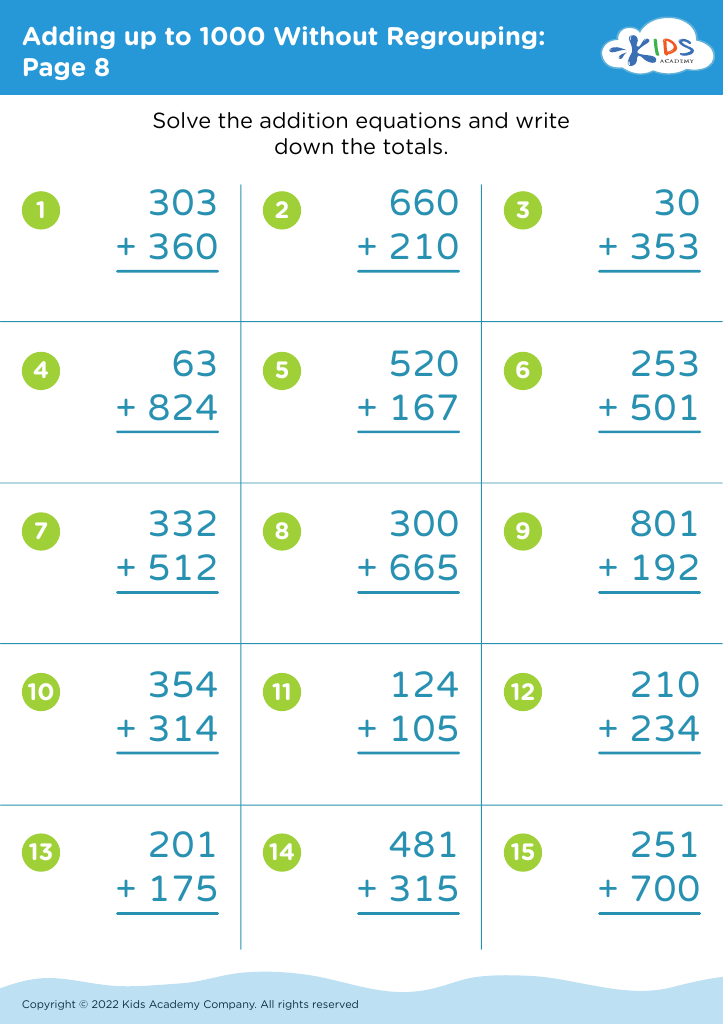
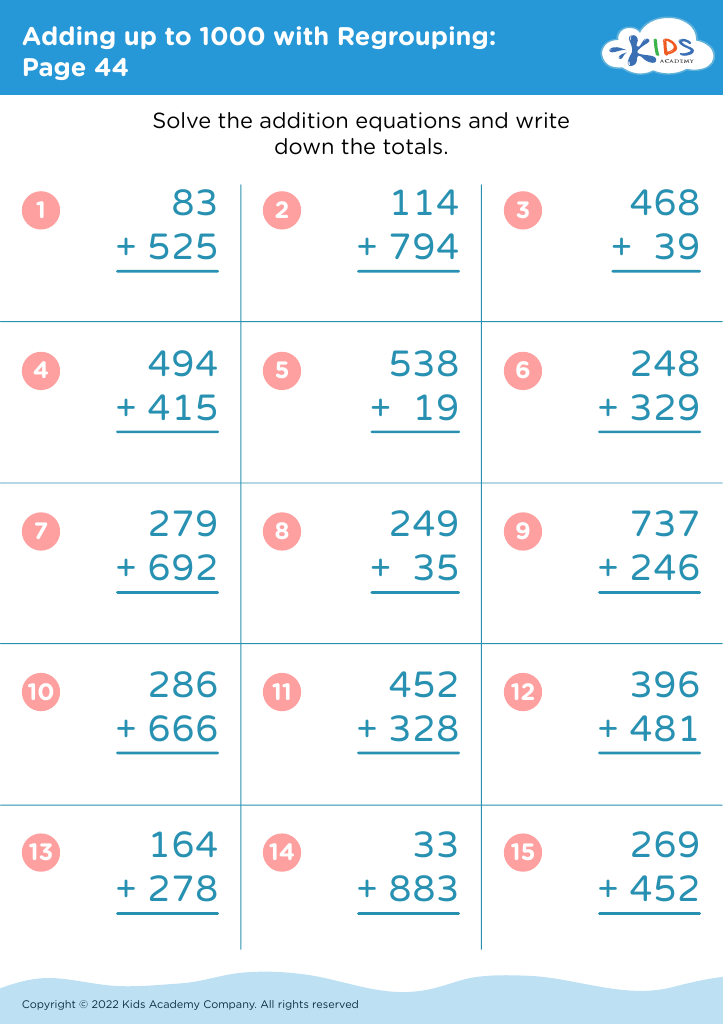



Developing critical thinking skills in children aged 7-8 is essential for their academic and personal growth. At this stage, children are naturally curious and beginning to understand more complex concepts. Guiding them to think critically helps enhance their problem-solving abilities, making them better equipped to face challenges independently. Critical thinking fosters creativity, logical reasoning, and the ability to analyze information—all crucial for academic success in subjects like mathematics, where they learn to add up to 1000.
Specifically, mastering addition up to 1000 provides a practical application of these skills. It encourages kids to recognize patterns, make connections between numbers, and apply logical steps to find solutions. Understanding how to break down large problems into smaller, more manageable parts is a vital aspect of both mathematics and critical thinking.
Additionally, these skills extend beyond the classroom. Critical thinkers are more adept at making informed decisions, recognizing biases, and articulating their thoughts clearly. This foundational ability supports lifelong learning and adapttive thinking, enabling children to thrive in an ever-changing world.
By fostering critical thinking and mathematical skills early, parents and teachers create a strong framework for children to become thoughtful, independent learners capable of tackling not only academic challenges but everyday problems as well.








