Improve math skills Adding up to 1000 Worksheets for Ages 7-8
6 filtered results
-
From - To
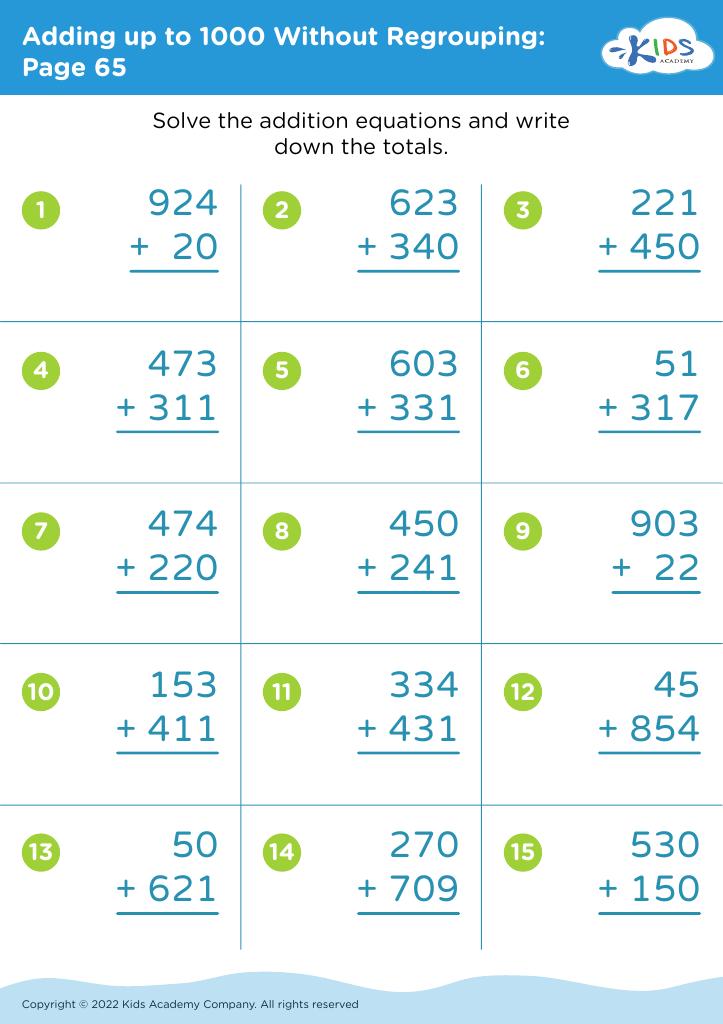
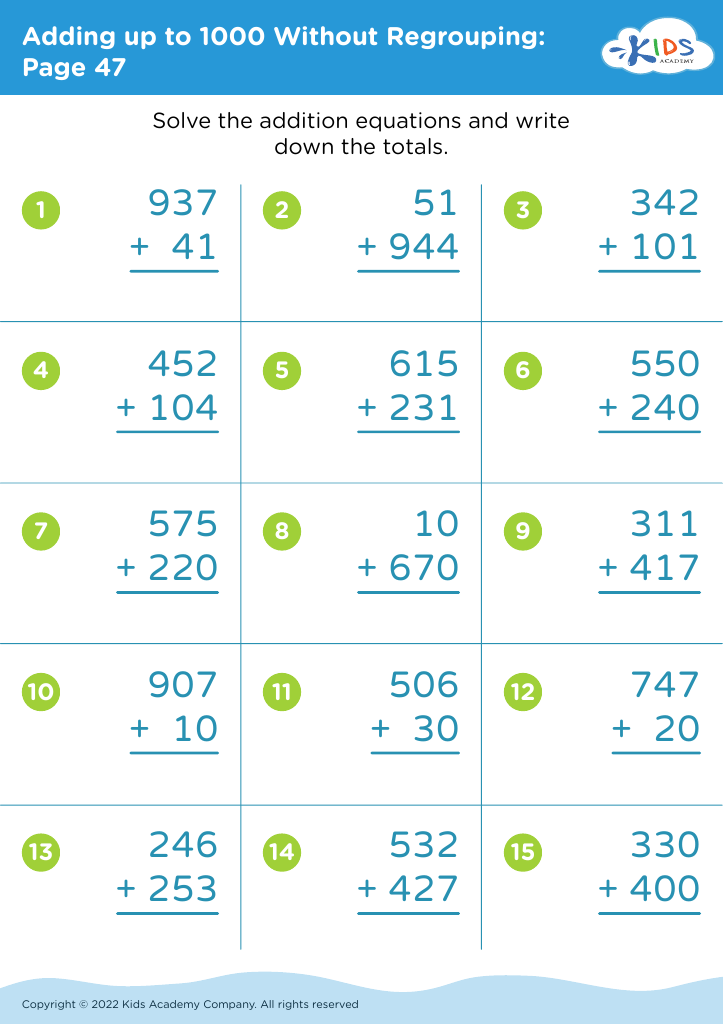
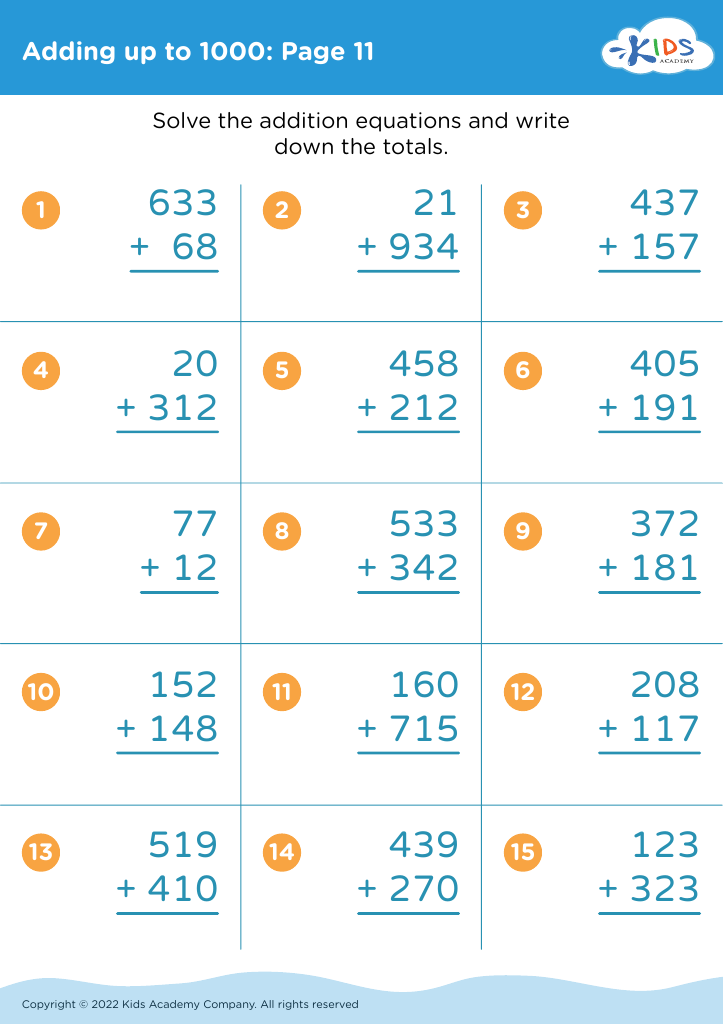
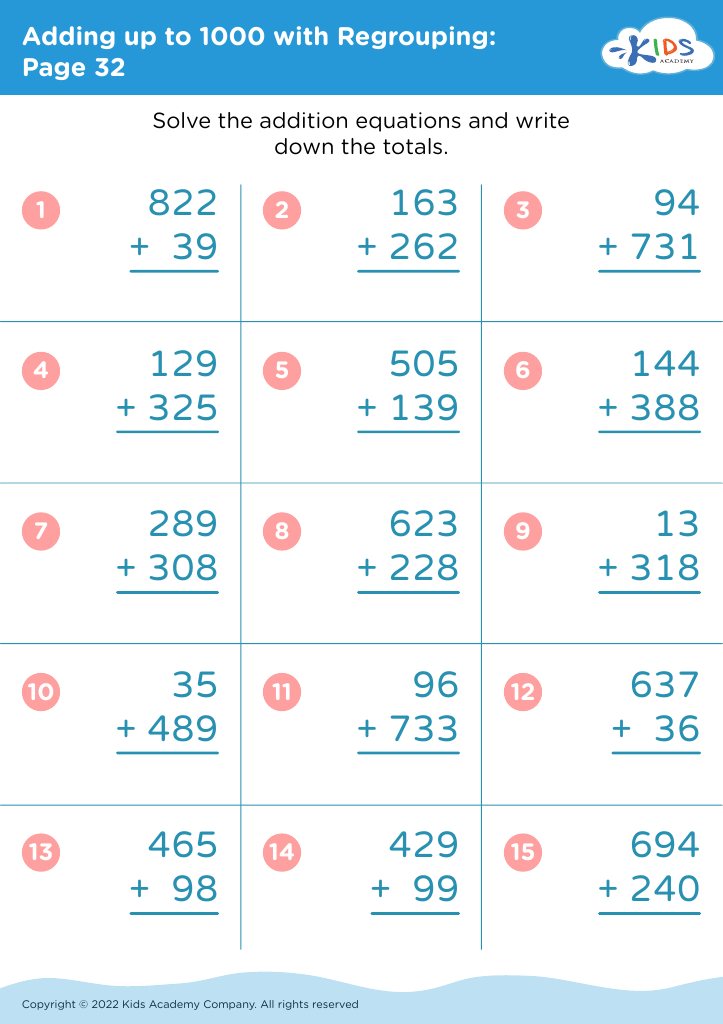
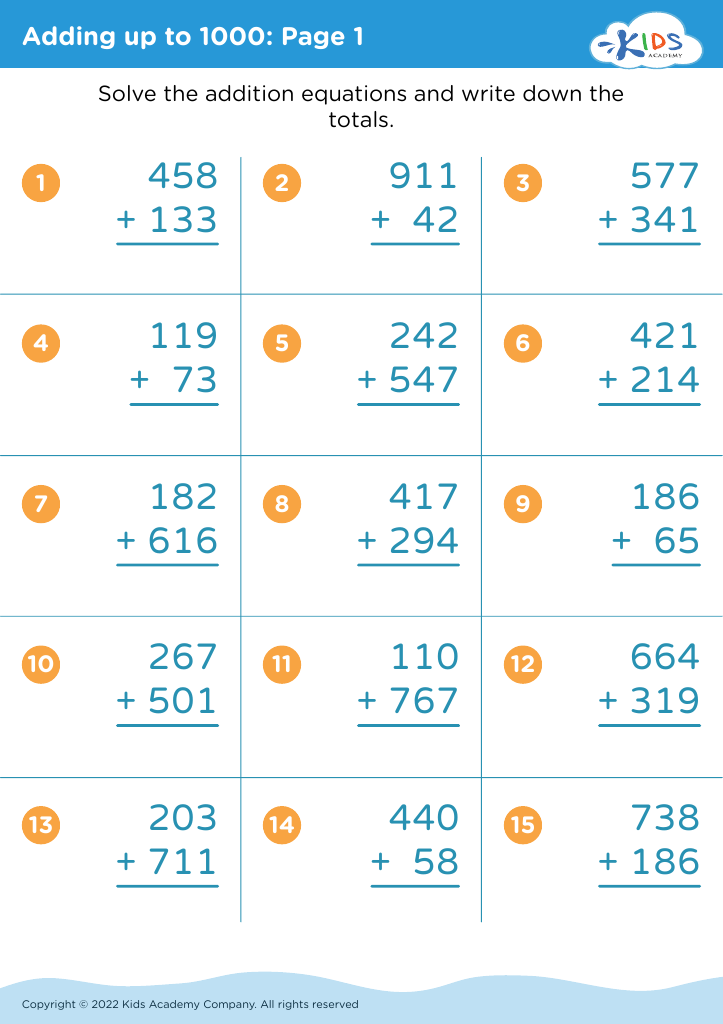
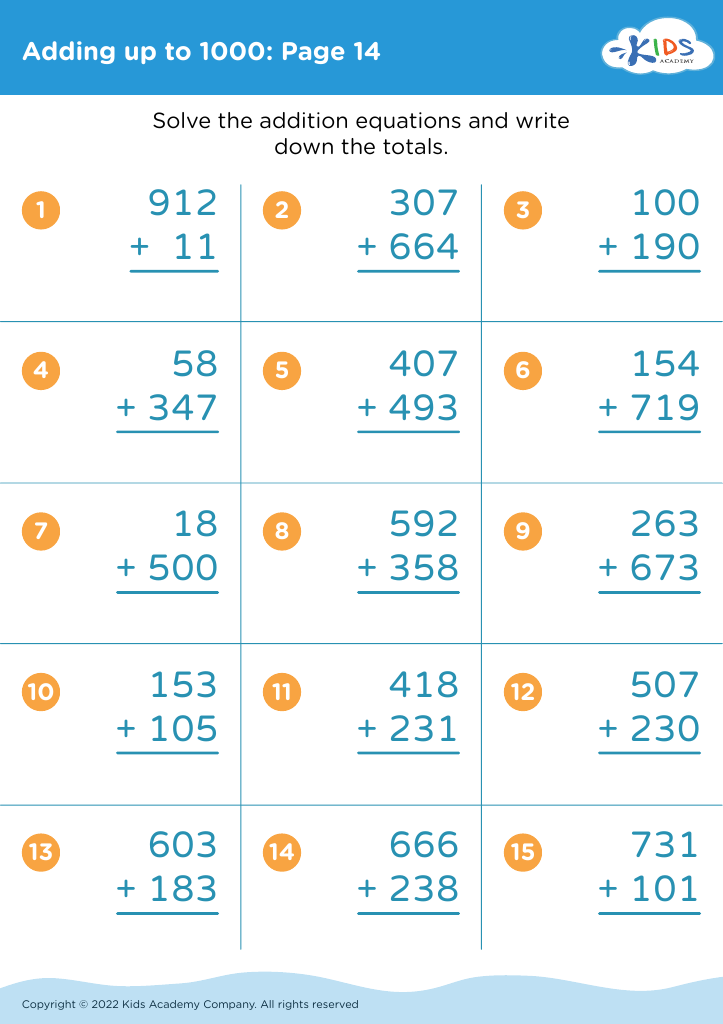
Enhance your child's math skills with our comprehensive collection of "Adding up to 1000 Worksheets" specifically designed for ages 7-8. These engaging worksheets from Kids Academy provide fun, interactive exercises to develop number sense and arithmetic proficiency. Perfect for classroom or home use, each sheet presents challenges tailored to build confidence and improve accuracy in addition. With a variety of problems to solve, kids will strengthen their understanding of larger numbers and improve their calculation speed. Download now and watch your child excel in math, turning addition into an enjoyable learning experience!



Improving math skills, particularly the ability to add up to 1000, for children aged 7-8 is fundamentally important for several reasons. At this age, children are typically in second or third grade, and a strong understanding of basic arithmetic lays the foundation for all advanced mathematical learning they will encounter throughout their education.
First, mastering addition up to 1000 is essential for developing number sense, which is the ability to understand and work comfortably with numbers. This proficiency fosters logical thinking and problem-solving skills, which are critical in daily life and future academic endeavors. Additionally, it prepares children for more complex mathematical concepts such as subtraction, multiplication, division, and eventually, algebra and higher-order mathematics.
Parents and teachers should also recognize that early proficiency in math is linked with improved self-confidence and attitudes towards learning. When children see tangible progress and understand concepts thoroughly, they are more likely to develop a positive attitude toward schoolwork in general. Moreover, early math skills are a strong predictor of later academic success not only in math but across various subjects as math skills are integral in subjects like science, technology, and engineering.
Finally, fostering early math competencies prepares children for a world increasingly driven by technology and analytics. Thus, prioritizing math skills like addition up to 1000 helps set up young learners for future success both academically and in their eventual careers.








