Pattern recognition Adding up to 1000 Worksheets for Ages 7-8
3 filtered results
-
From - To
Unlock advanced mathematical skills with our "Pattern Recognition Adding up to 1000 Worksheets" designed for ages 7-8. These engaging exercises help students improve their addition skills while recognizing and understanding patterns in numbers up to 1000. Through carefully crafted problems, children will enhance their logical thinking, boost confidence in math, and build a solid foundation for advanced arithmetic concepts. Brightly illustrated and easy-to-follow, these worksheets make learning enjoyable and effective. Perfect for both classroom and home use, our worksheets support your child's path to success in mathematics. Get ready to see incredible progress and fun in learning!
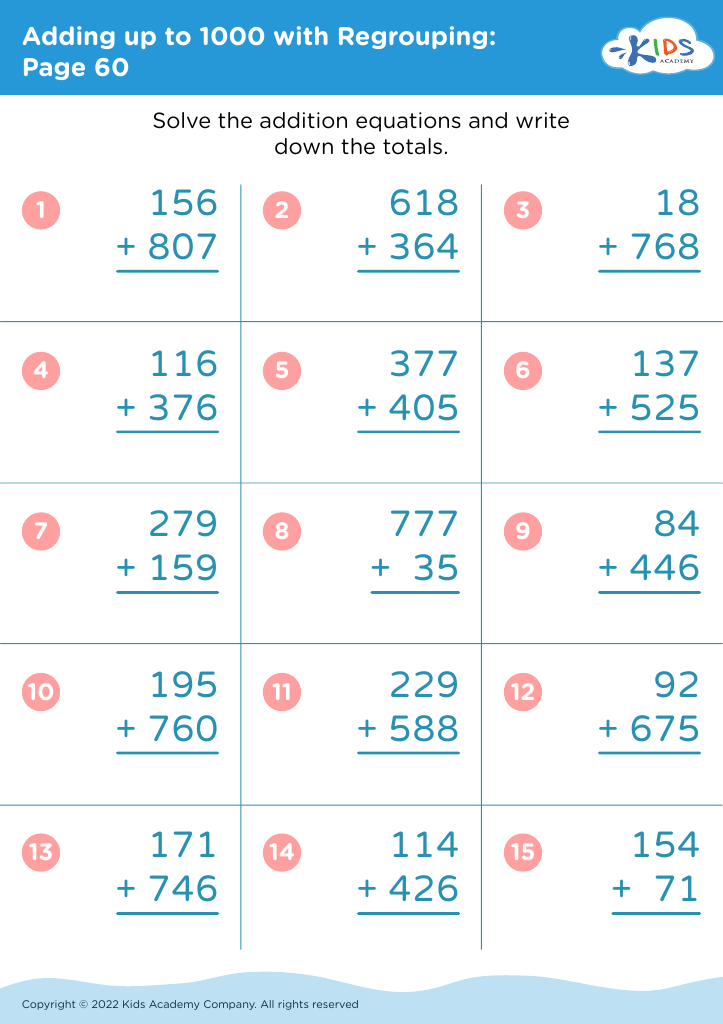
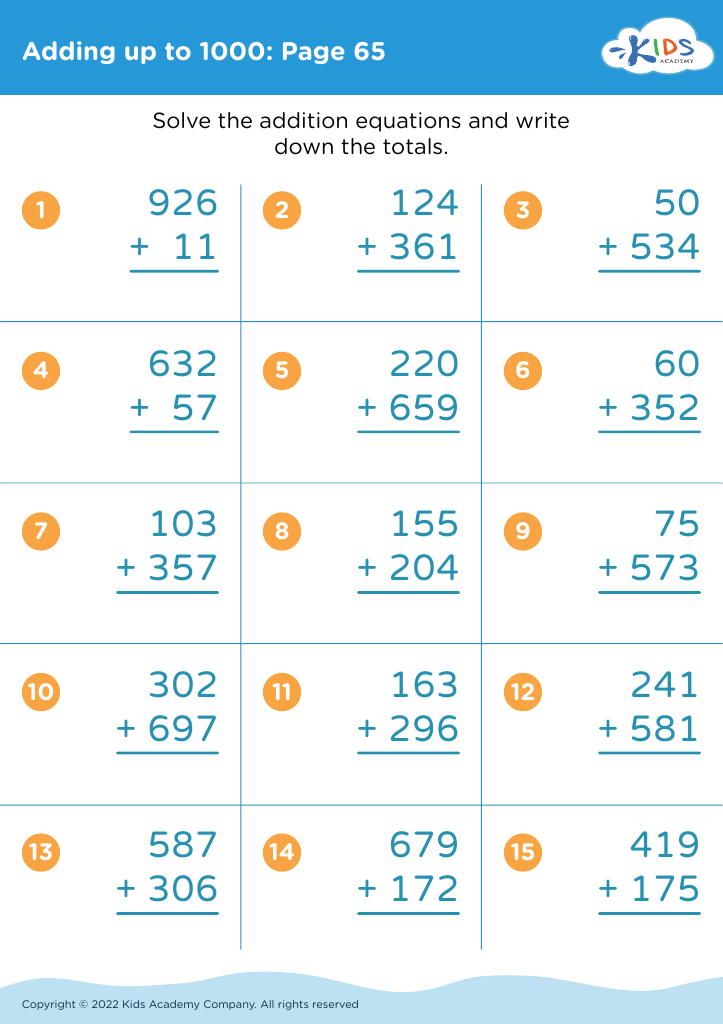
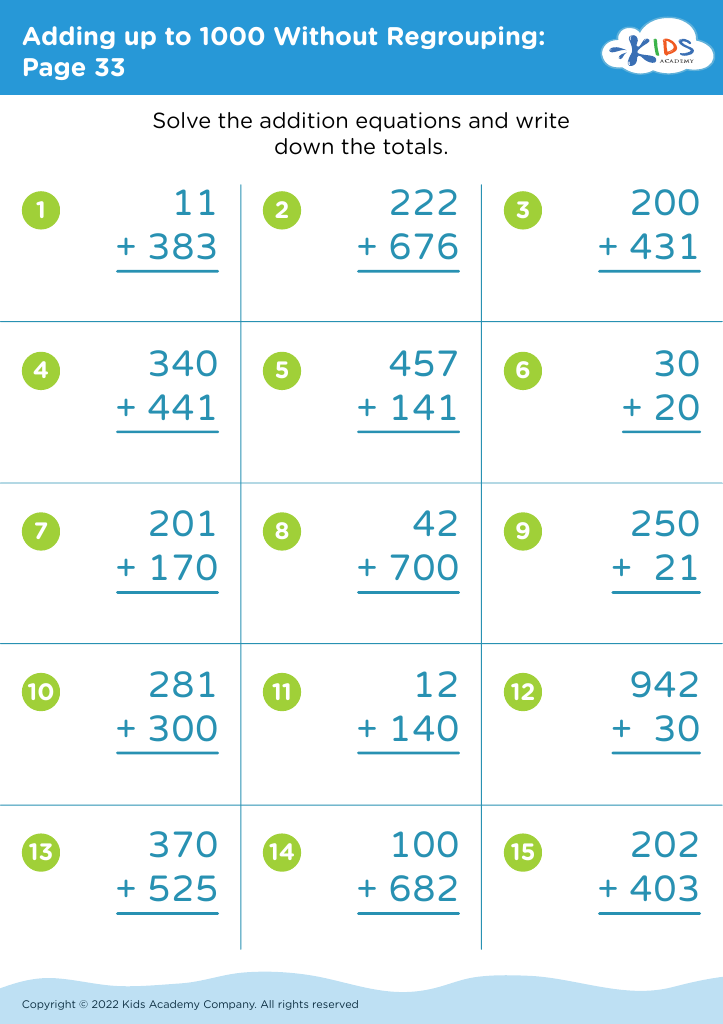



Understanding pattern recognition and summing up to 1000 is essential for students aged 7–8 because these skills build foundational mathematical abilities that are crucial for their academic growth. Pattern recognition helps children identify, understand, and predict sequences in numbers, shapes, and other objects, which is fundamental to learning more complex math concepts later on, such as algebra and geometry. When children can see patterns, they develop logical thinking, improve their problem-solving skills, and learn how to organize information systematically.
Adding up to 1000 helps students grasp the concept of larger numbers and teaches them about place value, which is a key component of the base-10 number system. This knowledge is important not only for arithmetic operations but also for understanding concepts like multiplication, division, and even decimals and fractions in the future.
Parents and teachers should focus on these areas because they foster a child’s numerical fluency and confidence. Instilling these skills at a young age can encourage a positive attitude towards mathematics, making it more likely that children will pursue STEM subjects in higher grades. Additionally, these skills are not limited to academic success; they have practical applications in everyday life, such as budgeting, time management, and logical reasoning, making them essential life skills.








