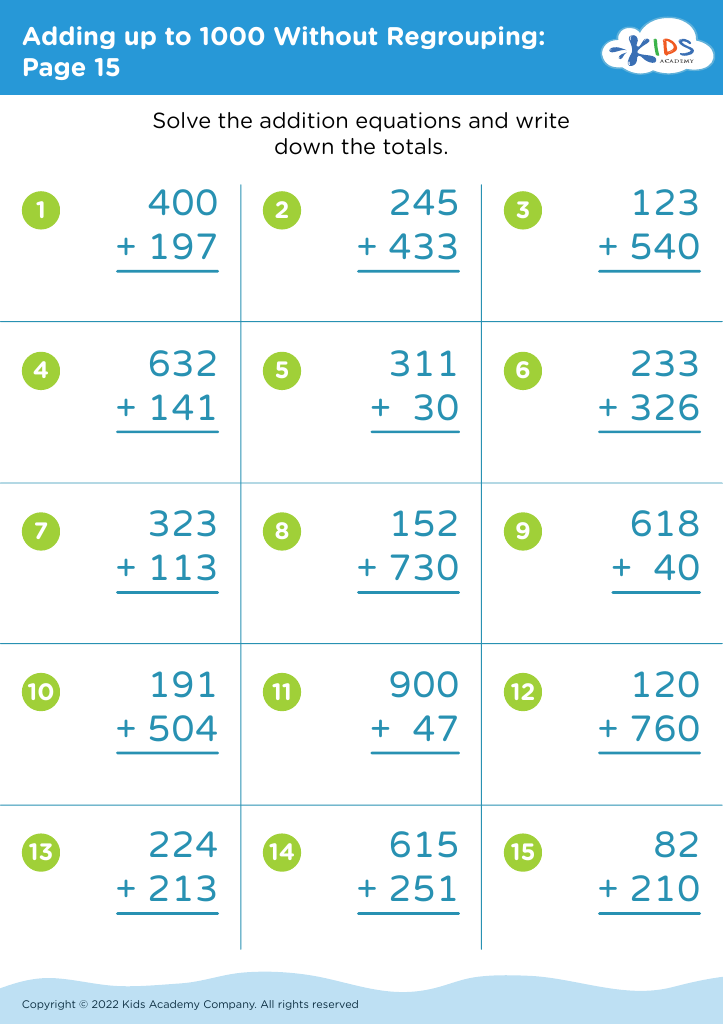




Parents and teachers should care about developing problem-solving skills in children ages 7-8, particularly in adding up to 1000, because it lays a critical foundation for future academic success and everyday functioning. At this age, children are transitioning from basic arithmetic to more complex mathematical concepts, and mastering addition up to 1000 strengthens their ability to handle larger numbers confidently.
Problem-solving skills go beyond simple calculations. They enhance critical thinking and logical reasoning, which are essential for tackling not just mathematical problems but challenges in various life situations. Encouraging these skills at a young age fosters a growth mindset, helping children view challenges as opportunities to learn and grow rather than setbacks.
Moreover, incorporating problem-solving in math makes learning more engaging and relevant. Real-life applications of math, such as budgeting allowance or measuring for a craft project, show children the practical importance of what they're learning. This relevance boosts motivation and interest, leading to a more positive attitude toward the subject.
In summary, focusing on problem-solving skills, including adding up to 1000, equips children with essential cognitive tools, promotes a positive learning experience, and prepares them for more advanced math and real-world situations they will encounter later in life.








