Understanding quantity Adding up to 1000 Worksheets for Ages 7-8
3 filtered results
-
From - To
Discover our "Understanding Quantity Adding up to 1000 Worksheets for Ages 7-8," designed to build a strong foundation in math with engaging activities. These expertly crafted worksheets offer a variety of exercises that help kids understand and practice addition up to 1000. Perfect for young learners, they aid in grasping large number addition through visual aids, number lines, and hands-on tasks. These worksheets not only reinforce understanding of quantity but also enhance problem-solving skills, boosting confidence in math. A perfect resource for parents and teachers to support children in mastering essential math concepts in an enjoyable way.
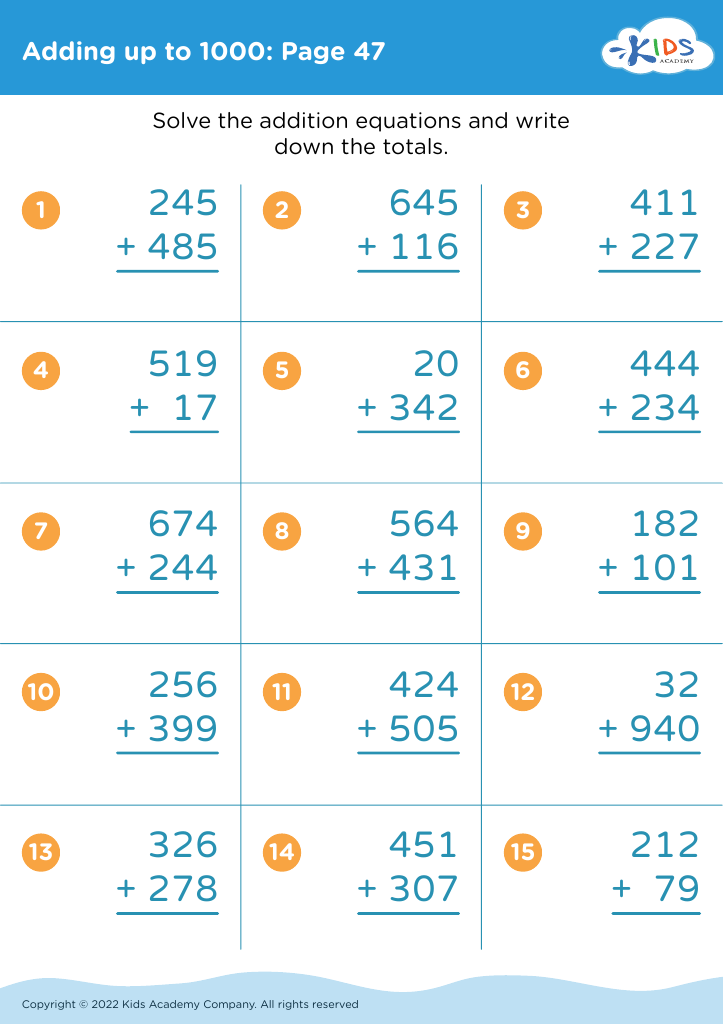
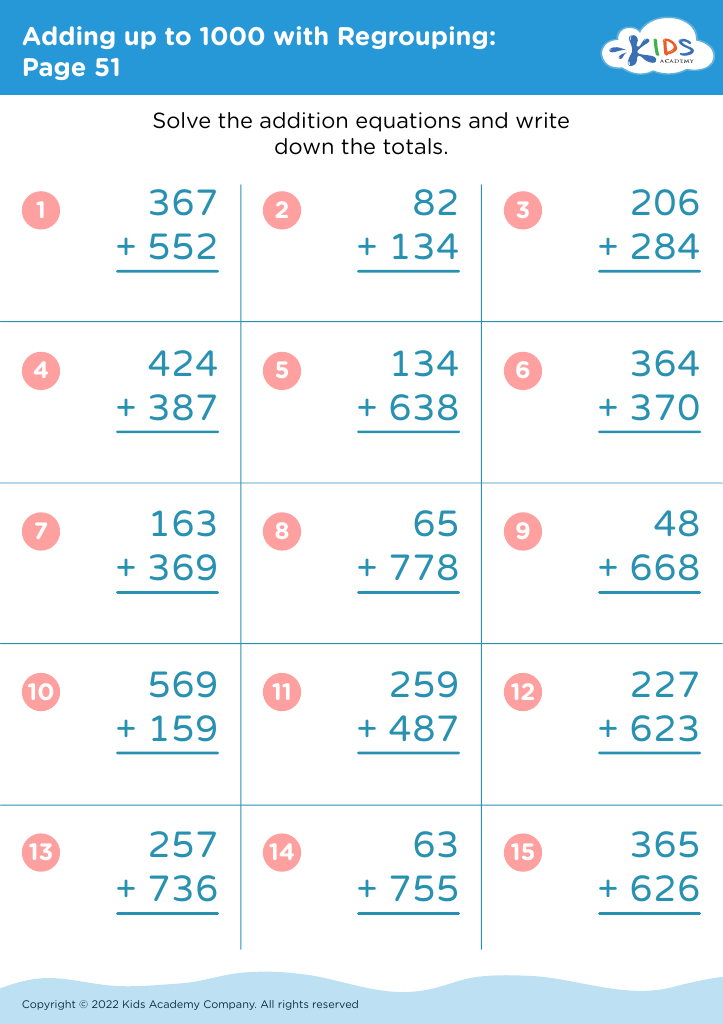
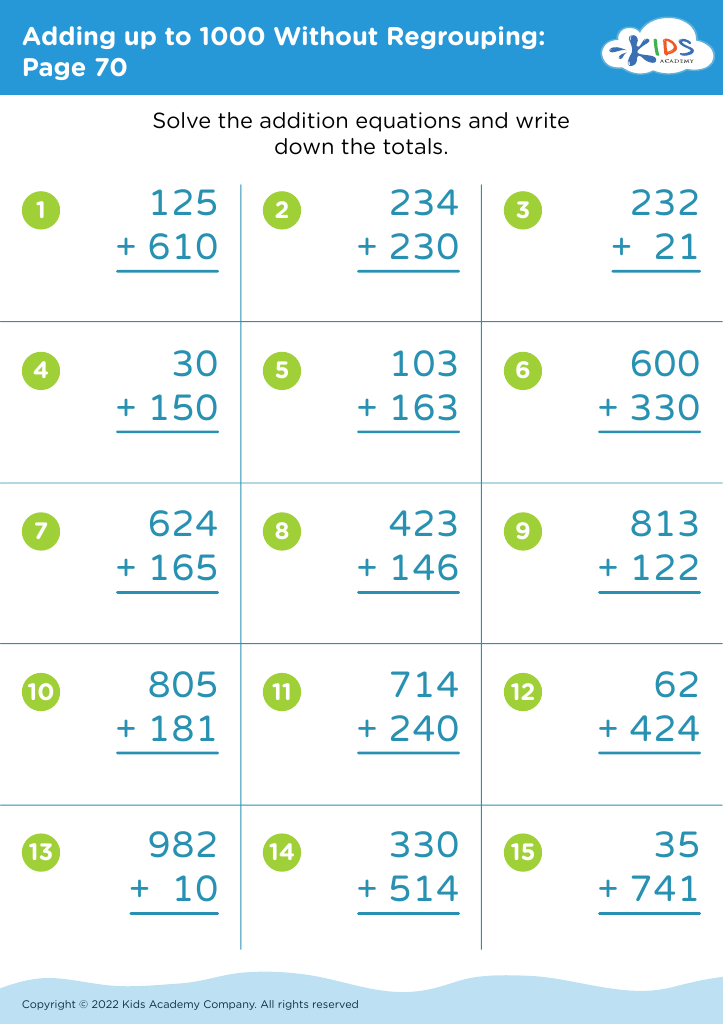



Understanding quantities that add up to 1000 is a crucial math skill for children aged 7-8, as it forms the foundation for complex arithmetic and practical life skills. At this developmental stage, children transition from basic counting to more sophisticated mathematical operations. Grasping this concept enhances their numerical fluency, enabling them to process, interpret, and manipulate larger numbers confidently.
When children learn to handle quantities up to 1000, they develop better problem-solving skills and mental arithmetic capabilities. This proficiency is vital for academic success, making it easier for students to tackle topics such as place value understanding, multi-digit addition, and subtraction. Mastery in these areas translates to a smoother progression through the math curriculum.
Moreover, quantitative reasoning extends beyond the classroom. Everyday activities such as shopping, reading time, and money management become opportunities for applying these math skills. This not only fosters independence but also enhances children's practical understanding of numbers in the real world.
In summary, focusing on understanding quantities up to 1000 equips children with essential mathematical skills, promotes cognitive development, and prepares them for future academic challenges. It bridges classroom learning and real-life application, making it imperative for parents and teachers to support this vital learning milestone.








