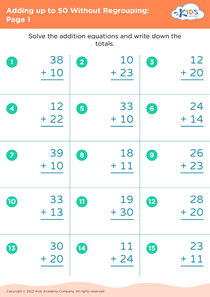
Addition skills Adding up to 50 with Regrouping Worksheets for Ages 7-8
3 filtered results
-
From - To
Enhance your child's addition skills with our "Adding Up to 50 with Regrouping Worksheets" tailored for ages 7-8. These engaging worksheets are designed to help young learners master the essential skill of adding numbers up to 50, incorporating regrouping techniques for a stronger mathematical foundation. Through structured practice and interactive problems, children will grow their confidence in solving addition problems efficiently. Perfect for classroom supplementation or extra practice at home, these worksheets make math fun and educational. Give your child the tools they need to succeed in math with our expertly crafted resources. Start building strong addition skills today!
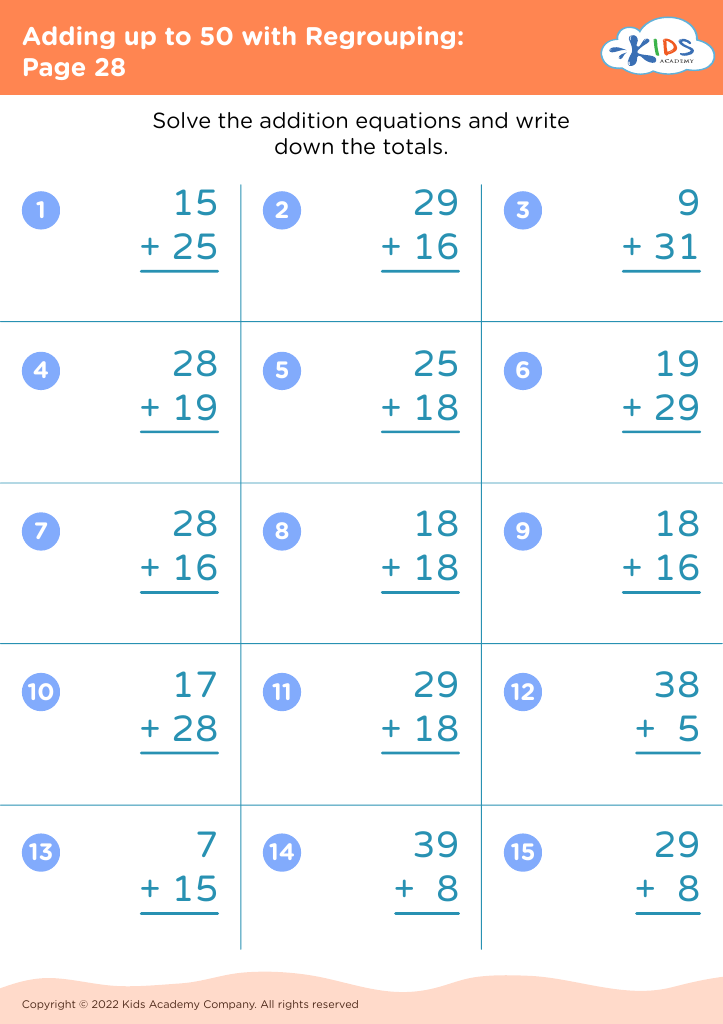
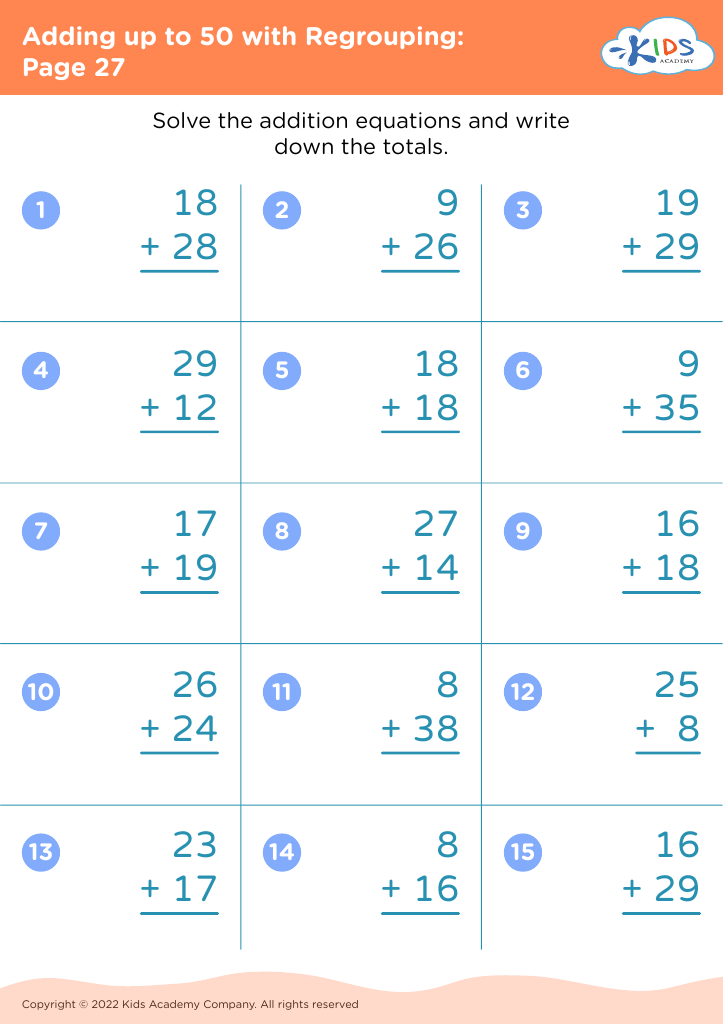
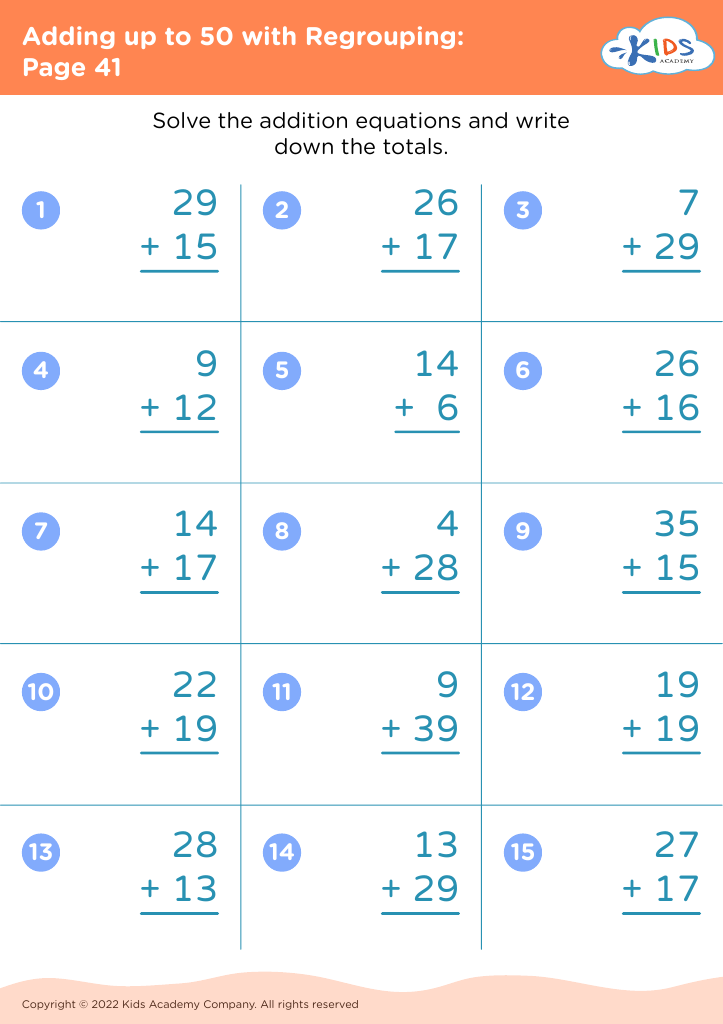


Addition skills, especially adding up to 50 with regrouping, are foundational in a child’s math education and play a critical role in their cognitive development. For children aged 7-8, this stage marks a transition from simple addition to more complex arithmetic that involves carrying over values to the next column, known as regrouping. This skill is essential because it enhances their understanding of place value—a core concept in math.
By mastering addition with regrouping, children learn to process multi-digit numbers more efficiently and accurately. This understanding is crucial as they progress to higher-level math concepts such as subtraction with borrowing, multiplication, and division. Beyond math, these skills enhance problem-solving abilities and logical thinking.
For teachers and parents, paying attention to a child’s proficiency in this area ensures that they build a strong math foundation. It prevents future learning gaps that could lead to math anxiety or a lack of confidence in mathematical abilities. Encouraging practice in addition with regrouping within the 50 range helps solidify a child's comfort and proficiency with numbers, fostering a positive attitude towards learning math and setting them up for academic success in various subjects that require quantitative skills.