Addition Practice Adding up to 50 Without Regrouping Worksheets for Ages 7-8
6 filtered results
-
From - To
Enhance your child's math skills with our Addition Practice Adding up to 50 Without Regrouping Worksheets, designed specifically for ages 7-8! Perfect for young learners, these worksheets help children master basic addition in a fun, engaging manner. Each worksheet is crafted to reinforce foundational math concepts, promote confidence in solving problems, and strengthen mental arithmetic skills. Tailored for easy understanding, our printable activities provide ample practice without the need for regrouping, making them ideal for classroom or at-home learning. Watch as your child's proficiency in addition grows while enjoying the exciting, educational exercises provided by Kids Academy!
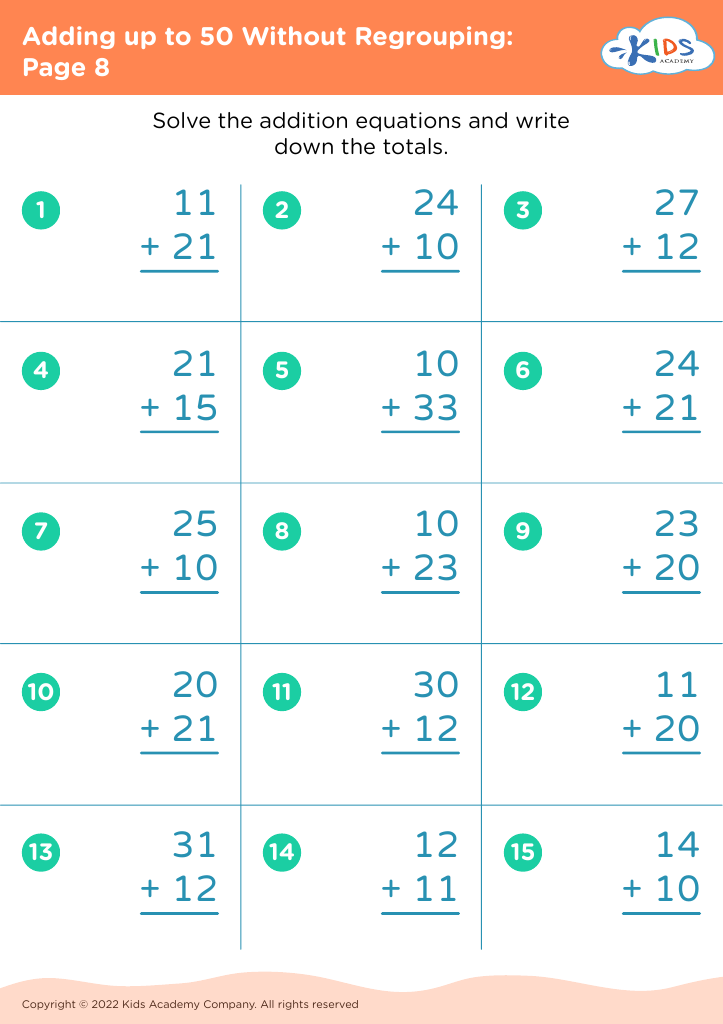
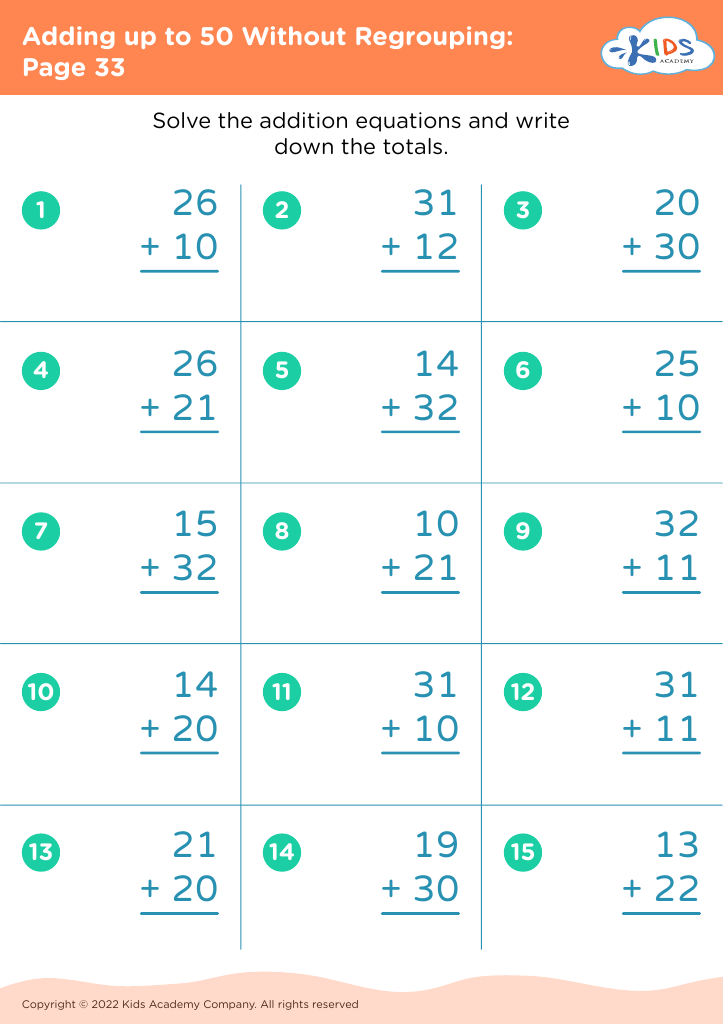
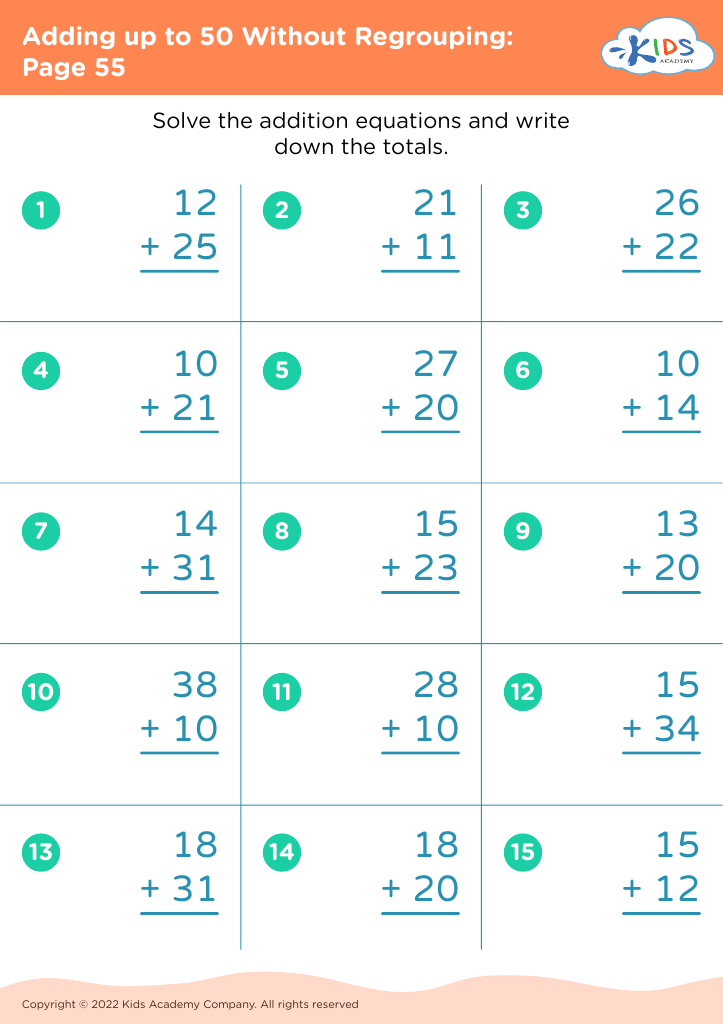


Parents and teachers should place importance on practicing addition up to 50 without regrouping for children aged 7-8 because it is a foundational math skill that supports further mathematical learning and daily life numeracy. At this stage, students are transitioning from simple counting to more complex arithmetic operations, and mastering addition without regrouping is crucial to build their confidence and accuracy. This practice enhances their mental math abilities and speeds up their computation skills, reducing anxiety about math problems.
Furthermore, being proficient in these basic addition tasks sets the groundwork for understanding more advanced concepts such as subtraction, multiplication, and division. It also aids in developing problem-solving skills and logical thinking. By consistently practicing addition within manageable limits (up to 50), children gain the ability to approach larger numbers and more complicated problems without feeling overwhelmed.
In everyday life, addition skills are used constantly—whether it's handling money, measuring ingredients for a recipe, or determining times and durations. Parents and teachers should ensure that students are comfortable with these basic operations to promote a sense of independence and competence in their daily interactions. By investing time in practicing addition up to 50 without regrouping, we are giving children an essential tool for both academic success and practical, everyday applications.