Compare fractions Addition Worksheets for Ages 7-8
6 filtered results
-
From - To
Boost your child's math skills with our Compare Fractions Addition Worksheets for Ages 7-8. Perfect for second and third graders, these engaging worksheets help young learners master comparing and adding fractions with ease. Each worksheet is designed to build foundational skills, enhance problem-solving abilities, and boost confidence in a fun, interactive way. With colorful visuals and step-by-step instructions, math becomes a delightful adventure! Ideal for classroom use or at-home practice, these printable worksheets are a prime resource for parents and educators aiming to support early math proficiency. Shape your child’s future success, try them today!
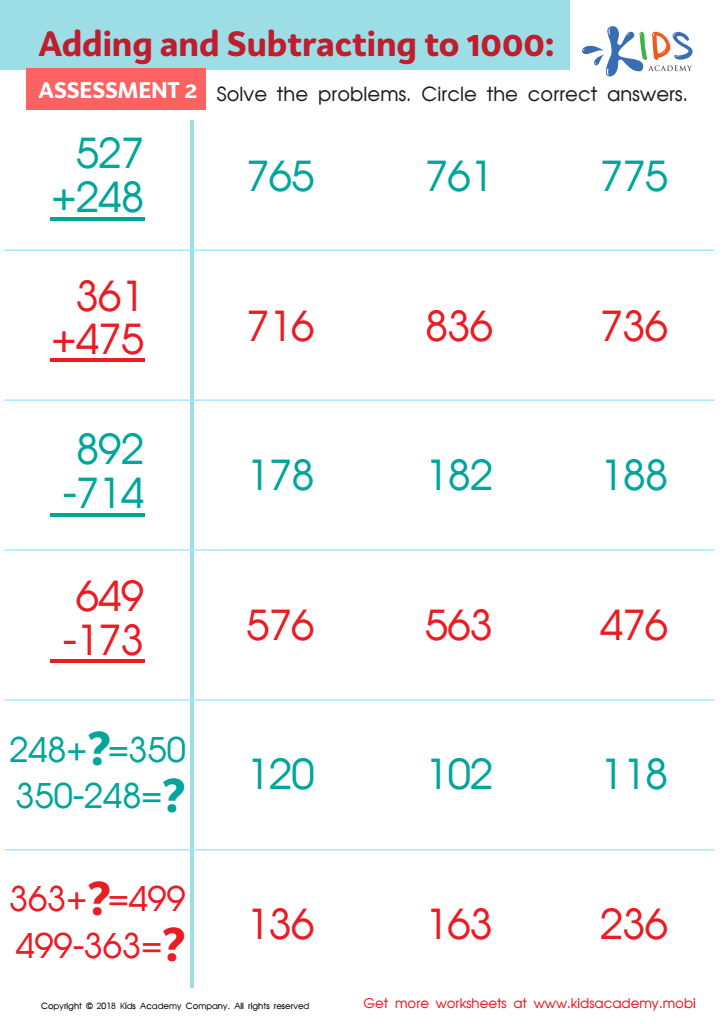
Adding and Subtracting to 1 Worksheet: Assessment 2
 Assign to My Students








At ages 7-8, children are developing critical cognitive and mathematical skills that serve as foundational building blocks for more advanced concepts. Comparing fractions and understanding fraction addition at this stage is essential for several reasons.
First, these skills enhance numerical literacy. Fractions represent a child's first real encounter with numbers that are not whole, thus expanding their perception of what numbers can represent. This helps in cultivating a more comprehensive understanding of mathematics and its applications in everyday life, such as measuring ingredients for a recipe or dividing a pizza among friends.
Second, proficiency in fractions promotes logical thinking and problem-solving abilities. Children must grasp concepts like numerators and denominators and understand how different fractions relate to each other. This involves recognizing equivalency and applying strategies to determine common denominators, which are critical thinking exercises that build analytical skills.
Third, early competence in fractions can boost a child's confidence in math. Children who struggle with foundational concepts may develop math anxiety, impacting their educational journey. By mastering fractions early, they are more likely to approach advanced math topics, like algebra and geometry, with confidence and enthusiasm.
Finally, reinforcing these skills aligns with educational standards and prepares children for standardized tests and future academic challenges. Parents and teachers focused on fraction competency are essentially setting their young learners up for long-term academic success and practical everyday proficiency.








