
Pattern identification Addition Worksheets for Ages 7-8
3 filtered results
Difficulty Level
Grade
Age
-
From - To
Subject
Activity
Standards
Discover our engaging Pattern Identification Addition Worksheets designed specifically for children aged 7-8! These interactive worksheets help young learners strengthen their addition skills while recognizing and understanding patterns in numbers. Through fun exercises and challenges, kids will enhance their critical thinking and problem-solving abilities. Each worksheet encourages exploration and promotes a solid foundation in math concepts. Perfect for both classroom activities and at-home practice, our resources are designed to make learning enjoyable. Download these worksheets now to help your child master addition while developing essential pattern recognition skills. Boost their confidence in math today!
Favorites
With answer key
Interactive
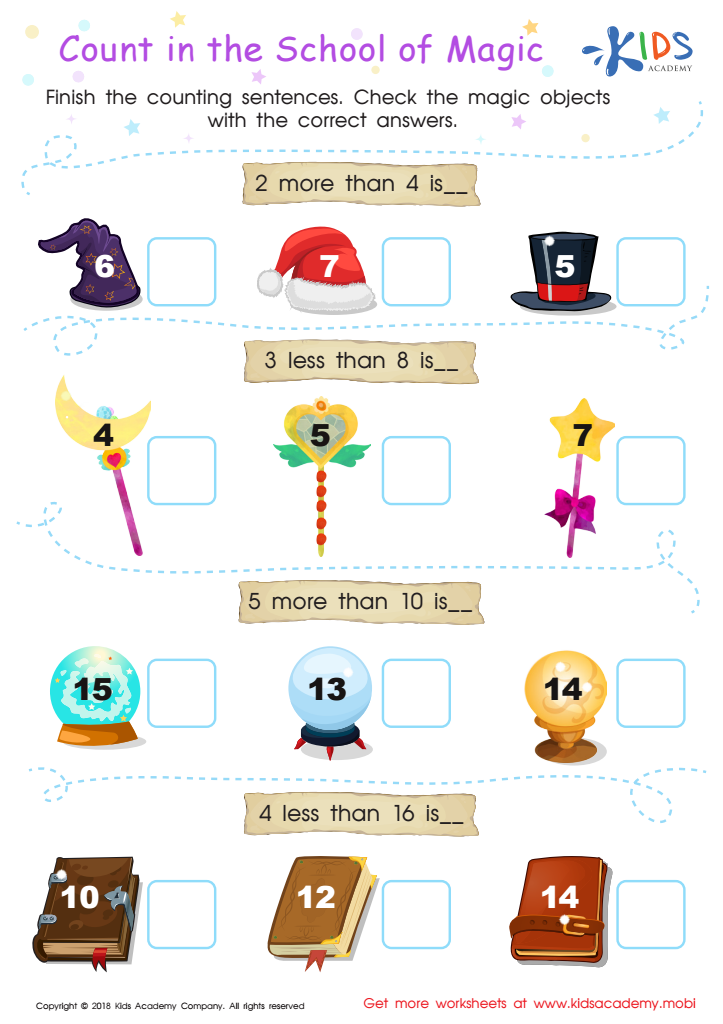
Count in the School of Magic Worksheet
Your math learners can explore the School of Magic with this worksheet. They'll read equations with addition and subtraction numbers under 20, count back and forth to find the answer, then complete the counting sentences. Fun pictures and easy accuracy make it an enjoyable and successful learning experience.
 Assign to My Students
Count in the School of Magic Worksheet
Worksheet
Join Kids Academy for Free
Who is primarily going to use this learning content?






.jpg)

Pattern identification in addition is a foundational skill that significantly benefits children aged 7-8. At this age, children are not just learning to add numbers; they are beginning to understand the underlying concepts of mathematics that will support their future learning. Recognizing patterns, such as those found in skip counting or identifying sums that recur, enables students to develop mental math skills that enhance their confidence and efficiency.
Furthermore, pattern identification promotes critical thinking and problem-solving abilities. When students learn to recognize relationships between numbers and find patterns in addition tables, they improve their ability to approach complex mathematical problems logically. This skill also relates to other areas of mathematics, including multiplication and division, paving the way for a smoother transition to more advanced concepts.
For parents and teachers, fostering this skill helps ensure that children develop a strong mathematical foundation. This mastery can also boost engagement in math-related activities, making learning more enjoyable. Overall, pattern identification in addition is crucial for building a numeracy skill set that extends beyond elementary school, empowering students for long-term achievement in mathematics and beyond. Thus, parents and teachers should prioritize this essential aspect of early math education.








