
Understanding greater/less than Worksheets for 7-Year-Olds
3 filtered results
Difficulty Level
Grade
Age
-
From - To
Subject
Activity
Standards
Engage your 7-year-old in mastering math concepts with our "Understanding Greater/Less Than" worksheets! Our carefully designed activities focus on helping children develop crucial comparison skills. Each worksheet provides fun, hands-on practice to confidently identify and comprehend greater and less than mathematical relationships. With colorful visuals and engaging exercises tailored for young minds, these resources make learning math both enjoyable and effective. Strengthen your child's foundational math skills, enhance their problem-solving abilities, and build confidence in comparing numbers. Visit Kids Academy to explore our collection and empower your child to excel in math today!
Favorites
With answer key
Interactive
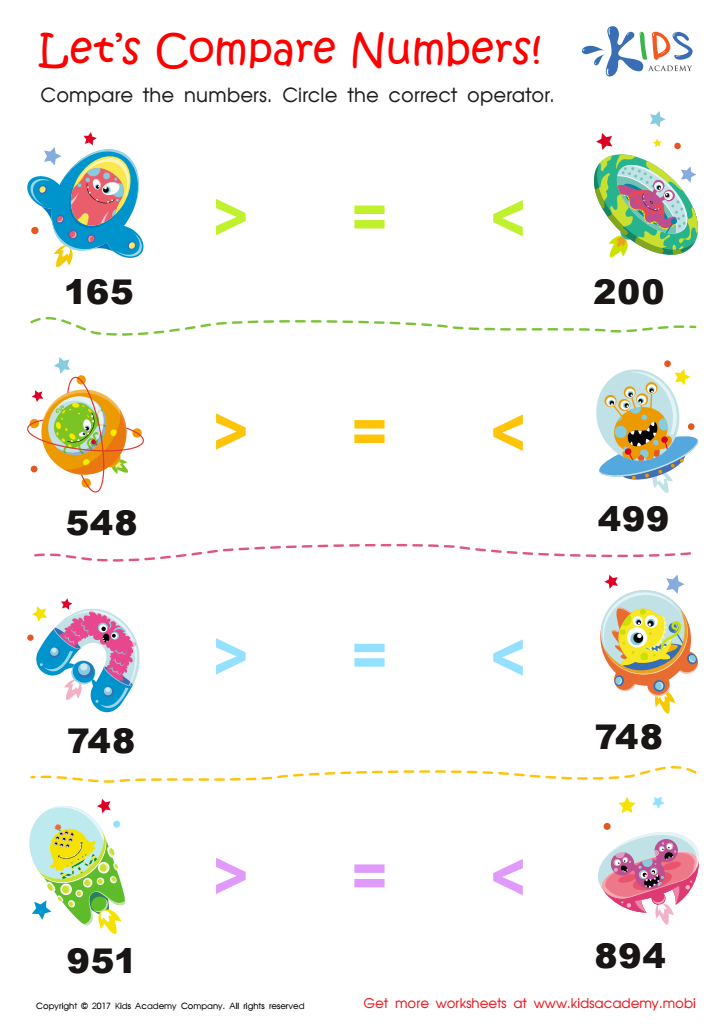
Comparing Numbers Worksheet for 2nd Grade
Alien friends are back to help your child learn to compare numbers using >, < and = symbols. This 2nd grade worksheet will challenge them with larger numbers!
 Assign to My Students
Comparing Numbers Worksheet for 2nd Grade
Worksheet
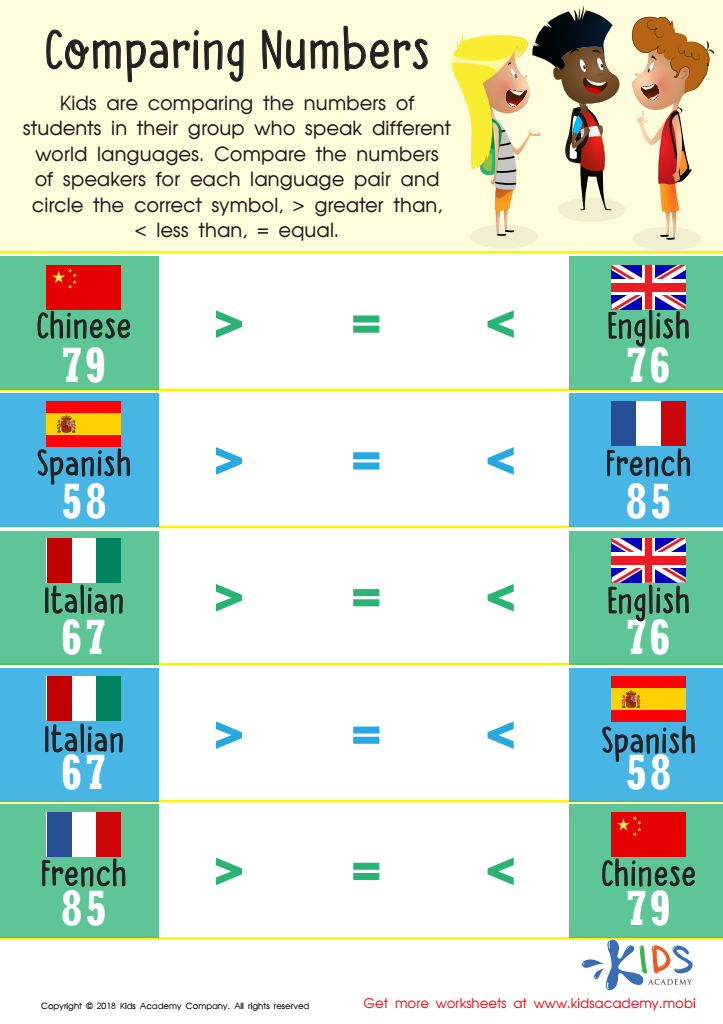
Comparing Numbers Worksheet for 1st Grade
Children can build number sense by exploring the relationship between numbers. This worksheet uses bright international flags to compare numerical groups. Kids will love the cheerful colors and flags from different countries. It encourages them to compare numbers and reinforces their number sense with tens and ones place values.
Comparing Numbers Worksheet for 1st Grade
Worksheet
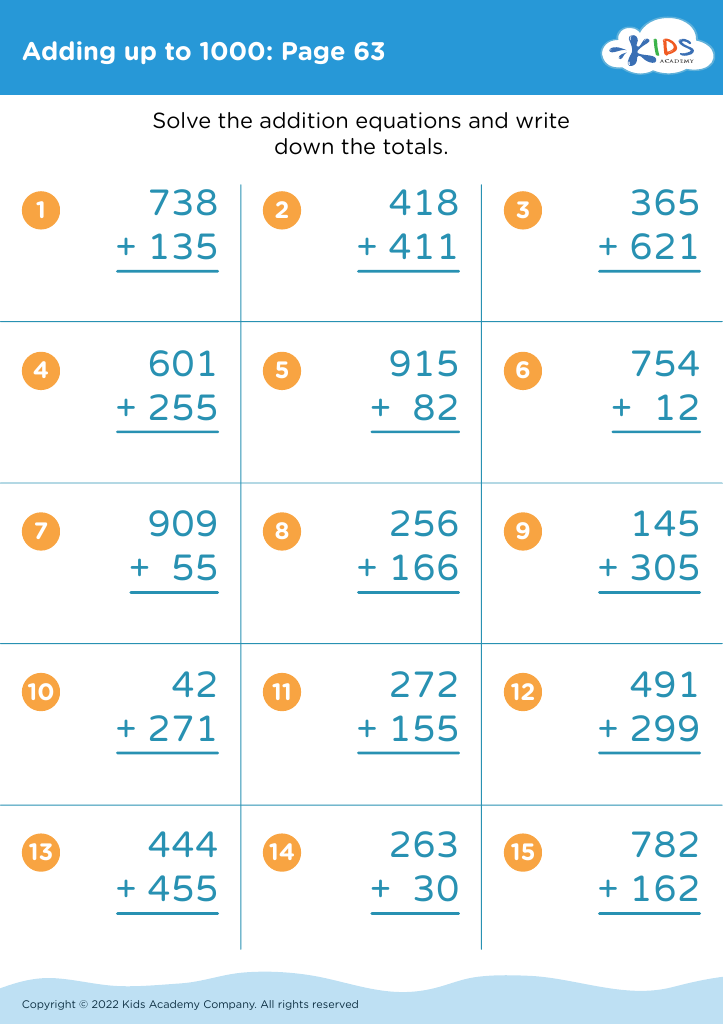
Join Kids Academy for Free
Who is primarily going to use this learning content?







Understanding the concepts of greater than and less than is vital for 7-year-olds as it lays the foundation for their future mathematical learning and logical thinking skills. At this age, children are developing their ability to compare quantities, which is an essential part of number sense. Grasping these concepts helps them improve their mathematical fluency and ability to perform basic arithmetic operations like addition and subtraction.
Furthermore, the ability to understand and compare numbers enhances critical thinking and decision-making skills. For example, when children determine which number is larger or smaller, they engage in cognitive processes such as reasoning and problem-solving. These skills go beyond mathematics and prove useful in daily life scenarios, such as deciding which group of objects has more or fewer items.
Moreover, understanding greater than and less than concepts aids in the development of confidence in dealing with numbers. Early positive experiences with these mathematical concepts can foster a love for the subject, making future learning experiences more engaging and less daunting.
Therefore, parents and teachers should actively support and nurture this understanding to provide a strong educational foundation, ensuring children are well-prepared for more complex mathematical challenges ahead. Encouraging curiosity and making math enjoyable at this stage can have long-lasting benefits in their overall academic journey.








