Addition Practice Adding up to 1000 with Regrouping Worksheets for 7-Year-Olds
3 filtered results
-
From - To
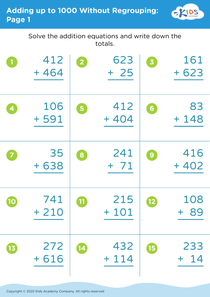
Discover engaging addition practice worksheets designed for 7-year-olds, focused on adding up to 1000 with regrouping. These worksheets help children enhance their arithmetic skills while making learning fun and interactive. Our user-friendly resources provide step-by-step exercises that promote understanding of regrouping concepts, ensuring kids build a solid mathematical foundation. Each worksheet is tailored to reinforce addition techniques through colorful graphics and relatable examples, making it easier for young learners to grasp complex ideas. Ideal for home or classroom use, these printable worksheets enable children to develop confidence in their math abilities while enjoying the journey of learning addition!
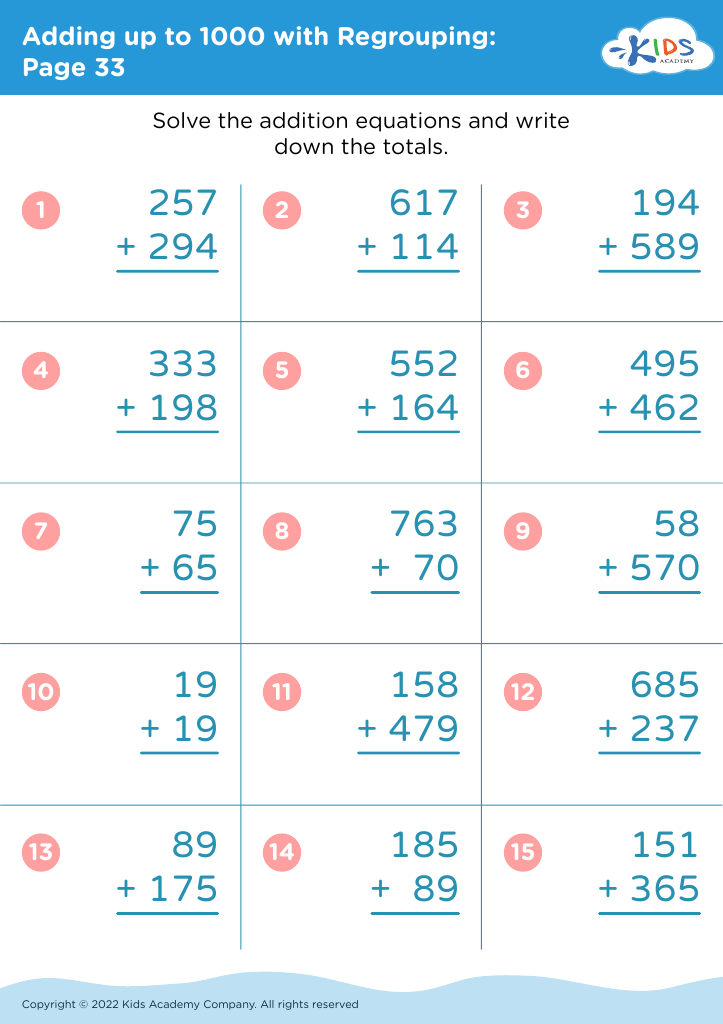
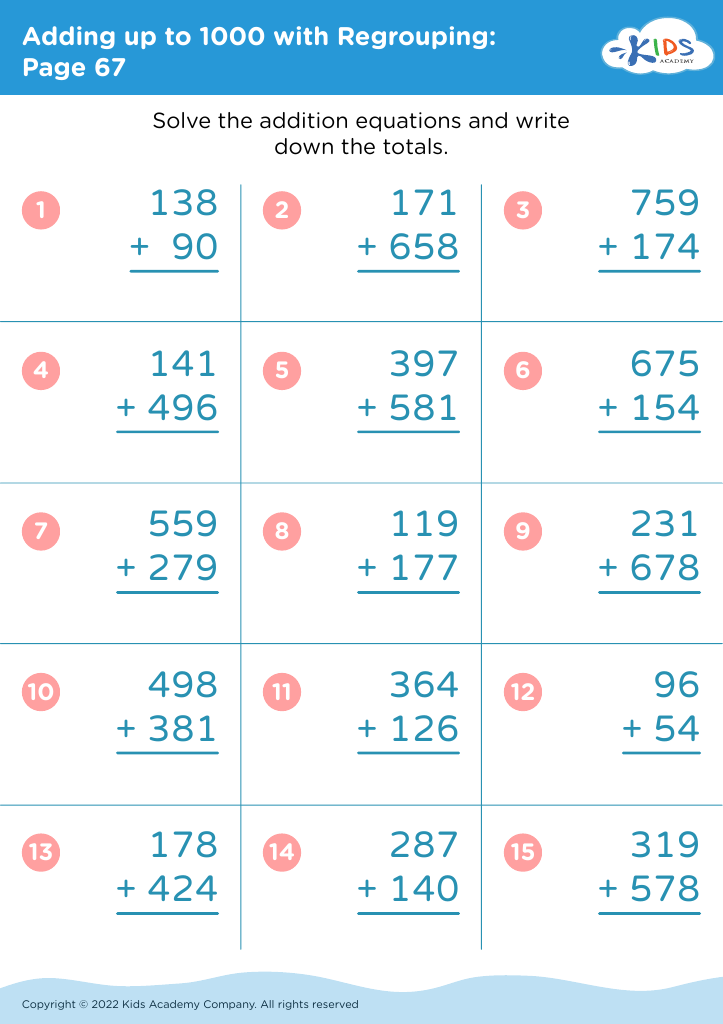
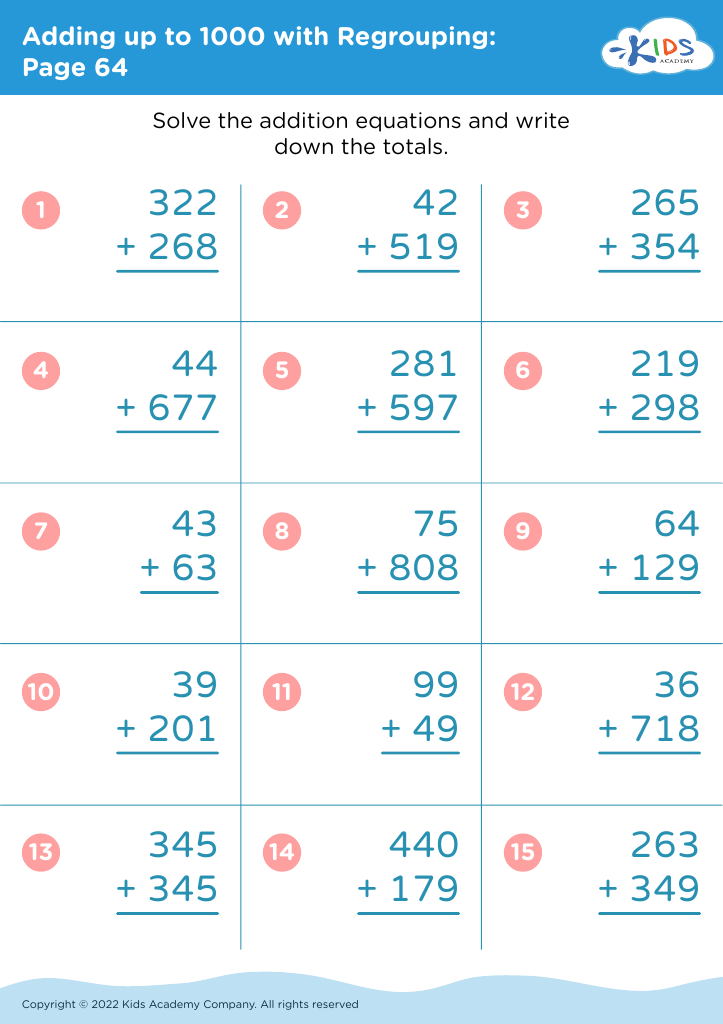


Parents and teachers should prioritize addition practice, specifically adding up to 1000 with regrouping, for 7-year-olds for several essential reasons. First, mastering this foundational math skill is crucial as it develops children’s number sense, enhances their understanding of place value, and prepares them for more complex mathematical concepts in the future. Regrouping, or carrying numbers, reinforces critical thinking and problem-solving skills, enabling children to approach math challenges with confidence.
Second, the ability to add larger numbers accurately ensures that children can tackle everyday arithmetic, such as calculating expenses, making predictions, and understanding basic financial concepts—skills vital for their development as functional adults. Additionally, improvement in addition skills can boost a child's overall academic performance, as proficiency in math often correlates with success in other subjects.
Finally, regular practice can foster a positive attitude towards mathematics. Engaging students through interactive activities and games turns potentially daunting tasks into enjoyable learning experiences. Overall, focusing on addition practice not only enhances mathematical understanding and skills but also nurtures a love for learning that will benefit children throughout their education and beyond.