Develop counting skills Adding up to 1000 Without Regrouping Worksheets for 7-Year-Olds
3 filtered results
-
From - To
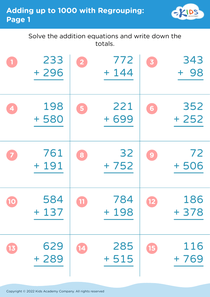
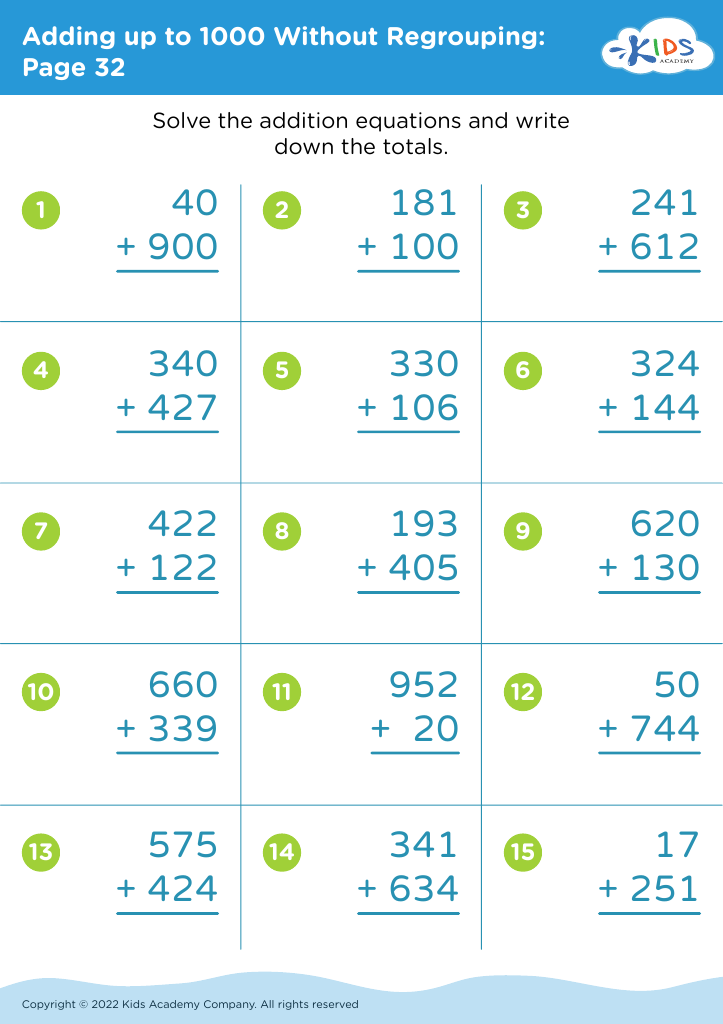
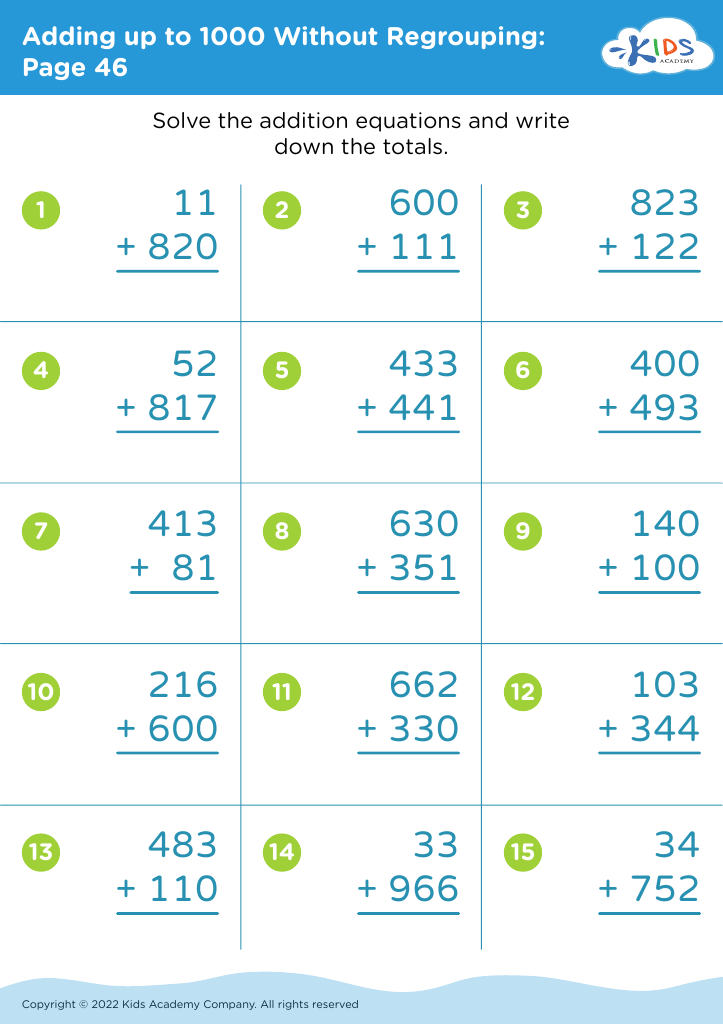
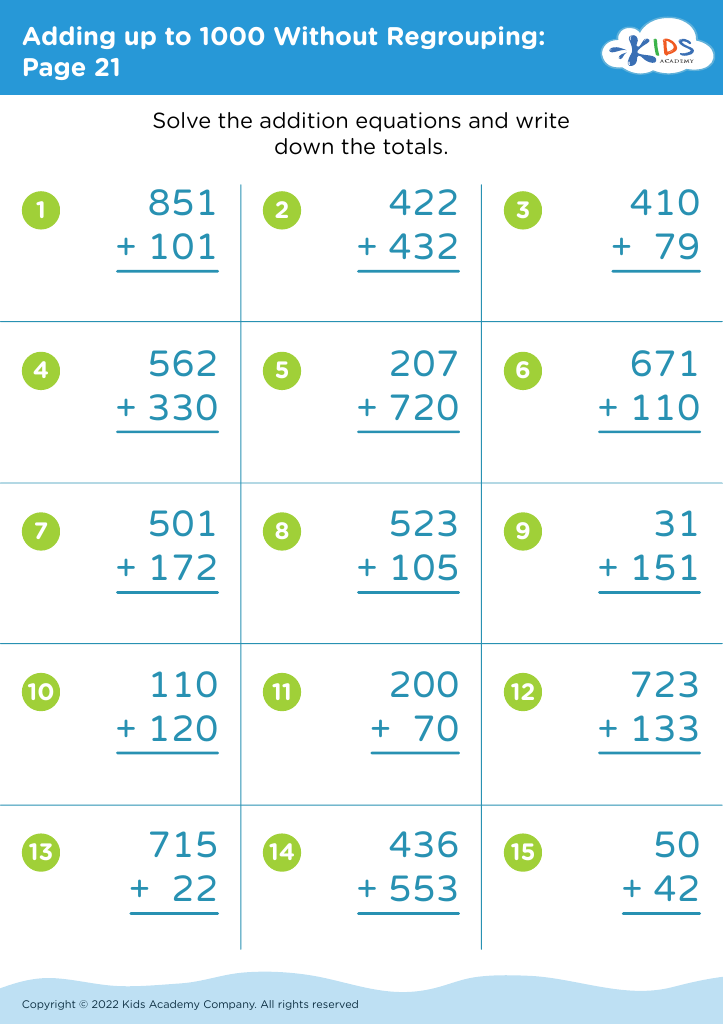
Enhance your 7-year-old's counting skills with our engaging worksheets designed to teach adding up to 1000 without regrouping. These educational resources from Kids Academy offer fun and interactive exercises that strengthen addition proficiency and boost overall math confidence. Suitable for young learners, our worksheets provide step-by-step guidance, enabling kids to understand and master the foundational concepts of addition. Perfect for both classroom and homeschool settings, these worksheets ensure skill development in a supportive and enjoyable way. Visit Kids Academy to access our printable worksheets and help your child excel in math today!


Developing counting skills up to 1000 without regrouping is fundamental for 7-year-olds as it lays a strong foundation for their future math competence. Parents and teachers should prioritize this as it fosters essential cognitive skills such as numerical recognition, pattern identification, and logical reasoning.
First, mastering basic counting helps children understand the concept of quantity, which is essential for all higher-level math concepts. Accurate counting up to 1000 without needing to regroup demonstrates that children have a solid grasp on the consistency and behavior of numbers. This builds their confidence and proficiency in simpler arithmetic tasks, which are crucial stepping stones for more complex problem-solving.
Moreover, counting up to 1000 involves recognizing and manipulating large numbers, which can enhance memory and concentration. Engaging with numbers in various forms—whether through visual aids, physical objects, or written exercises—stimulates multiple areas of the brain. This diversification helps maintain engagement and accelerates learning.
Additionally, harnessing these skills early can yield long-term educational benefits, as math is a cumulative subject where advanced concepts are built on basic ones. Early competence in counting avoids future struggles, promoting a positive attitude towards math and reducing anxiety linked with more challenging material. Therefore, a focus on these skills ensures a robust numerical foundation, opening doors to academic success and a lifelong affinity for learning.