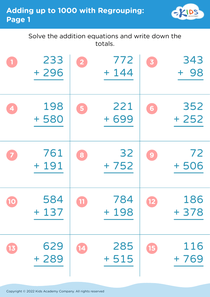
Improving math skills Adding up to 1000 Without Regrouping Worksheets for 7-Year-Olds
3 filtered results
-
From - To
Welcome to our "Improving Math Skills: Adding Up to 1000 Without Regrouping" worksheets designed specifically for 7-year-olds! These engaging and colorful worksheets provide a fantastic opportunity for young learners to practice addition skills, building confidence as they work towards reaching 1000 without regrouping. Featuring a variety of exercises tailored to enhance understanding and retention, these worksheets encourage mastery in a fun and interactive way. Perfect for classroom use or at-home practice, they help students develop essential mathematical competencies while fostering a love for learning. Explore our resources today and watch your child's math skills flourish!
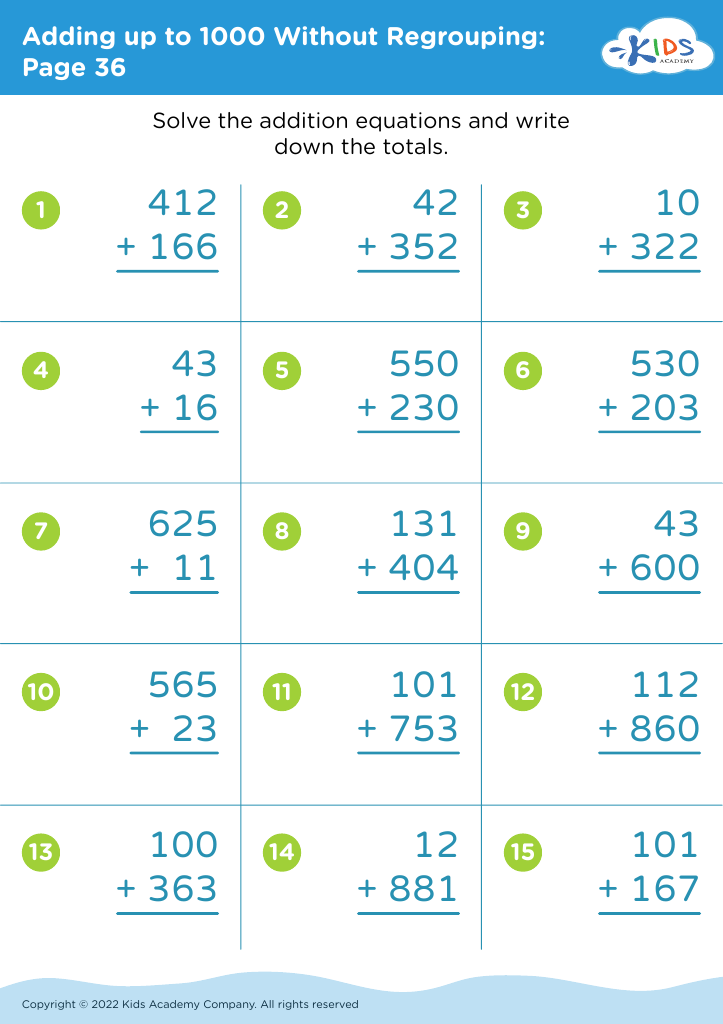
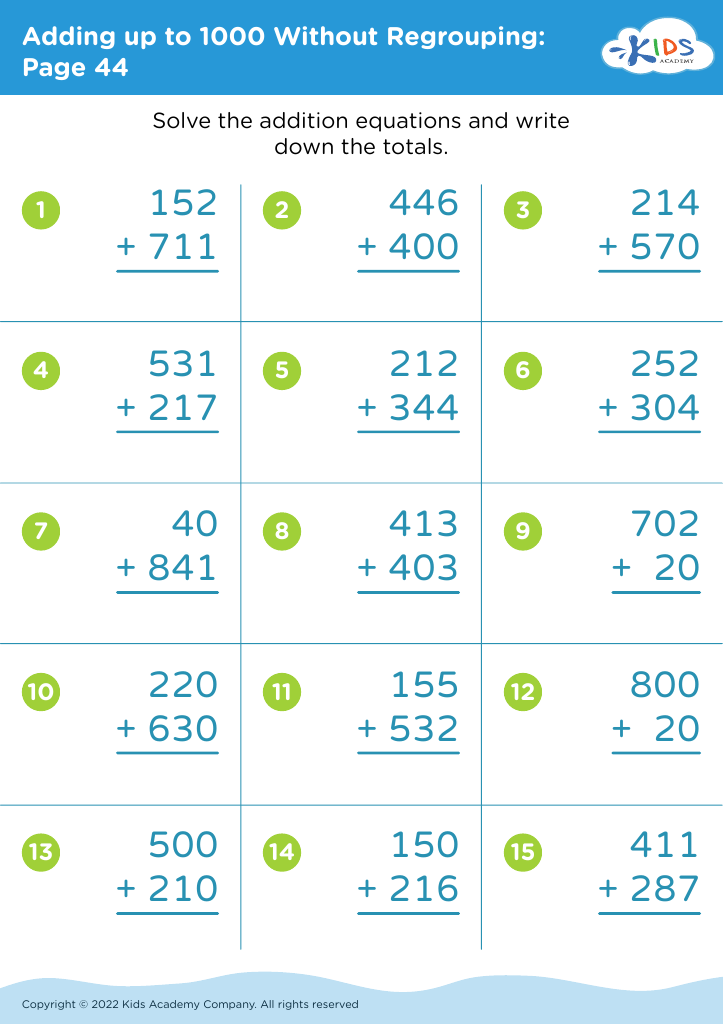
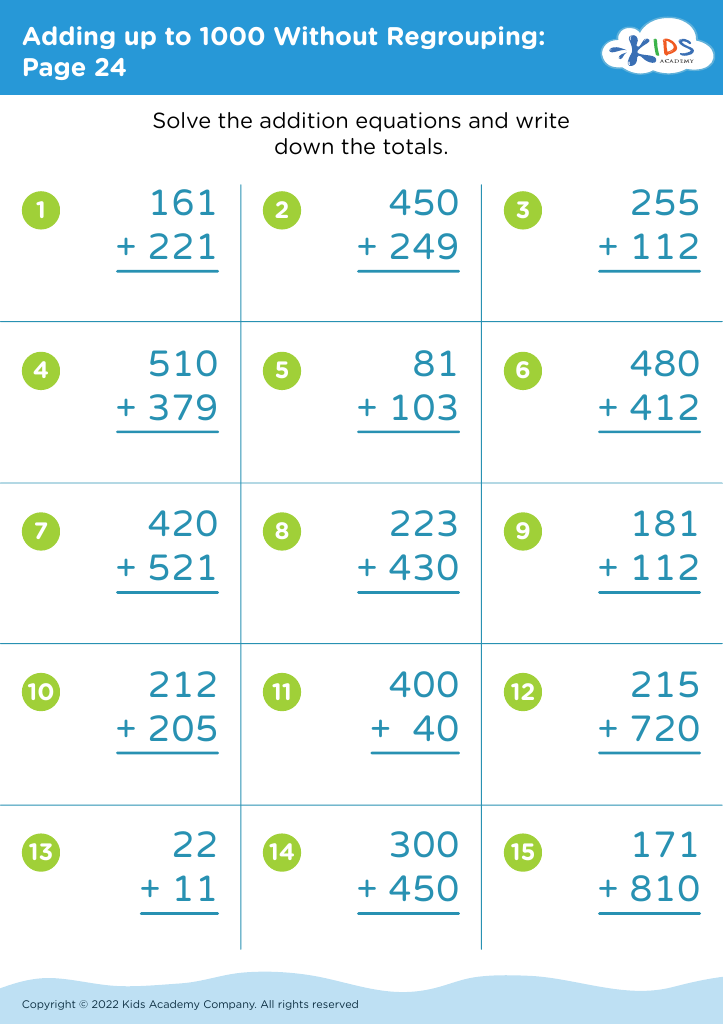


Improving math skills, particularly the ability to add up to 1000 without regrouping, is essential for 7-year-olds as it lays the foundation for future mathematical concepts. At this age, children develop critical thinking and problem-solving abilities. Mastering addition up to 1000 enhances their number sense, enabling them to grasp larger concepts of mathematics more effectively.
Moreover, having a strong foundation in basic addition builds confidence and reduces math anxiety. When children can perform addition tasks without regrouping, they can focus more on learning higher concepts such as multiplication and division, which often require a strong understanding of addition. This skill is not only crucial in academic settings but also has practical applications in everyday life, such as budgeting, shopping, and planning, fostering independence and life skills.
Parents and teachers should work collaboratively to improve these skills, creating engaging activities or games that encourage practice in a fun way. This approach can make learning enjoyable, while also reinforcing the idea that proficiency in math is attainable. Ultimately, these efforts contribute to well-rounded development and better academic outcomes, ensuring that children build a positive relationship with mathematics as they grow.