Number identification Adding up to 1000 Worksheets for 7-Year-Olds
3 filtered results
-
From - To
Introduce your 7-year-old to math fun with our "Number Identification Addition up to 1000 Worksheets"! Perfectly crafted for young learners, these engaging printables help kids master identifying and adding numbers within 1000. Each worksheet provides a hands-on approach to build strong number sense, enhance addition skills, and boost confidence in math. Children will enjoy solving these colorful exercises while strengthening their foundational mathematics abilities. From single-digit to three-digit addition, every worksheet is designed to be educational and exciting. Visit Kids Academy and download these invaluable resources to support your child's journey to math proficiency!
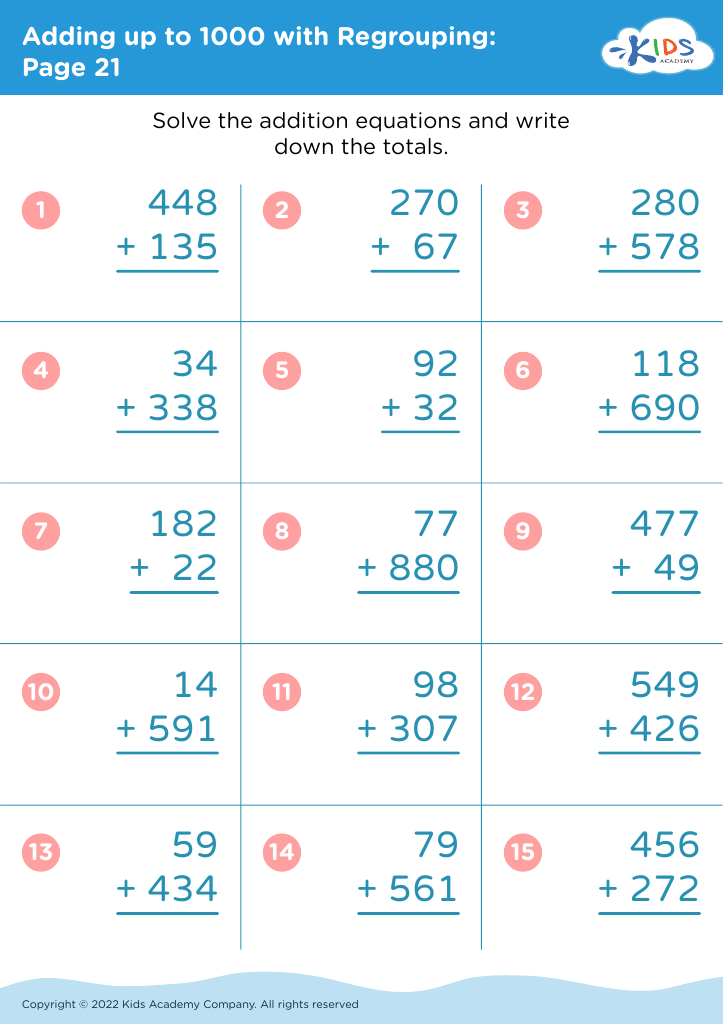
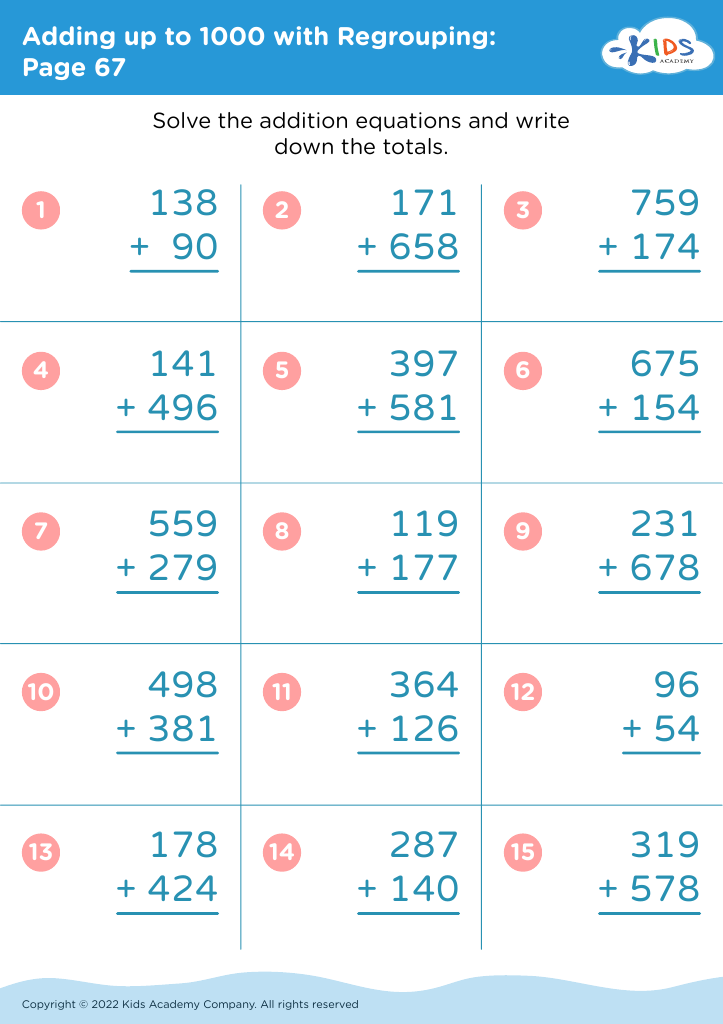
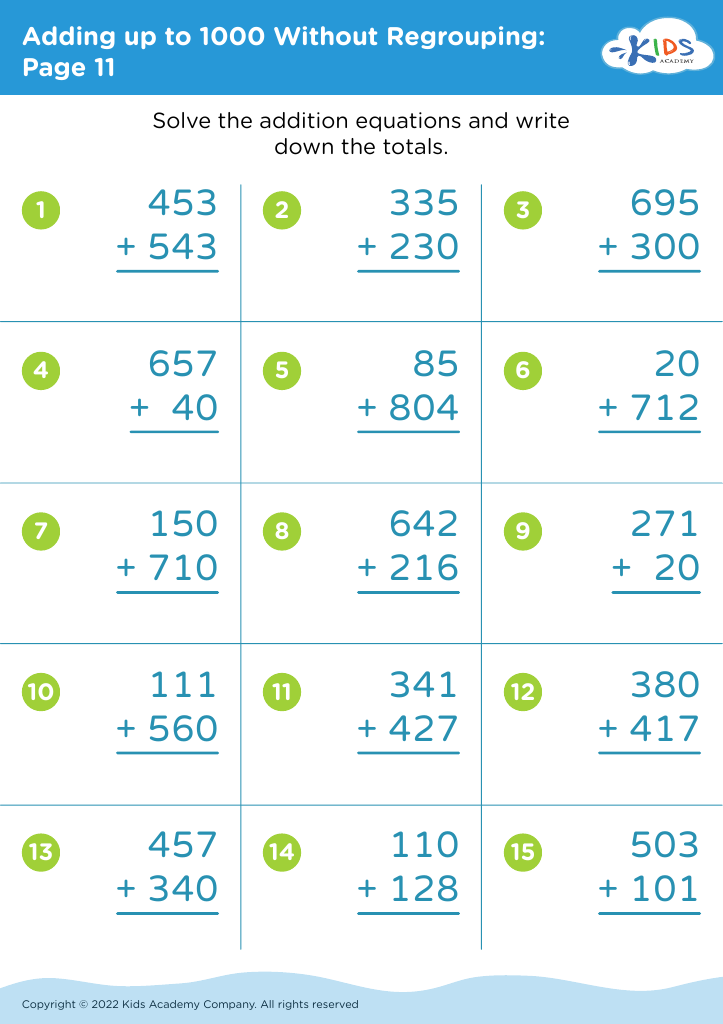



Number identification and adding up to 1000 are essential skills for 7-year-olds because they form the foundation for future mathematical learning. Understanding numbers and their relationships fosters a strong grasp of place value, which is crucial for more advanced mathematical operations like multiplication and division. By recognizing numbers up to 1000, children begin to understand the concepts of units, tens, and hundreds, which makes learning and applying mathematics more intuitive.
Introducing addition up to 1000 at this age encourages cognitive development, enhances problem-solving skills, and builds confidence as children succeed in understanding and manipulating larger numbers. This foundation equips them with the necessary tools to tackle more complex topics as they advance in their education, such as decimals, fractions, and multi-step word problems.
Furthermore, these skills have practical everyday applications. The ability to add and understand larger numbers helps children make sense of real-life scenarios, such as counting money, telling time, measuring quantities in recipes, and even planning or budgeting for events. By caring about a child’s ability to identify numbers and perform addition up to 1000, parents and teachers not only support their academic success but also prepare them for a multitude of daily tasks that require numerical proficiency.








