Visual interpretation Adding up to 1000 Worksheets for 7-Year-Olds
3 filtered results
-
From - To
Boost your child's math skills with our "Visual Interpretation Adding up to 1000 Worksheets for 7-Year-Olds!" Designed specifically for kids aged 7, these engaging worksheets utilize visual aids to help young learners grasp the concept of adding numbers up to 1000. With a focus on developing both number sense and critical thinking, our colorful and interactive sheets make learning math enjoyable and effective. These worksheets are perfect for classroom use or at-home practice, ensuring your child gains confidence and mastery in addition. Let the journey to math success begin today with our top-quality visual interpretation resources!
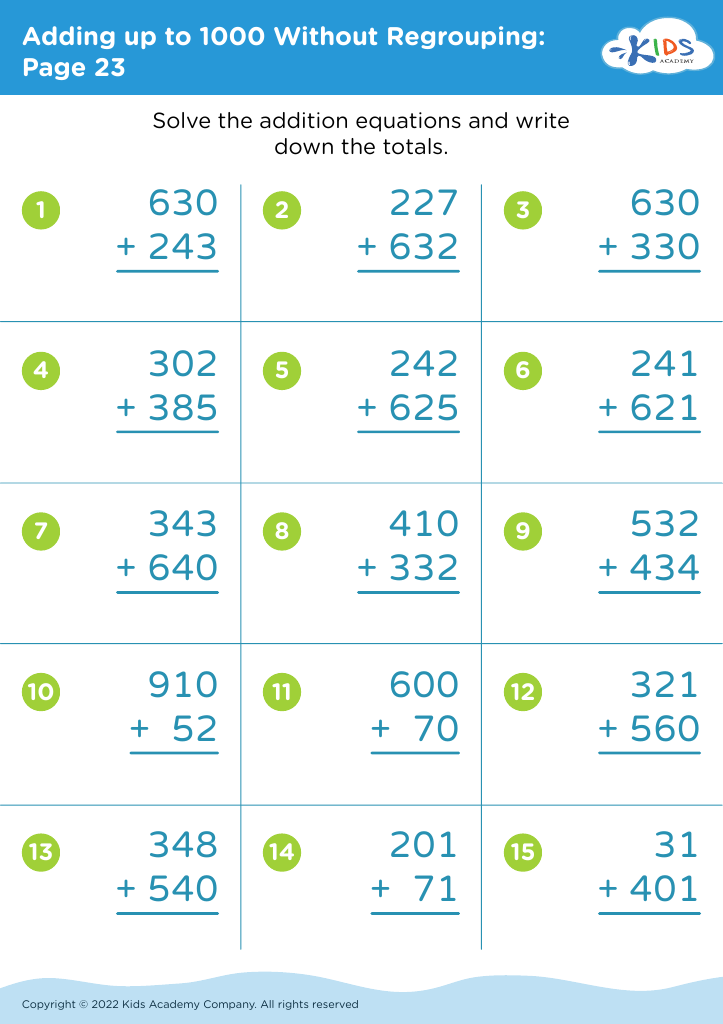
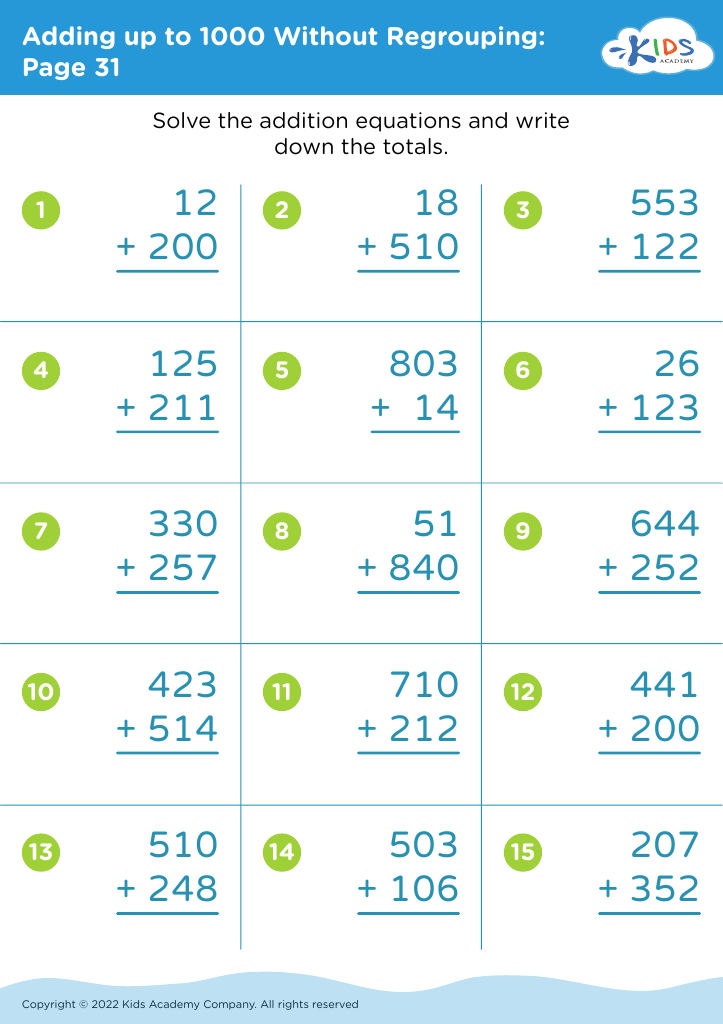
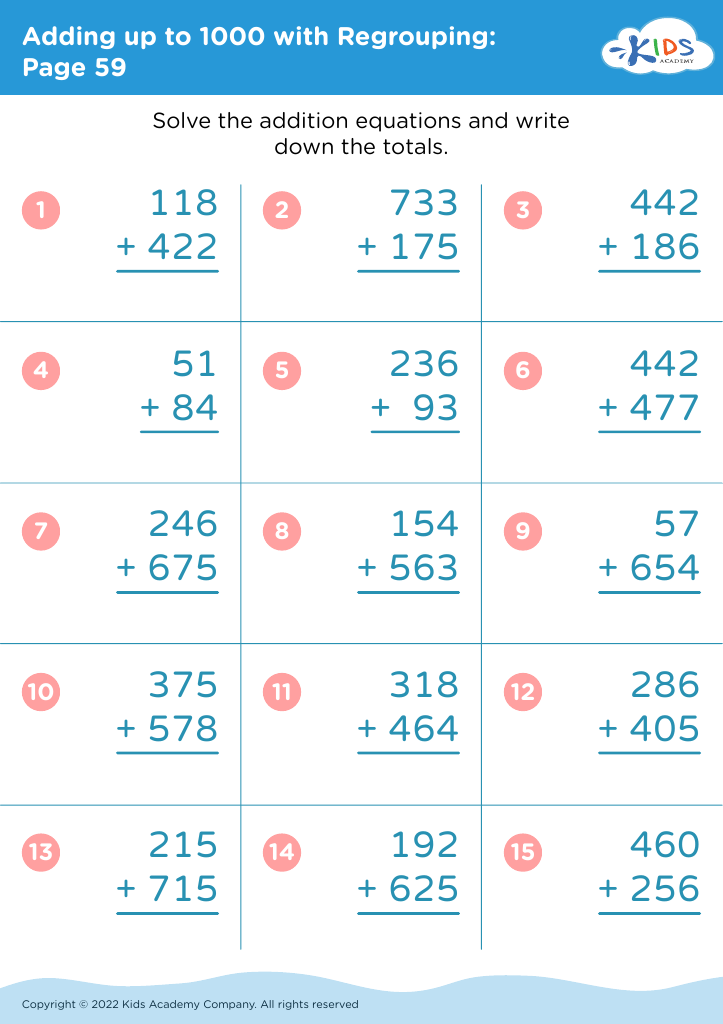



Parents and teachers should prioritize visual interpretation skills for 7-year-olds learning to add up to 1,000 because this foundational skill unleashes a variety of educational benefits critical for young learners. At this developmental stage, children heavily rely on visual aids to make abstract concepts tangible. Visual interpretation transforms numbers into more comprehensible, concrete ideas through tools like number lines, place value charts, and visual grouping.
Understanding visual representations of addition not only reinforces arithmetic comprehension but also aids in spatial reasoning. This will facilitate a smoother transition to more complex mathematical concepts in later grades. For example, visual aids make it easier to understand carrying over in multi-digit addition, which is essential for performing sums up to 1,000.
Moreover, engaging visual learning keeps children motivated and makes math less intimidating. It also caters to different learning styles, ensuring no child is left behind. Equipping children with these skills early on fosters confidence, encourages problem-solving, and develops critical thinking.
Thus, investing in visual interpretation skills aligns with both immediate educational goals and long-term academic success, making it an invaluable focus for parents and teachers.








