Improving mental math Addition & Subtraction Worksheets for 7-Year-Olds
3 filtered results
-
From - To
Enhance your 7-year-old's math skills with our "Improving Mental Math Addition & Subtraction Worksheets." Designed to foster quick thinking and strong problem-solving abilities, these engaging worksheets provide a variety of exercises that help children practice adding and subtracting numbers mentally. By working through fun and challenging problems, kids will boost their confidence and accuracy in mental math, laying a solid foundation for future mathematical success. Perfect for both classroom use and home study, these worksheets make learning enjoyable while reinforcing essential math skills. Unlock your child's potential and watch them thrive in math with our thoughtfully crafted resources!
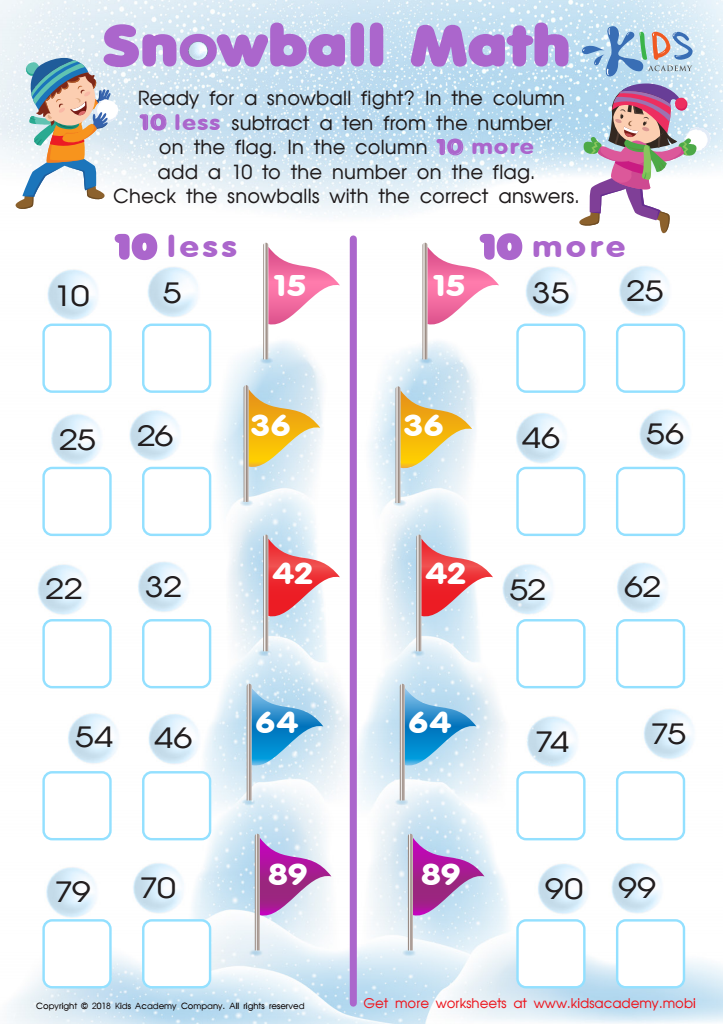
Snowball Math Worksheet
 Assign to My Students
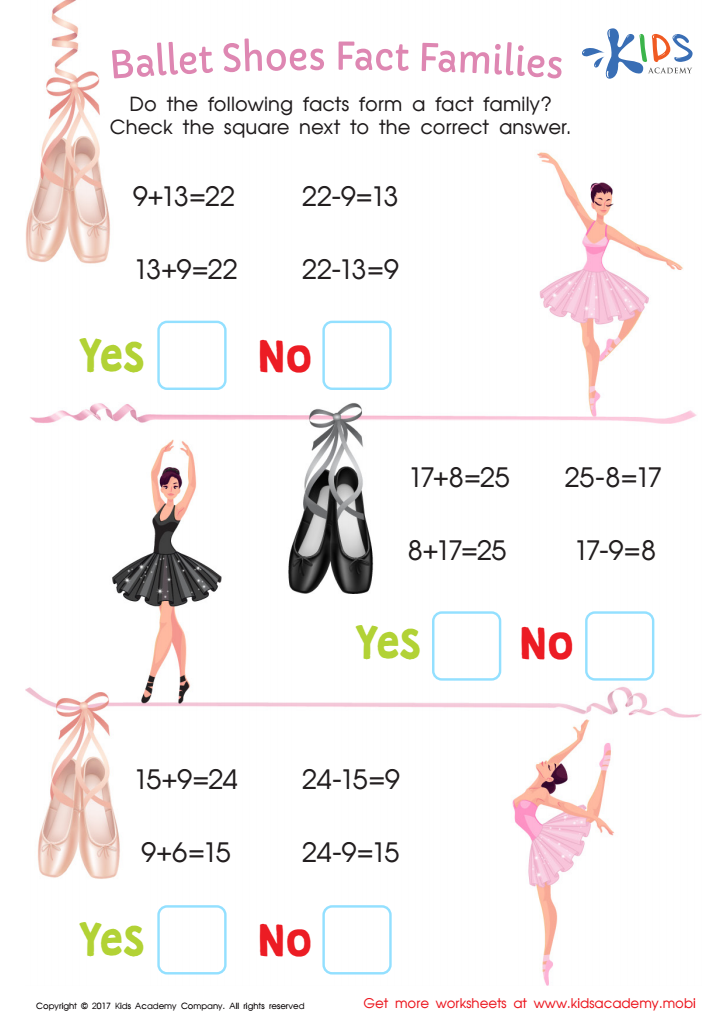
Ballet Shoes Fact Family Printable








Improving mental math skills in addition and subtraction for 7-year-olds is crucial for several reasons. Firstly, these foundational skills are essential for a child's overall mathematical development. Mastering mental math enhances number sense, enabling children to understand and manipulate numbers confidently. This lays the groundwork for more complex mathematical concepts they'll encounter in higher grades.
Secondly, strong mental math skills promote academic confidence. When children can quickly and accurately solve basic math problems without relying on tools or help, they boost their self-esteem and develop a positive attitude towards math. This emotional aspect is vital, as children who feel capable are more likely to pursue and excel in mathematics.
Moreover, in our everyday lives, mental math enables children to make quick calculations, such as figuring out change, estimating costs, or determining time. These are practical skills that foster independence and critical thinking.
Finally, collaborating with parents and teachers to nurture these skills helps create a supportive learning environment. Encouraging regular practice through games and activities aids retention and makes learning fun. This partnership between home and school ultimately empowers children to succeed, both academically and in daily situations.








