
Observational skills Addition Worksheets for 7-Year-Olds
3 filtered results
Difficulty Level
Grade
Age
-
From - To
Subject
Activity
Standards
Enhance your 7-year-old's math journey with our engaging Observational Skills Addition Worksheets! Designed to help young learners sharpen their observation abilities while mastering addition, these worksheets offer a fun and interactive way to build crucial skills. Each activity encourages children to carefully analyze visual clues, fostering critical thinking and attention to detail. Our worksheets incorporate vibrant illustrations and relatable contexts to make math enjoyable and relevant. Perfect for classroom use or at-home practice, these resources help kids develop confidence in their addition abilities while enjoying the process. Dive into our collection today and watch your child's math skills flourish!
Favorites
With answer key
Interactive
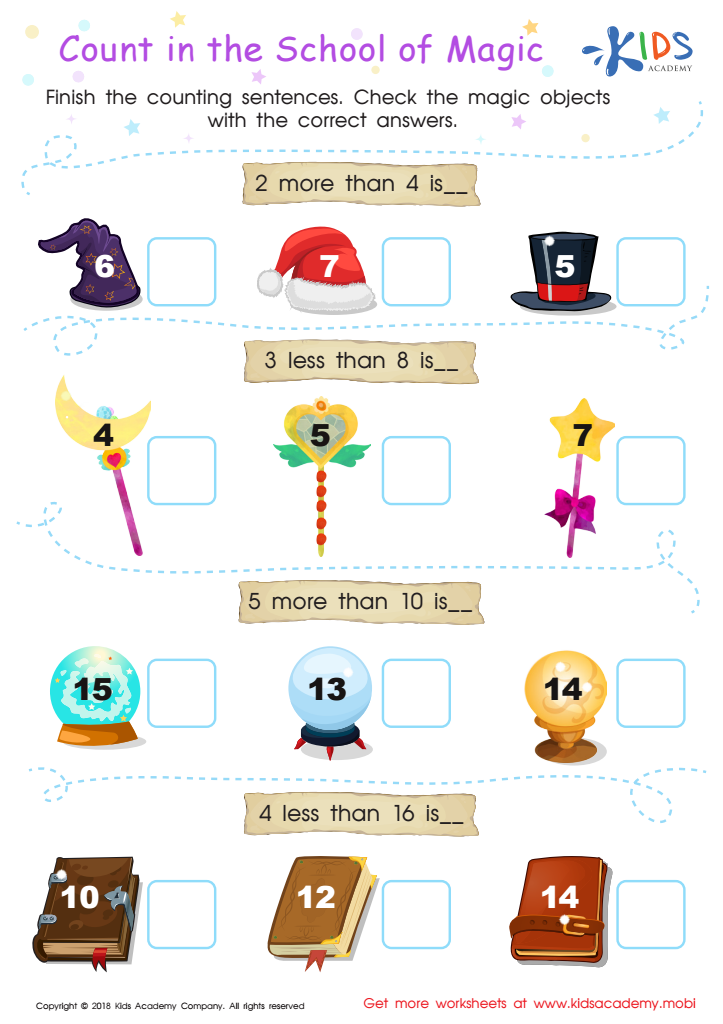
Count in the School of Magic Worksheet
Your math learners can explore the School of Magic with this worksheet. They'll read equations with addition and subtraction numbers under 20, count back and forth to find the answer, then complete the counting sentences. Fun pictures and easy accuracy make it an enjoyable and successful learning experience.
 Assign to My Students
Count in the School of Magic Worksheet
Worksheet
Join Kids Academy for Free
Who is primarily going to use this learning content?








Observational skills are crucial for the development of 7-year-olds, especially regarding mathematical concepts like addition. Parents and teachers should prioritize these skills as they form the foundation for effective learning and problem-solving. When children develop keen observational abilities, they learn to notice patterns, similarities, and differences in numbers and operations, leading to a deeper understanding of addition.
Enhancing observational skills promotes critical thinking—skills that will benefit children throughout their education and beyond. By engaging children in activities that foster these skills, such as recognizing groups of objects, counting, or comparing quantities, educators and parents can provide hands-on experiences that solidify mathematical concepts. Observational skills also tie into real-world applications, allowing children to relate mathematics to their everyday life.
Moreover, improving these skills encourages a positive attitude toward learning. When children are actively engaged in observing and discussing their findings, they build confidence in their abilities and enjoyment in the learning process. Therefore, supporting observational skills in addition empowers children not only to succeed in their current academic endeavors but also to cultivate lifelong learning habits essential in the ever-evolving world.








