
Comparing quantities Math Worksheets for 7-Year-Olds
9 filtered results
Difficulty Level
Grade
Age
-
From - To
Subject
Activity
Standards
Discover our engaging "Comparing Quantities Math Worksheets" designed specifically for 7-year-olds! These worksheets provide a fun and interactive way for children to enhance their understanding of comparing sizes, amounts, and values. With colorful illustrations and easy-to-follow exercises, students will practice identifying greater than, less than, and equal quantities. Each worksheet is crafted to boost critical thinking skills and build confidence in mathematical concepts. Perfect for home or classroom use, these resources promote independent learning and reinforce essential math skills that are vital for future success. Start your child’s journey in mastering comparisons today!
Favorites
With answer key
Interactive
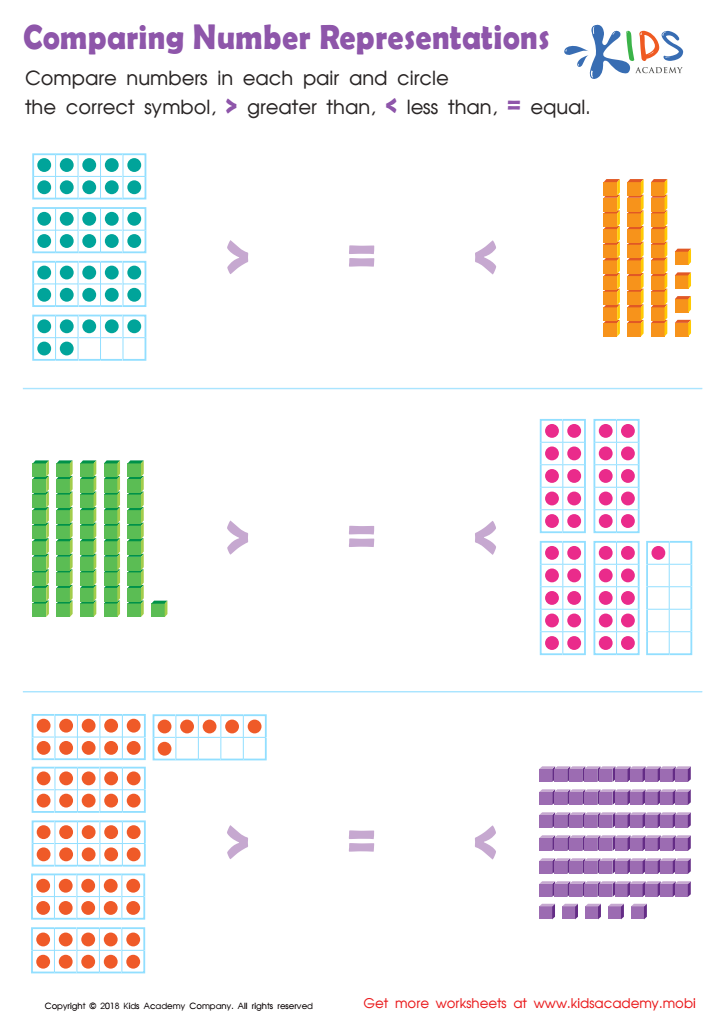
Comparing Number Representations Worksheet
Children need number representation skills to develop efficient computation and number sense. This free worksheet gives them practice with ten frames and place value blocks. They compare numbers and select the right comparative symbol: <, > or =. This helps them build a solid foundation for math.
 Assign to My Students
Comparing Number Representations Worksheet
Worksheet
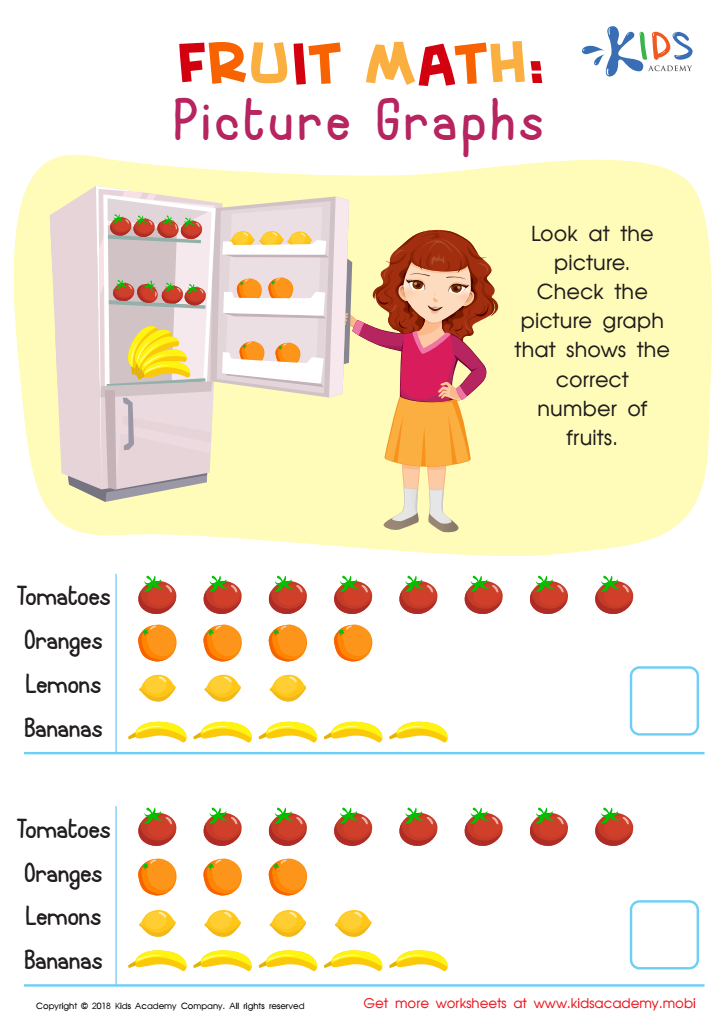
Fruit Math: Picture Graphs Worksheet
Help your child learn to draw graphs by having them look at pictures. Ask them to identify a graph that accurately portrays the data and have them explain why. This will prepare them to easily draw more complex graphs in the future. For example, have them look at the picture with the number of fruits in the colorful worksheet and explain why the graph is accurate.
Fruit Math: Picture Graphs Worksheet
Worksheet
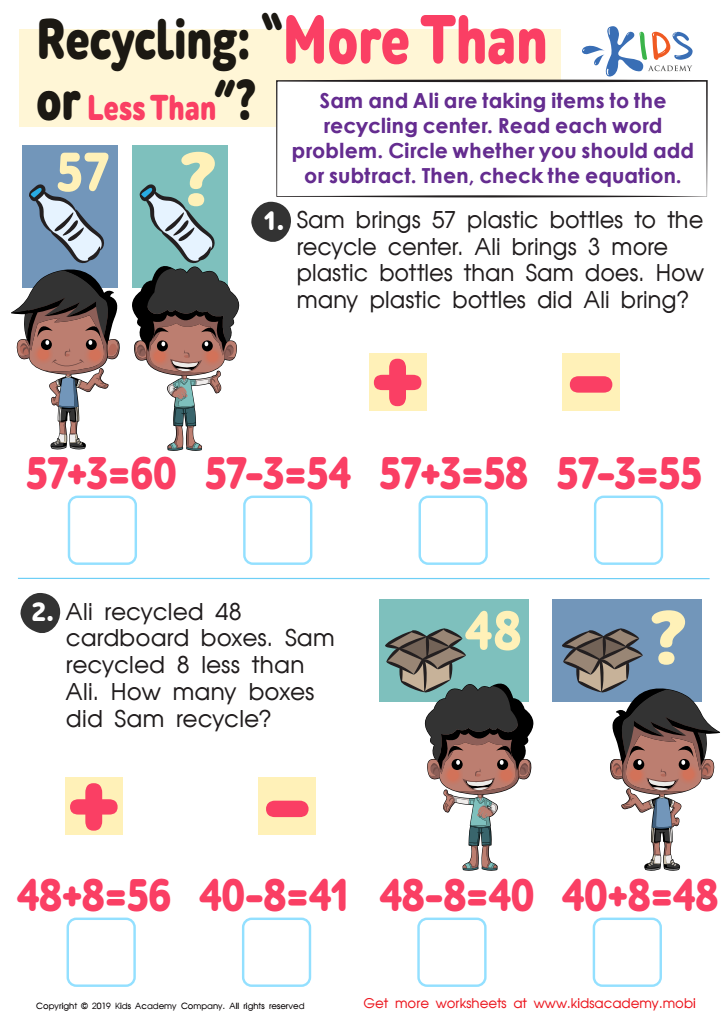
Recycling - More or Less Worksheet
Your child can compare numbers and solve word problems with this free worksheet. Help them understand what's being asked as Sam and Ali take items to the recycling center. They can choose the correct equation to match the word problem and apply their skills in reading and pulling out the appropriate information.
Recycling - More or Less Worksheet
Worksheet
Join Kids Academy for Free
Who is primarily going to use this learning content?







Comparing quantities is a fundamental mathematical skill that plays a crucial role in the cognitive development of 7-year-olds. At this age, children are beginning to understand the concepts of larger and smaller numbers, which forms the basis for more complex mathematical operations. By engaging with comparing quantities, children learn not only to recognize and articulate numerical differences but also to develop critical thinking and problem-solving skills.
For parents and teachers, fostering this understanding opens the door to everyday applications—like understanding money, measuring ingredients, or recognizing patterns in their environment. It encourages logical reasoning, which is invaluable not just in math but across all subjects. Moreover, these skills build confidence, helping children to feel more competent and engaged in their education.
In addition, comparing quantities lays the groundwork for more advanced mathematical concepts such as addition, subtraction, multiplication, and even division. When children grasp how to compare different amounts, they also begin to understand relationships between numbers, which can help them excel academically. Thus, investing time and resources in teaching this skill not only helps children in their current grades but also promotes better performance in future learning.








