
Understanding greater/less than Math Worksheets for 7-Year-Olds
3 filtered results
Difficulty Level
Grade
Age
-
From - To
Subject
Activity
Standards
Welcome to our "Understanding Greater/Less Than Math Worksheets" page for 7-year-olds! Designed to enhance foundational math skills, these engaging worksheets help young learners grasp important concepts of comparison through visuals, interactive activities, and clear explanations. Kids will explore how to compare numbers, recognize symbols, and understand the relationships between values in a fun and age-appropriate manner. With varied exercises, our worksheets cater to different learning styles, ensuring each child gains confidence while mastering greater and less than scenarios. Ideal for classroom or home use, these resources will make learning math an enjoyable experience for every 7-year-old!
Favorites
With answer key
Interactive
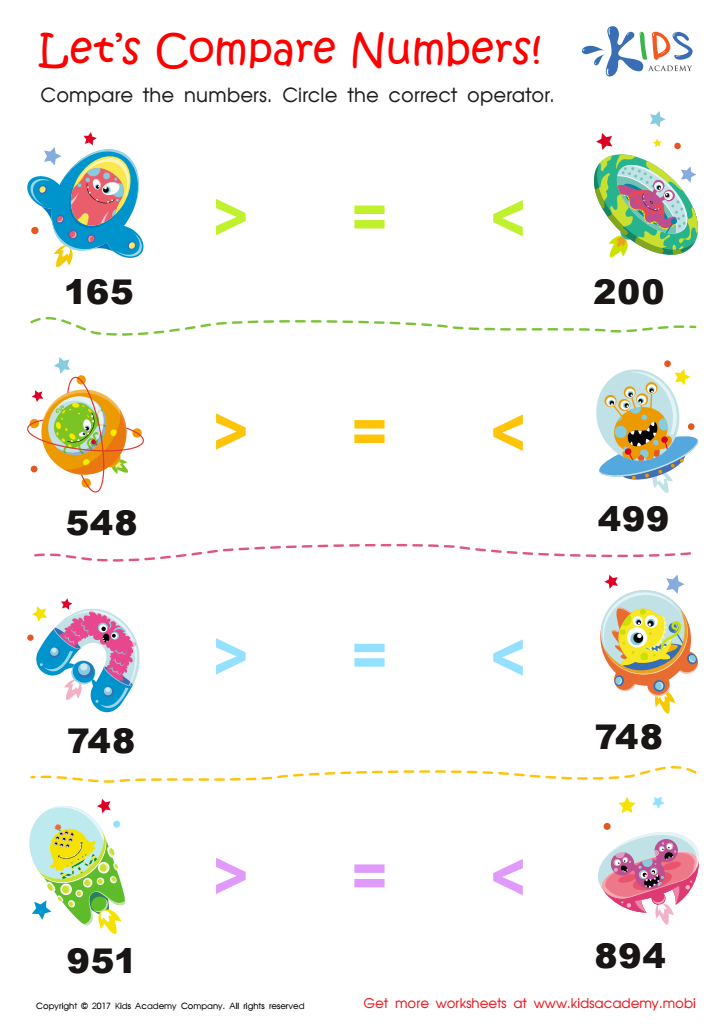
Comparing Numbers Worksheet for 2nd Grade
Alien friends are back to help your child learn to compare numbers using >, < and = symbols. This 2nd grade worksheet will challenge them with larger numbers!
 Assign to My Students
Comparing Numbers Worksheet for 2nd Grade
Worksheet
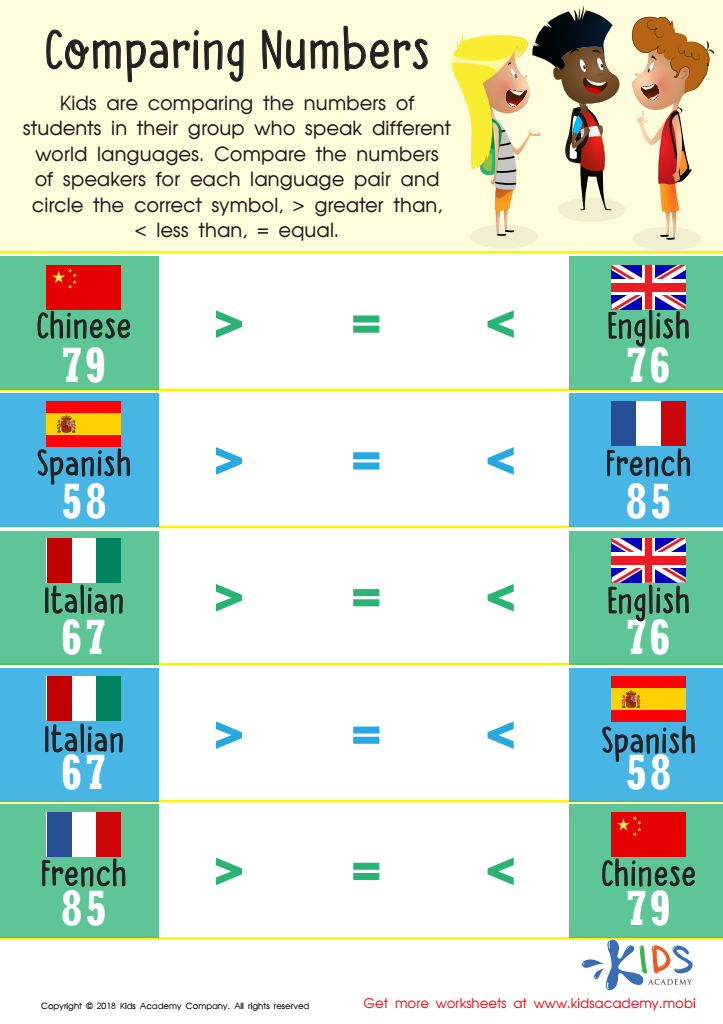
Comparing Numbers Worksheet for 1st Grade
Children can build number sense by exploring the relationship between numbers. This worksheet uses bright international flags to compare numerical groups. Kids will love the cheerful colors and flags from different countries. It encourages them to compare numbers and reinforces their number sense with tens and ones place values.
Comparing Numbers Worksheet for 1st Grade
Worksheet
Join Kids Academy for Free
Who is primarily going to use this learning content?







Understanding greater and less than concepts is fundamental for 7-year-old children, forming the basis of their mathematical reasoning. For parents and teachers, this concept is crucial as it develops foundational number sense, enabling children to compare quantities, sequences, and eventually more complex operations.
At this age, children begin transitioning from concrete to abstract thinking. Grasping greater than and less than not only improves their ability to perform arithmetic calculations but also enhances their problem-solving skills, logical thinking, and critical reasoning. Facilitating mastery of these concepts empowers them in real-world situations, such as budgeting allowance or comparing scores.
Moreover, in cooperative learning environments, being able to read and interpret numerical information fosters communication skills. Children learn to articulate their thought processes and engage in discussions about data, enhancing their collaborative and social capabilities. Statistically, solid grasping of these basic concepts correlates with long-term academic success in math.
For diverse learners, realizing that some children may find these concepts challenging is crucial. This calls for differentiated instructional strategies and parental encouragement at home, creating an environment where exploring numbers can be enjoyable and enriching. Investing time in understanding these mathematical principles will serve children well throughout their educational journeys and beyond.








