
Understanding grouping Math Worksheets for 7-Year-Olds
3 filtered results
Difficulty Level
Grade
Age
-
From - To
Subject
Activity
Standards
Discover our engaging grouping math worksheets designed specifically for 7-year-olds! These worksheets aim to enhance students' understanding of grouping concepts, essential for developing their foundational math skills. Through fun and interactive exercises, children will learn to group numbers, objects, and collections effectively, fostering critical thinking and problem-solving abilities. Perfect for at-home practice or supplementary classroom activities, our worksheets cater to diverse learning styles and can be easily integrated into any curriculum. Encourage your child's enthusiasm for math while building confidence in their grouping skills! Explore our collection today and support your young learner's growth.
Favorites
With answer key
Interactive
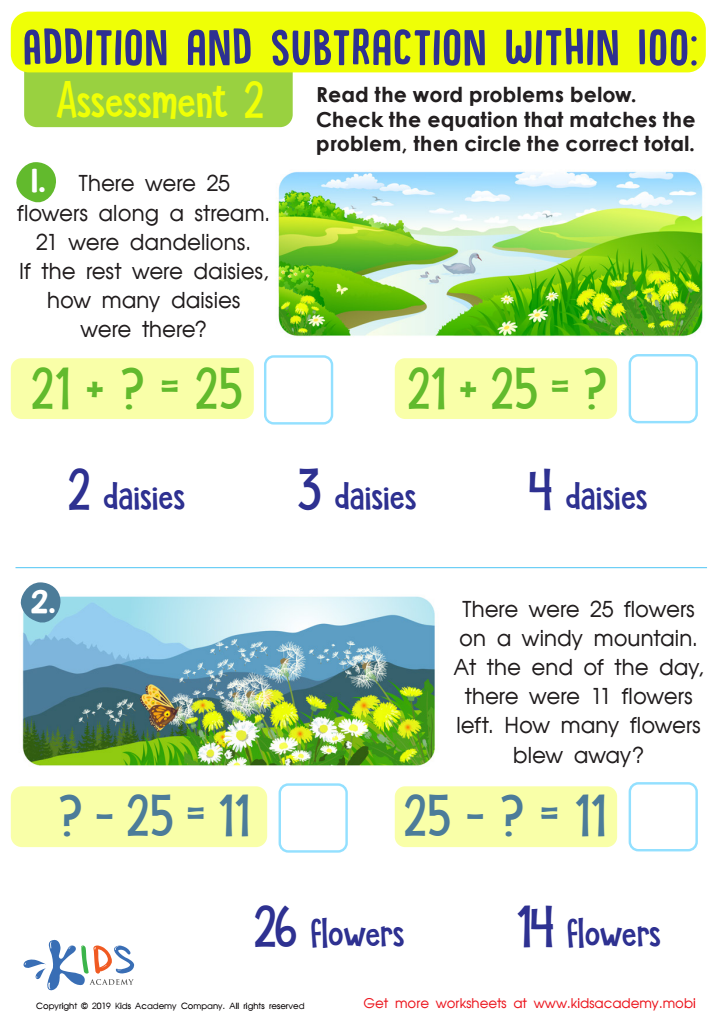
Assessment 2 Math Worksheet
Using fun exercises and pictures, you can get kids excited about math. With practice and reminders of what they've learnt, they'll be solving simple addition and subtraction equations with ease. Read the word problems in the picture to them, then help them check the equation and choose the correct answer.
 Assign to My Students
Assessment 2 Math Worksheet
Worksheet
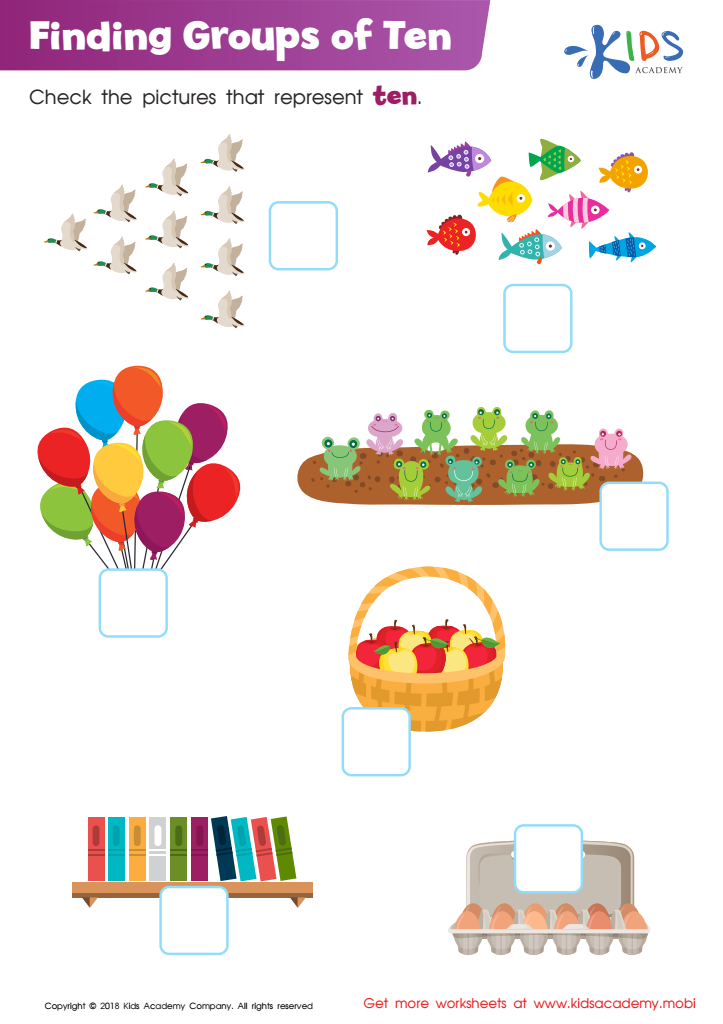
Finding Groups of Ten Worksheet
Can your kids count? If they can't go higher than tens, introduce them to this worksheet. Counting can be fun and easy with this exercise. Ask if they can identify the pictures, then help them count each group. Help them check the pictures that represent ten.
Finding Groups of Ten Worksheet
Worksheet
Join Kids Academy for Free
Who is primarily going to use this learning content?








Understanding grouping in math is essential for 7-year-olds as it lays the foundation for more complex mathematical concepts they will encounter in the future. Grouping helps young learners recognize relationships between numbers, facilitating a deeper comprehension of addition and subtraction. For instance, grouping objects into sets simplifies operations, making it easier for children to perform calculations and understand quantities.
Moreover, grouping enhances critical thinking skills. When children learn to categorize and group numbers or objects, they develop the ability to notice patterns and make connections, fostering a sense of curiosity and problem-solving. This skillset not only aids in math but also translates into other academic areas and real-life situations.
Both parents and teachers play a crucial role in nurturing these skills. By engaging children in activities that involve grouping, such as sorting objects or practicing with visual aids, they can reinforce these skills in a fun and interactive manner. Understanding grouping also helps parents and teachers identify areas where a child may need additional support, ensuring that they build confidence in their math abilities. Ultimately, fostering a solid understanding of grouping sets the stage for lifelong learning and success in mathematics and beyond.








