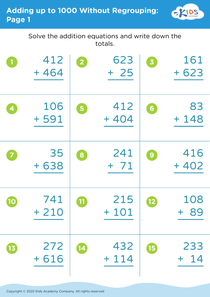
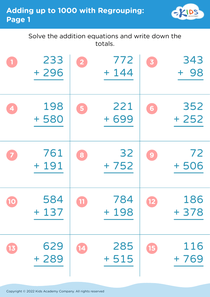
Improve math skills Adding up to 1000 Misc Worksheets for 9-Year-Olds
3 filtered results
-
From - To
Enhance your child's math skills with our "Adding up to 1000" miscellaneous worksheets designed specifically for 9-year-olds. These engaging and diverse exercises not only make learning fun but also reinforce essential math concepts such as addition, number recognition, and problem-solving. Each worksheet is tailored to help students gradually build their confidence and proficiency in adding larger numbers. With colorful illustrations and varied activities, children will enjoy the learning experience while developing critical math competencies. Perfect for classroom use or at-home practice, these worksheets provide valuable opportunities for improvement and mastery of essential math skills that set the foundation for future success.
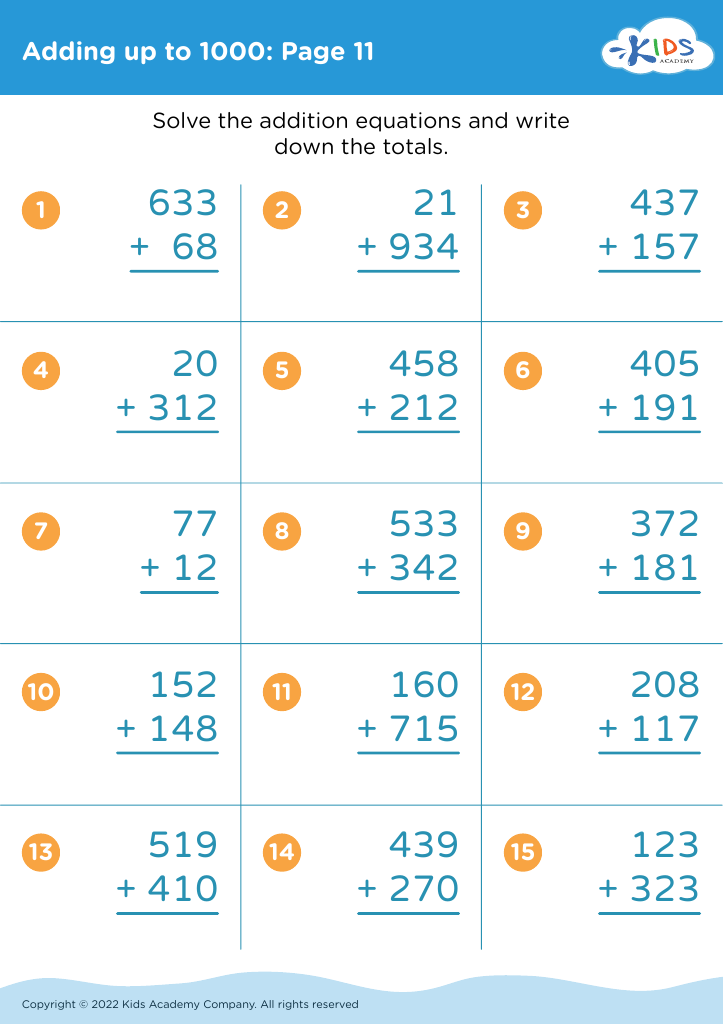
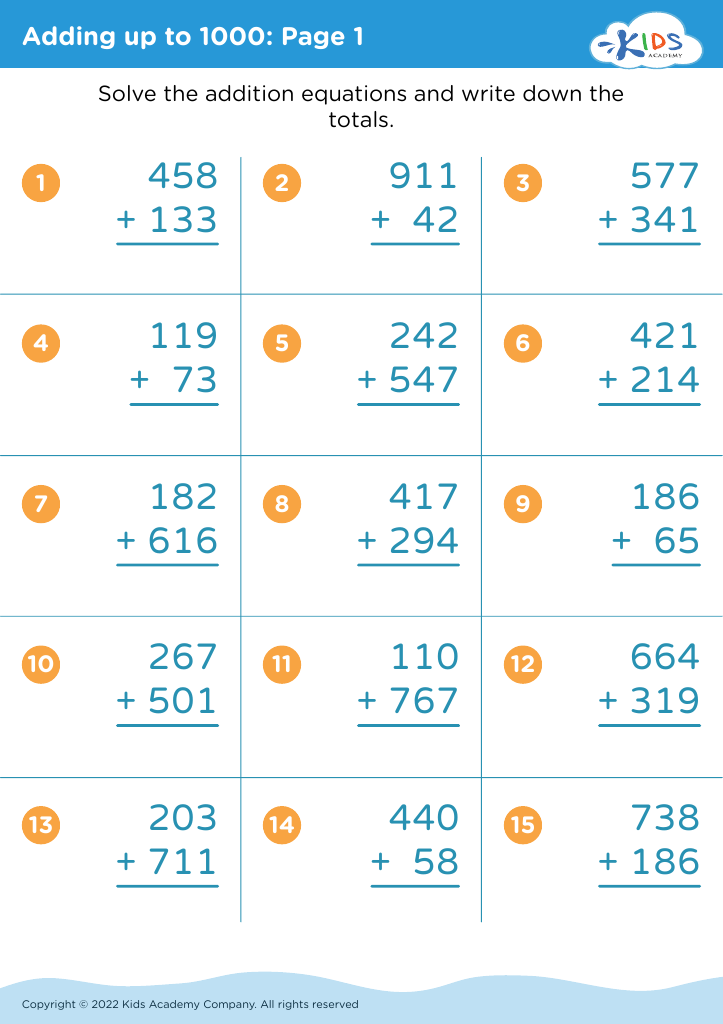
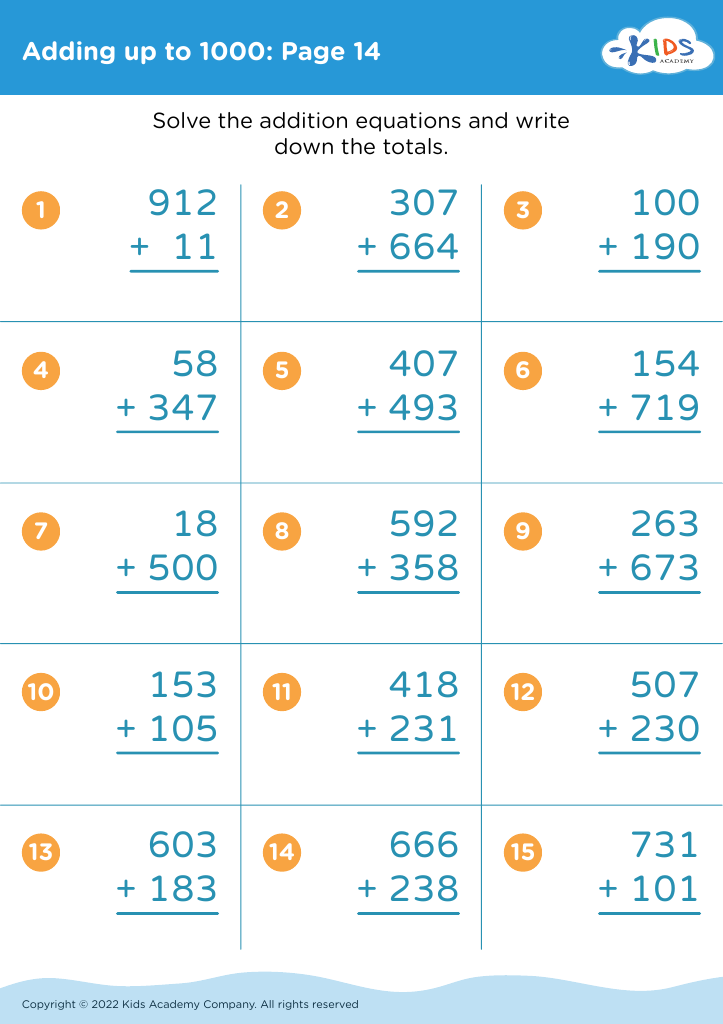


Improving math skills, specifically in adding up to 1000, is crucial for 9-year-olds for several reasons. First and foremost, strong foundational math skills are essential for academic success. By mastering addition through engaging activities and real-life applications, children build confidence and improve their problem-solving abilities. This strong foundation supports their transition into more complex mathematical concepts, such as subtraction, multiplication, and division.
Moreover, enhancing math skills boosts critical thinking and analytical abilities, empowering children to approach challenges systematically. This competency is not only valuable in academic settings but also applicable in everyday life, helping them make informed decisions regarding money, time management, and resource allocation.
Engaging teachers and parents can facilitate a supportive learning environment where children feel encouraged to practice and apply their skills. Collaborative activities can also strengthen relationships, fostering a love for learning. Additionally, as children improve their math skills, they may feel motivated to participate in math-related extracurricular activities or competitions, further enhancing their enthusiasm and interest in the subject. Ultimately, focusing on addition skills up to 1000 prepares 9-year-olds for future mathematical learning and instills a lifelong appreciation for mathematics.